
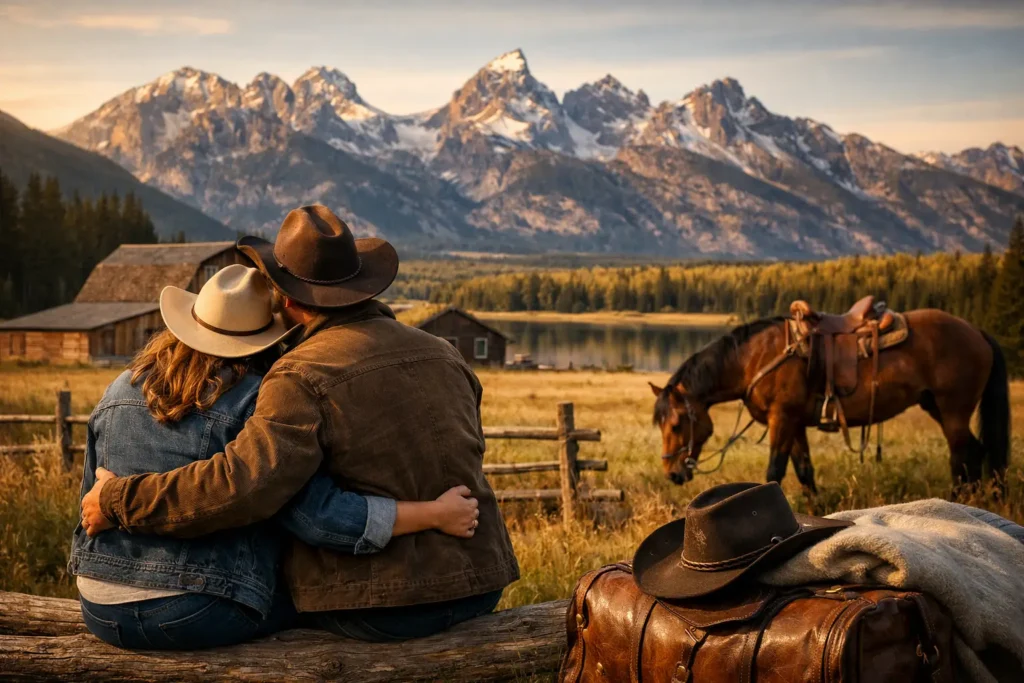
A romance about starting over in Montana begins with a practical fact: the landscape doesn’t care what went wrong somewhere else. The mountains will still catch the last light. A ranch gate will still need mending before the weather turns. The coffee will still be hot if somebody remembers to make it. That indifference can be a mercy to a character carrying regret, grief, a failed marriage, or a plan that came apart at the seams.
Montana is not a magic eraser, of course. A change of address doesn’t automatically repair a broken heart. But it gives a story room to tell the truth about recovery: people rebuild a life through ordinary choices, repeated over time. They show up for work. And they learn the roads. Then they discover which neighbor will lend a hand and which one will offer unsolicited advice before breakfast.
That is fertile ground for clean romance. The attraction matters, but so does what two people do when the truck won’t start, the fence line is down, or a difficult past comes knocking. Love feels more convincing when it is built alongside a life worth staying for.
Why a Romance About Starting Over in Montana Feels Earned
The best second-chance stories are not really about escaping. They are about facing what follows a person from one state to another.
A heroine may arrive in a small Montana town after a career disappointment, determined to keep her head down and make a fresh start. A hero may have spent years maintaining a family ranch, convinced that leaving would mean letting everyone down. Their circumstances are different, yet both know the private discomfort of realizing that the old plan no longer fits.
That tension gives the romance something sturdier than instant chemistry. The characters are not merely deciding whether they like each other. They are deciding whether they can be seen clearly, flaws and all, without retreating into the habits that protected them before.
Montana helps because it creates believable pressure. Distance is real. Weather has opinions. A town may be welcoming, but it is also observant. Someone who has lived there for thirty years knows the history behind the abandoned barn, the dispute over water access, and probably who quietly paid for the high school band uniforms. Newcomers cannot simply blend into the wallpaper.
For a writer, that means setting can do useful work without becoming a postcard. A broad valley, a creek running high in spring, or the long drive between communities can shape decisions. For readers, those details make emotional stakes tangible. If a character says she wants to leave, there ought to be a reason she stays besides a handsome man in a good hat.
Starting Over Requires More Than a New View
There is a temptation in romance to make reinvention look easy. A character arrives, gets a job, finds a charming local, and is completely transformed by chapter six. Real change has poorer timing. It arrives in awkward conversations, wrong assumptions, and the moment someone realizes that an apology is not the same thing as repair.
That doesn’t make a story bleak. It makes the hopeful parts matter.
A convincing Montana romance lets its characters retain some history. The woman starting over after public embarrassment may still dislike being the center of attention. The man who learned to handle everything alone may not become an eloquent communicator overnight. Their progress can be measured in smaller, more satisfying moments: he asks for help before a problem becomes a disaster; she accepts kindness without treating it as a debt.
This is where clean romance has particular strength. Without relying on explicit scenes to carry the emotional weight, the story can linger on the things that often matter most: a long conversation on a porch, a meal brought over after a hard day, a hand held when words fail. Those scenes are not less romantic because they are quiet. Often, they are the reason readers remember the relationship after the final page.
The West Should Be a Character, Not a Costume
Cowboy boots and pickup trucks can set a scene, but they cannot carry a novel by themselves. The American West has been flattened into a collection of shortcuts often enough. Real places deserve more attention than a few scenic adjectives and a conveniently placed horse.
Montana can be rugged, beautiful, lonely, prosperous, struggling, crowded in one pocket and remarkably empty in the next. One town may depend on agriculture, another on tourism, another on a mixture of old families and recent arrivals. The setting becomes believable when the work, weather, distances, and local relationships affect the plot.
A romance about starting over in Montana also benefits from restraint. Not every character needs to ride a horse at sunset. Some will work in a bookstore, restore an old house, manage a diner, teach school, repair equipment, or take photographs of a landscape that refuses to cooperate with the light. They can still belong in the West. In fact, those less expected details often make a fictional town feel lived in.
As a photographer, I’ve learned that a grand view is only part of the picture. The story is frequently in the foreground: tire tracks in wet gravel, a battered mailbox, one warm window after dark. Fiction works much the same way. The mountain range may establish the scale, but the emotional photograph is made by the small, human detail.
Community Changes the Shape of the Love Story
Starting over is often described as an individual act. In a good small-town romance, it rarely stays that way.
A community can complicate the relationship in useful ways. Friends and family bring history. A longtime resident may be skeptical of the newcomer for reasons that have nothing to do with romance. A well-meaning neighbor might see the attraction before either main character is ready to admit it. Such moments can be funny, but they also reveal what is at stake. Belonging is not handed out with the welcome brochure.
There is a trade-off here. Small towns can offer connection, yet they can also make privacy difficult. That contrast is ideal for characters who want a new beginning but are afraid of being known. The person who comes to Montana hoping to disappear may discover that being noticed, in the right way, is part of healing.
Still, no town should exist solely to approve the couple. The most memorable supporting characters have lives, opinions, and limits of their own. They may offer help, challenge a poor decision, or refuse to smooth over a problem the protagonists need to solve themselves. Love grows stronger when it is supported by community without being rescued by it.
A Satisfying Ending Is Not a Perfect One
Readers come to romance for an emotionally satisfying ending, and rightly so. That does not require every loose board in life to be nailed down.
A hopeful ending can leave a couple with work ahead. Perhaps one character is still rebuilding a career. Perhaps a family conflict is only beginning to thaw. The important thing is that the central promise has changed. Two people who once believed they had to manage alone now have evidence that they can face the next hard thing together.
Montana suits that kind of ending because its scale keeps a story honest. The country remains big. Winter will come again. There will be chores, bills, misunderstandings, and probably mud where nobody wants mud. But there is also a porch light, a familiar road home, and someone waiting inside.
That is the lasting appeal of this kind of romance. Starting over does not mean becoming a different person. It means finding the courage to become more fully yourself, then trusting that the right person may recognize you when you do. Readers who enjoy Western romance, including stories such as Boots and Stilettos, know that a good love story does not promise an easy road. It gives its characters a reason to keep traveling it.