
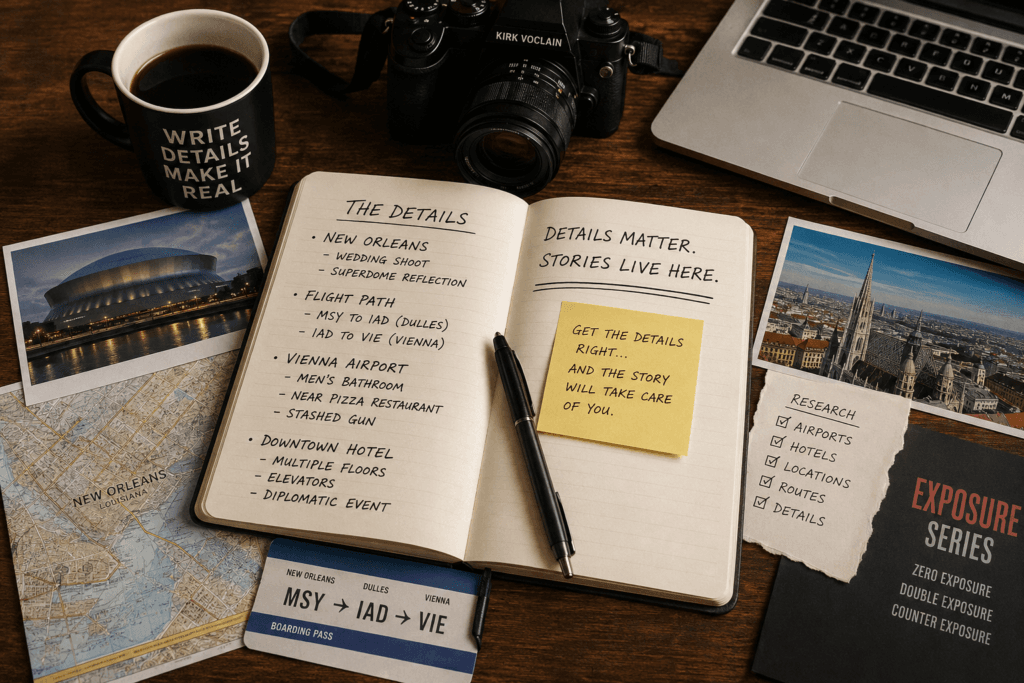
Some readers notice the big twist. But it’s the small things, the way details matter in fiction writing, that can make a story memorable for others.
Some notice the villain.
Some notice the final chapter.
Me?
I worry about the men’s bathroom near the pizza restaurant.
That may sound ridiculous, but welcome to the strange and wonderful brain of a writer who spent more than 40 years as a professional photographer. Details matter to me. They always have.
In photography, one tiny thing can change the whole image.
A hand in the wrong place.
A crooked tie.
A reflection you didn’t notice until after the session.
A tree growing out of someone’s head.
Little things matter.
Writing is no different.
The Story Has to Feel Real
In Double Exposure, Reed Sawyer is photographing a wedding in New Orleans. Then, suddenly, he has to fly to Vienna to photograph a Secretary of State. I said it before, I’m going to say it again, details matter in fiction writing.
That sounds simple enough.
New Orleans to Vienna.
Easy, right?
Not exactly.
That flight has to make sense. Reed cannot just magically appear in Austria because the plot needs him there. He has to travel the way a real person would travel.
So, the route matters.
The airport matters.
The connections matter.
For Reed, that means going through Dulles Airport.
Yes, that is a small detail. But small details are what keep a reader inside the story.
One wrong detail can pull them right out.
The Bathroom Near the Pizza Restaurant
Once Reed arrives in Vienna, there is another details matter in fiction writing, and I had to think through.
He has a gun stashed in the men’s bathroom at the Vienna airport.
That is not something you casually toss into a spy thriller and hope nobody asks questions.
Where is the bathroom?
Could he get to it?
What is nearby?
Would readers believe it?
In the book, the men’s bathroom is near a pizza restaurant.
That detail matters.
It gives the scene a physical location. It gives Reed a landmark. And it makes the airport feel like a real place instead of a cardboard movie set.
And yes, I explain elsewhere in the novel how Reed managed to pull that off.
Because again, details matter.
A spy cannot just stash a gun in an airport bathroom without a reason, a plan, and a really good explanation.
I mean, come on.
Even fiction has to behave itself once in a while.
The Hotel Had to Exist
In Vienna, Reed photographs the Secretary of State at a downtown hotel.
The hotel is not named in Double Exposure, but that does not mean I could make it up completely.
It needed to feel real.
More than that, it needed to physically work.
Could this hotel host a diplomatic event?
Would it have multiple floors?
Would the elevators fit the scene?
Could the layout support the action?
Would security be believable?
Those questions matter to me.
While writing Counter Exposure, which tells the same story from the villain’s point of view, I took the research even further. I found a specific hotel that fit what I had already written in Double Exposure.
That means the details now have to carry from one novel into the next.
Same city.
Same event.
And same physical reality.
Different point of view.
That is where storytelling gets really fun.
It is also where storytelling can get dangerous.
Because once you create a detail matter in fiction writing, so you have to live with it.
One Novel Talks to the Next
This is one of the things I love most about writing the Exposure Series.
The books are connected.
A location in one book may matter more in another.
A small comment in Double Exposure may become a major clue in Counter Exposure.
A scene that looked simple through Reed Sawyer’s eyes may look completely different when Barry Cox tells it.
That is the fun of writing a connected series.
The details are not decorations.
They are threads.
Pull one, and the whole story can move.
Real Places Make Fiction Stronger
In Zero Exposure, the prequel to Double Exposure, I talk about the sound of a camera hitting concrete.
Unfortunately, I know that sound.
I have heard it.
More than once.
After 40-plus years as a professional photographer, I have dropped cameras, bumped gear, cracked things, dented things, and probably done more damage than I care to mention.
That sound stays with you.
It is sharp.
It is ugly.
And it is expensive.
When I write about it, I am not guessing.
I am remembering.
That is the kind of real-life detail I love bringing into fiction.
New Orleans Is Not Just a Backdrop
In Zero Exposure, I also mention the reflection of the Superdome in New Orleans.
That is not random.
That is a real place.
I know those streets.
I know those routes.
And I know what it feels like to move through New Orleans with camera gear, a job to do, and the strange pressure that comes with photographing something important.
The streets in Zero Exposure matter.
The directions matter.
The reflections matter.
The city is not just scenery.
It is part of the story.
Why I May Call Zero Exposure “A True Story”
Now, let me be careful.
Zero Exposure is still fiction.
It is not supernatural, although it gets creepy.
Also it is strange.
It is fast moving.
It is fun.
But so much of it comes from my real life as a professional photographer that I am seriously considering billing it as “A True Story.”
Not because every event happened exactly as written.
But because so much of the foundation is real.
The locations are real.
Many of the photography experiences are real.
The emotions are real.
The pressure is real.
The sound of a camera hitting concrete?
Very real.
Painfully real.
My wallet remembers.
Readers Can Feel the Difference
Readers may not always stop and say, “Wow, that airport bathroom location felt accurate.”
But they feel it.
They may not know why a scene works.
They may not notice the research behind the hotel, the route, the reflection, or the elevator.
But they feel grounded.
They trust the story.
They believe the world.
That is the goal.
I want my readers to feel like they are standing beside Reed Sawyer. And I want them to feel the weight of the camera in his hand. I want them to hear the airport noise, see the hotel lobby, sense the danger, and wonder who is watching from across the room.
Details do that.
Not big speeches.
Not fancy tricks.
Details.
Photography Trained Me to See
I think photography trained me to write this way.
A photographer learns to notice.
Light.
Angles.
Backgrounds.
Expressions.
Tiny changes in posture.
The way a person looks when they are nervous, proud, scared, or hiding something.
That same habit follows me into writing.
When I write Reed Sawyer, I see the scene like a photographer.
Where is the light coming from?
What is reflected in the glass?
Who is standing too close?
What object would Reed notice first?
What detail would tell him something is wrong?
That is where the story begins to breathe.
The Fun Is in the Details that Matter in Fiction Writing
Research can be work.
Sometimes, it is a LOT of work.
But it is also part of the fun.
Finding the right airport.
Tracing the route.
Checking the streets.
Making sure the hotel could actually exist.
Connecting one book to the next.
Those little things make the writing feel special to me.
Hopefully, they make the reading feel special too.
Because when the details come together, the story becomes more than a plot.
It becomes a place.
And if I do my job right, maybe readers will step into that place and forget, just for a little while, that they are reading fiction.
That is the magic.
That is the challenge.
And honestly?
That is the fun part.
Buy Double Exposure here: https://a.co/d/06bV0xJz