
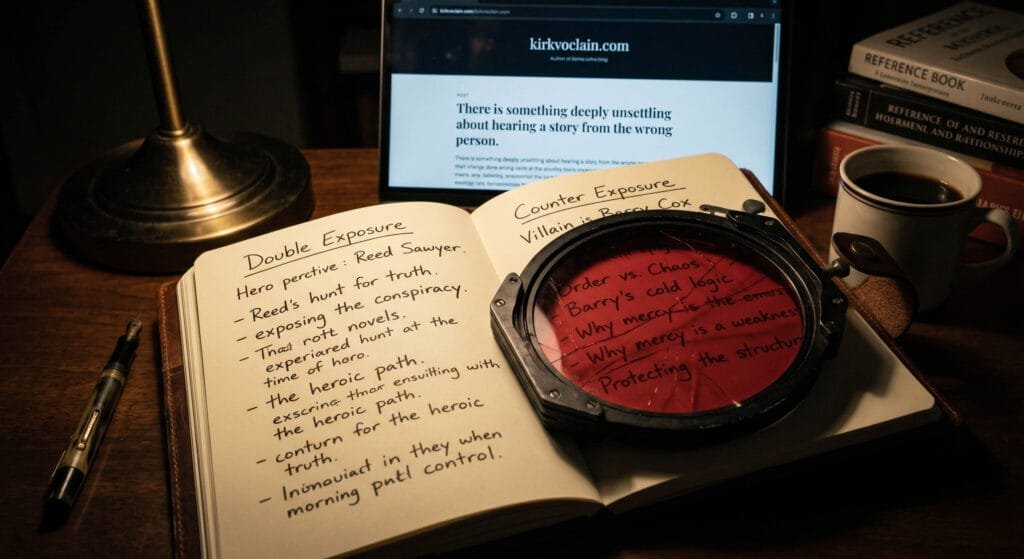
There is something deeply unsettling about hearing a story from the wrong person.
Not the hero.
Also not the victim.
And not the man running for his life.
The wrong person.
That is one of the reasons I wanted to write Counter Exposure.
On the surface, it may sound like a risky idea. After all, Double Exposure already tells the story. Readers know the danger. They know the tension. They know who they were rooting for. So why go back? Why return to that same world and walk through those same events again?
Because it is not the same story anymore.
Not once the villain starts talking.
A new point of view changes everything
I have always been fascinated by perspective in fiction.
Two people can walk through the same moment and come away with two completely different truths. One sees courage. The other sees recklessness. One sees loyalty. The other sees weakness. One sees survival. The other sees betrayal.
That is where Counter Exposure lives.
This book is not about replaying old ground just for the sake of it. It is about stepping into the mind of Barry Cox and seeing how a man like that interprets the exact same chain of events. It is about understanding how someone can make ruthless decisions, defend them with total confidence, and never once believe he is the villain.
That is what makes him dangerous.
And frankly, that is what makes him interesting.
Villains rarely think they are villains
The most frightening antagonists are not the ones who wake up in the morning twirling their imaginary mustaches.
They are the ones who believe they are necessary.
Barry Cox is that kind of man.
He does not see himself as cruel for the sake of cruelty. He sees himself as disciplined. He sees himself as the one willing to do what weaker people avoid. In his mind, he is not breaking order. He is preserving it. He is not creating chaos. He is managing it. He is not destroying something valuable. He is protecting a structure that others are too emotional, too impulsive, or too blind to understand.
That kind of thinking creates a very different kind of thriller.
Because when a villain can explain himself well enough, readers begin to feel something they did not expect.
Not trust.
And not forgiveness.
Something worse.
Recognition.
The story shifts when the lens shifts
One of the things I love most about storytelling is how much power there is in the telling itself.
Change the narrator, and the whole emotional shape of the story can change.
A moment that once looked simple starts to feel layered. A decision that seemed obvious starts to look strategic. A scene that felt clear now carries tension underneath it. Motives bend. Assumptions crack. Familiar ground starts to feel unstable.
That is exactly what I wanted Counter Exposure to do.
I did not want it to feel like a copy of Double Exposure. I wanted it to feel like walking back into a room you thought you understood, only to discover there was another conversation happening in the corner the whole time.
That is where the energy is.
And that is where the danger is.
Barry Cox is not trying to win sympathy
This part matters.
Counter Exposure is not an apology for Barry Cox.
I am not asking readers to excuse him. I am not asking them to suddenly declare that he was right all along. That would be too easy, and honestly, too shallow.
What interests me is something more complicated.
I want readers to see how Barry thinks. I want them to understand the architecture of his mind. I want them to feel the precision, the control, the discipline, and the cold certainty that drives him. I want them to see how a man can justify almost anything once he decides that he alone understands what must be protected.
That is different from sympathy.
Understanding a villain can be far more unsettling than hating one.
Reed Sawyer looks different from Barry’s side
That is another reason this book matters to me.
When the villain takes control of the narrative, the hero changes too.
From Barry’s point of view, Reed Sawyer is not some noble man trying to uncover the truth. He is a threat. A variable. And a fracture in the system. Also a man whose instincts cannot be trusted because they are guided by conscience instead of control.
And Barry would argue that conscience is exactly what gets people killed.
That shift opens up a tension I find irresistible as a writer. Readers already know Reed one way. Now they get to see how he appears through the eyes of the man trying to stop him.
It is the same conflict, yes. But it carries an entirely different emotional charge.
Why this story had to be written
Some stories end when the final page turns.
Others leave behind questions.
Counter Exposure grew out of those questions.
What did Barry believe while all this was happening?
How did he justify what he did?
What did he fear?
What did he think Reed represented?
How does a man like that explain the world to himself?
Those questions would not leave me alone.
And when that happens, I usually pay attention.
Because sometimes the most interesting part of a story is not what happened. Sometimes it is the meaning different people assign to what happened. Sometimes the most revealing version of a conflict comes from the person you least want to hand the microphone to.
Which, of course, is exactly why you should.
Why I think readers will enjoy this angle
If you liked Double Exposure for the tension, the world-building, and the cat-and-mouse pressure, Counter Exposure opens a different door into that same danger.
It lets you step inside the machinery.
It lets you see how power justifies itself. How control defends itself. How a man with enough intelligence and enough certainty can shape the world around him and still believe he is the only adult in the room.
That is fun to write. It is unsettling to read. And I think that mix is where some of the best thrillers live.
Because once you let the villain explain himself, the story stops being simple.
And simple is rarely where the truth lives.
Final thoughts
So why tell the same story from the villain’s point of view?
Because it is not the same story anymore.
Not when the moral center shifts.
And not when the motives change shape.
Also not when the man behind the danger gets to explain why he thinks the danger is necessary.
That is what Counter Exposure explores.
It is not just a return to the world of Double Exposure. It is a challenge to it. A reframing of it. A deeper dive into the logic of a man who believes order matters more than mercy, structure matters more than sentiment, and survival belongs to those willing to see the world without illusion.
Readers may still hate Barry Cox by the end.
They probably should.
But if I’ve done my job right, they may also understand him more than they wanted to.
And that is where things get interesting.