
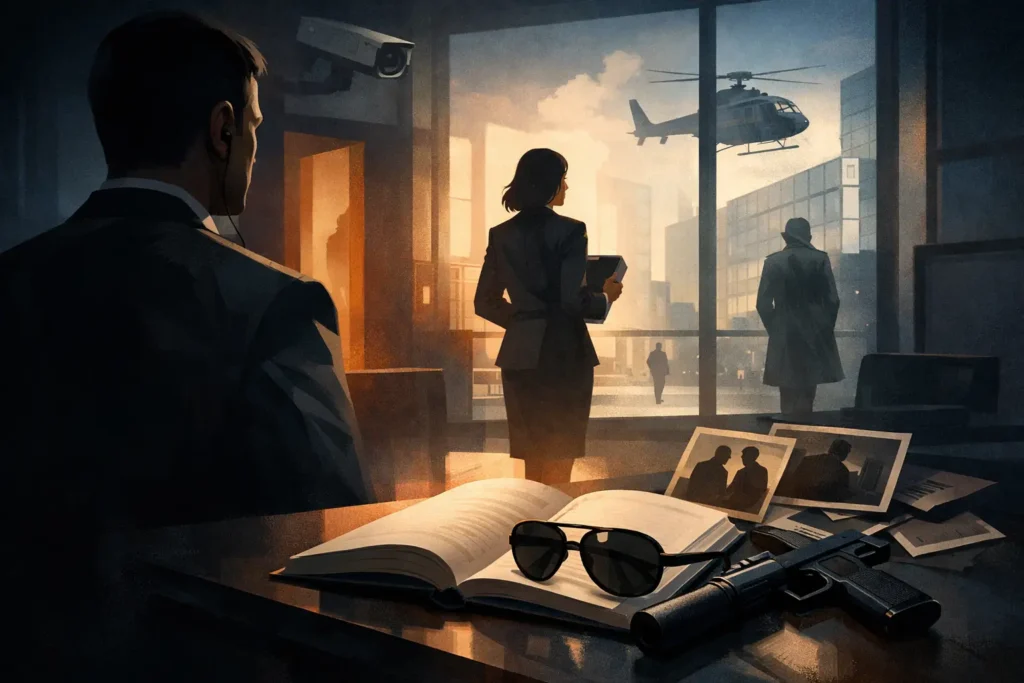
A locked door, a classified file, a familiar voice on a secure line – then the person giving the order turns out to be the danger. That is the particular charge of agency betrayal thriller books. They do not merely ask whether a hero can survive the enemy. They ask whether the hero can survive the people who trained them, paid them, and know exactly where to apply pressure.
The best versions of this story feel uncomfortably plausible because they begin with a truth most of us recognize: institutions are made of people. Most are decent. Some are ambitious. A few will protect the mission, their careers, or a secret at any cost. Put that truth inside an intelligence agency, add a compromised operation, and suddenly every briefing room has a shadow in the corner.
The Real Threat Is a Broken Chain of Trust
In a conventional spy thriller, the danger often arrives from outside the wire. A hostile operative is watching. A bomb is ticking. A foreign government wants something it should not have. Those stakes still matter, but betrayal shifts the center of gravity. The threat has access badges, legal authority, passwords, and a convincing explanation ready for every suspicious detail.
That changes the hero’s job. Skill alone is not enough. A capable operative can evade surveillance or spot a tail. It is harder to know whether a surveillance team has been assigned to protect you or quietly make sure you never reach daylight.
This is why agency betrayal works so well in thrillers. The protagonist cannot simply report a problem through the proper channels. The proper channels may be the problem. Every attempt to get help becomes a calculated risk, and every ally has to earn trust one difficult choice at a time.
The result is suspense with a human pulse. Readers are not only wondering who planted the evidence or leaked the operation. They are wondering what the betrayal costs the character personally. Did a mentor sell them out? Did a partner leave out one crucial fact? Was the mission itself built on a lie?
What Makes Agency Betrayal Thriller Books Credible
Believability does not require pages of acronyms or a lecture about classified procedures. In fact, too much technical explanation can drain the energy from a chase scene faster than a dead phone battery. Credibility comes from specific, practical details used at the moment they matter.
A secure building has cameras, visitor protocols, service corridors, and people who notice when something is out of place. Travel creates its own friction: delayed flights, luggage, hotel layouts, border questions, crowded terminals, and the uneasy fact that somebody can follow you without ever looking dramatic. Photography, too, can become part of the tension. A camera grants access, records what others overlook, and can make an ordinary assignment feel dangerous when the wrong image ends up in the wrong hands.
Those details ground a story because they are recognizable. They suggest that the author understands how spaces work when a person is trying to enter, leave, hide, or watch without being noticed. The reader does not need a handbook on tradecraft. They need to believe that the hotel elevator, the office lobby, and the hard case in the trunk could matter.
Credible betrayal also needs limits. Not every director can be secretly evil. Not every agency employee can be incompetent or corrupt. If everyone is lying, deception stops being surprising and the story loses its moral texture. The strongest books let readers see good people caught inside a bad system, doing their best with incomplete information.
That distinction matters. A character who makes a painful mistake can be more compelling than a cartoon villain who has been plotting world domination from page one. Sometimes the person who betrays the hero believes they are preventing something worse. Sometimes they are wrong. And sometimes they are not. That is where the story gets interesting.
The Best Betrayals Have a Personal Price
A good twist changes the plot. A great betrayal changes the meaning of what came before.
Perhaps the hero’s handler encouraged a relationship because it made the hero easier to control. Or perhaps an old mission was designed to fail, and the survivor has spent years carrying guilt that belongs to someone else. And perhaps the supposedly dead asset is alive and has a reason to hate the agency that abandoned them.
These reveals work when they reach backward. A throwaway warning, a missed call, a hesitant answer during a briefing – each takes on new weight after the truth surfaces. Readers enjoy being surprised, but they enjoy realizing the clues were there even more.
There is a trade-off. A betrayal that arrives only to shock can feel like the author moved the furniture after the reader left the room. A better approach plants doubt early, then gives the revelation a motive, consequences, and emotional force. The question is not just, “Who did it?” It is, “Why would they do this, and what will it take to live with it?”
Why the Lone Operative Still Needs People
Agency betrayal stories often push a protagonist off the grid. Their credentials are burned. Their accounts are frozen. And their own team is told they have gone rogue. It is a terrific setup because it strips away the resources that made the character effective in the first place.
But the most satisfying thrillers do not confuse isolation with depth. A hero on the run still needs human connection. They may turn to a skeptical journalist, an estranged sibling, a local contact, a former colleague, or a civilian who sees the situation more clearly than the professionals do. These relationships give the action consequences beyond the mission.
They also create useful friction. The trained operative may want to compartmentalize everything. The civilian may refuse to be treated like an expendable asset. The former partner may demand answers before offering help. Trust does not return because the plot needs a team. It returns in small, expensive increments.
That is one reason a photographer can make an intriguing thriller protagonist. A photographer is trained to observe, to work in unfamiliar places, and to notice composition, movement, and the moment before a room changes. Yet they can also move through public spaces with a believable reason to be there. In Double Exposure, Reed Sawyer stands at that dangerous intersection: a photographer with covert capabilities who learns that what he sees may be far more dangerous than what he was sent to capture.
The Conspiracy Should Be Big Enough, Not Bigger Than the Story
Readers come to conspiracy thrillers for scale. They want hidden operations, competing agendas, and consequences that can cross borders. But a conspiracy becomes less frightening when it grows so large that it can explain everything. If every event in the novel is controlled by one invisible hand, coincidence starts to feel more believable than the plot.
The better choice is a conspiracy with a clear objective. It might involve protecting a failed operation, burying evidence, manipulating a political outcome, or removing a witness before a secret becomes public. The stakes can be global, but the motive should remain understandable. Greed, fear, loyalty, revenge, and self-preservation have powered plenty of disasters without needing a mysterious supervillain in a glass tower.
A strong thriller also gives its hero meaningful choices. Running is one option. Exposing the truth is another. Protecting an innocent person may complicate both. The final act should not merely reveal the conspiracy. It should force the protagonist to decide what kind of person they will be after the institution they believed in has failed them.
What Readers Can Look For Next
If you are choosing your next agency betrayal thriller, look beyond the promise of a shocking twist. Look for a protagonist with something real to lose, a setting that feels lived-in, and an adversary whose access makes every safe place uncertain. Look for allies who are neither instantly trustworthy nor conveniently disposable.
Most of all, look for a story that remembers the cost of suspicion. A betrayed operative may uncover the truth, stop the operation, and make it out alive. Winning does not automatically restore faith in a badge, a boss, or a former friend. That lingering fracture is not a weakness in the ending. It is often the detail that makes the story stay with you after the last page.
The next time a trusted voice says, “This is a secure line,” listen carefully. In a great thriller, that is often when the real trouble begins.
PREORDER Zero Exposure now. The Exciting Prequel to Double Exposure and Book Zero in the Exposure Series: https://a.co/d/02vJWmGZ