
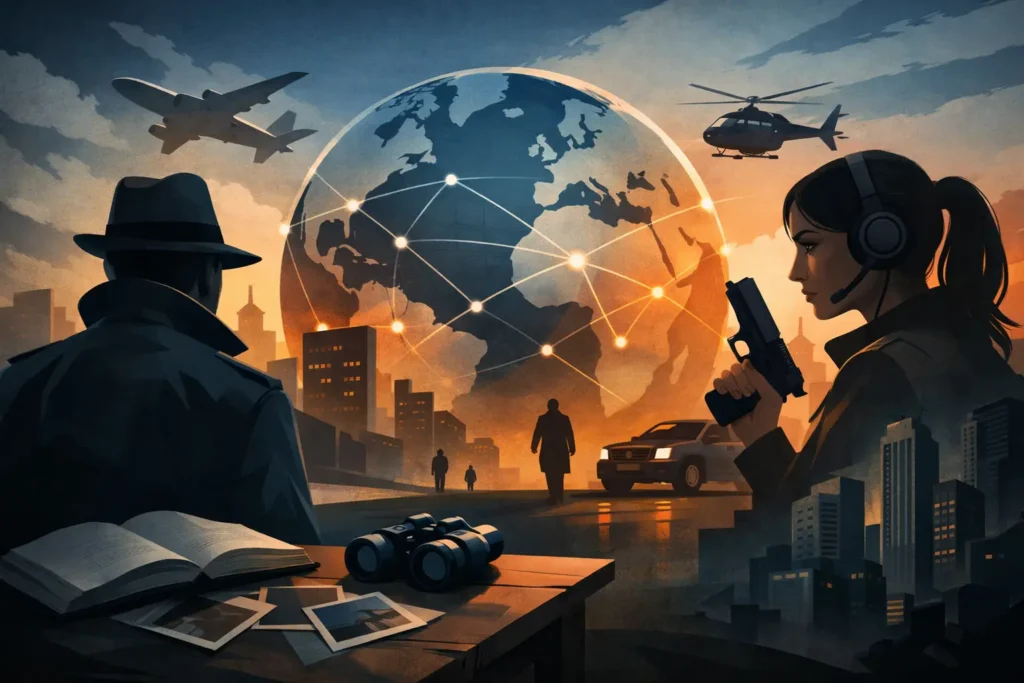
A locked service corridor, a camera card that should not exist, a stranger who knows a little too much about a routine assignment – global conspiracy thriller novels begin where ordinary life develops a hairline crack. The reader sees the same familiar airport, hotel lobby, government office, or crowded street. Then something is off. A door is guarded too carefully. A conversation stops when the wrong person enters. A photograph contains a detail nobody was meant to notice.
That is the particular pleasure of this kind of thriller. It takes a personal problem and keeps widening the frame until the threat reaches across borders, institutions, and identities. But the best stories do not rely on a bigger map alone. They make the danger feel close enough to touch.
The World Is Big, but the Fear Is Personal
A conspiracy can involve intelligence services, private contractors, multinational corporations, criminal networks, or a handful of powerful people operating behind respectable doors. Those forces provide scale. They can explain why the hero cannot simply call the police, why a mistake in one country causes trouble in another, and why the truth has been buried so deeply.
Still, readers do not turn pages because an organization has an impressive name or a shadowy boardroom. They turn pages because someone has something to lose.
Maybe the protagonist is trying to protect a child, clear a dead friend’s name, get home before a witness disappears, or decide whether exposing the truth will destroy an innocent person. The conspiracy creates pressure, but the character supplies the pulse. Without that human center, even a clever plot can feel like watching pins move across a wall map.
This is why a capable protagonist needs limits. A former operative may know how to spot surveillance, but he may be rusty, grieving, compromised, or trapped in a place where old contacts cannot help. A photographer may recognize a face or an impossible reflection in an image, yet have no idea why it matters until people begin asking for the file. Expertise opens one door. It should not magically open every door in the building.
What Makes a Global Conspiracy Feel Believable?
Believability is not the same as documentary-level detail. Few readers need an instruction manual for bypassing a security system. What they want is the feeling that the author understands the environment: the friction of travel, the procedures around secure spaces, the way people behave when they are protecting information, and the small errors that create opportunity.
A good thriller earns trust through specific, useful details. A badge that grants access in one area but not another. A hotel employee who remembers a bag left behind. A missed connection that turns out not to be an accident. The anonymous message that contains one fact only an insider could know.
Those details work because they are modest. Real danger often arrives in modest packaging. It is not always a black sedan racing through traffic. Sometimes it is an elevator held one floor too long, a familiar face seen twice in different cities, or a phone that goes silent at exactly the wrong moment.
Tradecraft should create problems, not remove them
Readers who enjoy spy fiction appreciate competent characters. They want the protagonist to notice the second exit, question the easy explanation, and understand that digital communication leaves a trail. Yet competence becomes dull when it means the hero always has the right device, contact, disguise, and escape plan.
The more satisfying approach is to let tradecraft complicate the choices. If the hero uses a secure channel, someone may learn that they are active. And if they recruit help, that person becomes vulnerable. Also if they evade surveillance, they may lose the only lead they have. Every smart move should carry a cost.
That balance gives the action weight. The protagonist is not invincible. They are observant, pressured, and willing to make difficult calls before all the facts are available.
Geography needs a job beyond scenery
International settings can be thrilling, but only when each location changes the story. A city should not appear just because it sounds glamorous on a book jacket. It needs to affect how characters move, communicate, hide, or trust one another.
An airport can become a place of surveillance and forced proximity. A remote border town can cut off resources and turn local knowledge into power. A polished capital can hide a maze of private offices, diplomatic protections, and people who cannot be questioned openly. The setting should shape the problem.
This is also where lived experience gives fiction an edge. Someone who has worked in unfamiliar buildings, traveled with valuable equipment, waited for clearance, and learned to read a room understands that logistics are never merely logistics. The route to a meeting matters. Who controls access matters. Even a harmless-looking assignment can place a person near a secret they were not supposed to see.
The Best Villains Believe They Are Necessary
A faceless villain can create suspense for a chapter or two. A villain with a coherent, terrible worldview can carry an entire novel.
The most memorable conspiracies are built by people who see themselves as protectors, reformers, patriots, or realists. They may believe that public panic would be worse than deception. And they may argue that a few sacrifices prevent a larger disaster. Also they may have started with a legitimate mission and gradually decided that no rule applies to them.
That does not make them right. It makes them dangerous in a way that feels uncomfortably familiar.
A strong antagonist also understands the hero’s values. Rather than simply trying to eliminate the protagonist, the antagonist may try to recruit, discredit, or morally corner them. If the truth will hurt people, should it still be exposed? If an ally has committed a crime for a defensible reason, can the hero trust them? Those questions add suspense that cannot be solved by outrunning a pursuer.
Why Clues Matter More Than Twists
Big twists are part of the bargain in a conspiracy thriller. Readers enjoy discovering that an assumed ally is not an ally, that the first crime was a diversion, or that a personal history connects to a much larger operation. The trick is not hiding every clue. The trick is hiding its meaning.
A fair twist makes the reader want to go back, not throw the book across the room. Once the truth is revealed, earlier scenes should look different. The suspicious pause, the odd phrasing, the missing document, and the character who knew just a little too much should snap into place.
That requires restraint. If every character is secretly working for someone else, the story loses emotional footing. Betrayal matters because trust mattered first. Give the reader genuine relationships: an ally who stays loyal, a mentor who tells an inconvenient truth, or a family member who refuses to be pushed aside. A novel full of betrayals becomes noise. One betrayal at the right moment becomes a wound.
Global Conspiracy Thriller Novels Need a Clear Moral Line
The genre often deals in gray areas, and it should. Intelligence work, political pressure, and institutional loyalty are rarely clean. But moral complexity is not the same as moral fog.
Readers need to understand what the protagonist will not do, even when the stakes are high. That line might shift under pressure, but it should exist. It reveals character more effectively than any backstory paragraph. A hero who chooses to protect a witness instead of taking the easier shot tells us who they are. A hero who refuses to turn a friend into collateral damage gives the final confrontation a personal cost.
That clarity is one reason a story like Double Exposure can put a photographer and covert operative at the center of a high-stakes threat. The tension is not only whether he can expose what is hidden. It is what exposure will demand from him when there is no safe angle left to shoot from.
The Ending Must Close the Case Without Shrinking the World
A global conspiracy does not need to be completely dismantled by the final page. In fact, a total cleanup can feel suspiciously tidy. Powerful systems leave remnants. Some people escape accountability. Some documents stay sealed. A hero may solve the central danger while recognizing that the wider world remains complicated.
What the ending must deliver is consequence. The core mystery needs an answer. The protagonist’s choices need to matter. The relationship at the story’s center – a partnership, family bond, friendship, or hard-won romance – should be changed by what happened.
Leave a little darkness at the edge of the frame if the story calls for it. Just make sure the reader can see what was saved, what was lost, and why the hero chose to keep going.
The next time a thriller opens with an ordinary assignment that goes wrong, pay attention to the smallest irregularity. In this genre, the forgotten detail is rarely forgotten by accident.