
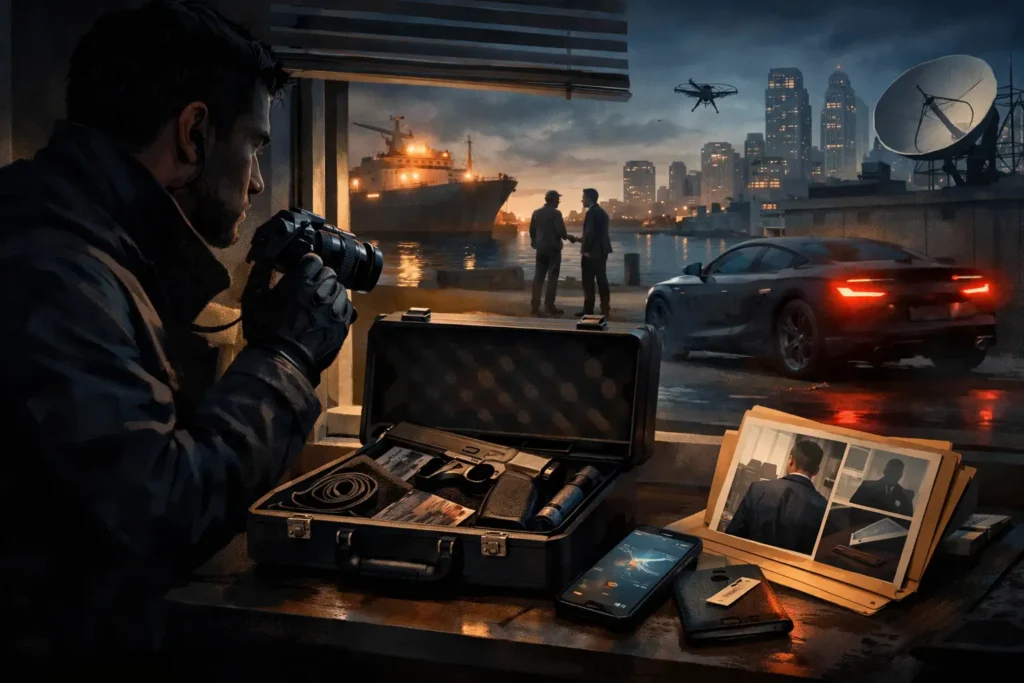
A spy who picks a lock in three seconds, downloads a secret file, and walks away untouched may be fun for a scene. But readers who love thrillers with authentic tradecraft know the better kind of suspense comes from friction: the badge that does not scan, the camera angle that catches too much, the contact who arrives five minutes late, the tiny lie that becomes impossible to maintain.
Realistic tradecraft does not slow a thriller down. It gives the danger weight. When a character succeeds because they have noticed the right detail, prepared for the wrong turn, or understood what a guarded person is not saying, the action feels earned. And when they fail, it hurts for the same reason.
What Authentic Tradecraft Actually Means
Authentic tradecraft is not a catalog of weapons, acronyms, and gadgetry. It is the believable practice of operating discreetly under pressure. In a strong thriller, that can mean surveillance, cover stories, dead drops, secure communications, social engineering, travel awareness, source handling, or simply knowing when to leave before a situation gets worse.
The key word is believable. A fictional operative does not need to follow every real-world procedure line by line. In fact, that would make for a long and rather dull evening. But the character’s choices should have logic. They should account for time, risk, location, people, and consequences.
A reader may not know the technical name for a surveillance detection route. They do know when a character seems careless. If someone meets the same source at the same coffee shop every Thursday, talks too freely, and never worries about who is watching, the story loses its grip. The reader starts seeing the author’s hand instead of the threat.
Why Thrillers With Authentic Tradecraft Feel More Dangerous
The best spy fiction makes ordinary spaces uneasy. A hotel lobby is no longer just a hotel lobby. It is a place with elevators, service corridors, sightlines, staff entrances, security cameras, and strangers pretending not to notice one another.
That shift in perspective is where authentic tradecraft shines. A character is not merely walking through an airport. They are evaluating whether they are being followed, whether their bag has been disturbed, and whether a familiar face has appeared once too often. And they may be wrong. And they may be tired. Or they may be trying to look perfectly ordinary while their pulse has other ideas.
That is tension readers can feel because it grows from recognizable experience. Most of us have entered a building where access seemed tighter than expected. We have wondered whether a person behind us was headed to the same place or just happened to be there. We have had a phone battery dip into the red at exactly the wrong moment. A good thriller takes those ordinary anxieties and gives them teeth.
The same principle applies to technology. A flashy device can be entertaining, but a phone should not become a magic wand that solves every problem. Realistic suspense recognizes that digital tools leave traces, connections fail, images can be manipulated, and supposedly secure information has a way of finding the wrong audience. The more capable the tool, the more interesting its limits become.
Preparation Creates Better Problems
Competence is compelling, but invincibility is not. Readers enjoy watching a skilled protagonist plan ahead: choosing an exit, memorizing a route, carrying a plausible reason to be somewhere, or arranging a fallback meeting point. Preparation tells us this person has survived long enough to know better.
Then the plan meets reality.
Perhaps the exit is blocked by a delivery truck. Or perhaps the fallback contact is compromised. Also perhaps a harmless photograph reveals something in the background that was not supposed to be there. Tradecraft becomes dramatic when it is useful but never enough to guarantee safety.
That balance matters. A protagonist who always has the right gadget is a vending machine for solutions. A protagonist who has prepared carefully and still must improvise becomes someone readers will follow into the next bad decision.
Observation Is More Cinematic Than It Sounds
In a thriller, observation is action. It is the difference between noticing a reflection in a dark window and missing it. It is recognizing that a room has been tidied too thoroughly, that a guard is wearing a new earpiece, or that the person claiming to be nervous is standing too close to the door.
Photography teaches a useful truth here: the frame always contains more than the first glance reveals. Light changes what can be seen. Angles hide or expose. A background detail can become the whole story once someone knows where to look.
That kind of awareness gives a thriller a tactile quality. The reader can see the wet pavement, the mirrored glass, the security desk, the conference badge turned backward on a lanyard. Details are not decoration. They are evidence, warnings, and sometimes traps.
The Trade-Off Between Accuracy and Pace
Authenticity has a limit. Readers pick up a thriller for a story, not a training manual. Too much procedural explanation can flatten a tense scene faster than a poorly timed fire alarm.
The answer is selective detail. Give readers the information that changes the stakes. If a character checks a door, the story does not need a lecture on every part of the lock. It needs to show why the door matters, what the character notices, and what happens if they are wrong.
It also depends on the scene. A slow-burn surveillance sequence can carry more process because anticipation is the point. During a chase, the prose should move. During an interrogation, a single precise observation may do more work than a page of technical language.
The goal is not to prove the author knows every term. The goal is to make readers trust that the author knows what can go wrong.
The Human Cost Makes the Craft Matter
Tradecraft without character is just choreography. The reader needs to understand what operating carefully costs the person doing it.
A good cover identity can isolate someone from the people they care about. A trained observer may have trouble relaxing in a crowded room. An operative who treats every conversation as a possible threat may miss the one person trying to help. These are not side effects to mention once and forget. They are fertile ground for suspense because they make every personal connection uncertain.
That is why conspiracy thrillers work best when the danger is both external and intimate. The plot may involve classified files, corporate influence, or a hidden agency with too much reach. But the emotional question is closer to home: Who can this character trust when the habits that keep them alive also keep everyone at a distance?
In Double Exposure, photographer and covert operative Reed Sawyer operates in that uneasy space, where an image can reveal more than it was meant to and professional instincts can become a liability. A camera is useful because it records. It is dangerous because it records.
The Details Readers Remember
Readers rarely close a thriller and rave about a perfectly named protocol. They remember the moment a character realizes the hotel room has been searched. And they remember the burner phone that rings when it should be silent. Also they remember a supposedly casual encounter that suddenly feels arranged.
Those moments work because authentic tradecraft honors cause and effect. A character takes a risk. Someone notices. The situation changes. There is no reset button, no convenient forgetfulness, and no clean escape just because the chapter needs to end.
That is the real pleasure of believable spy fiction. It asks readers to look twice at the everyday world: the camera above the doorway, the stranger at the gate, the email that arrives with one detail slightly wrong. Most of the time, it is nothing. Allegedly. But the right thriller makes you wonder what you missed.