
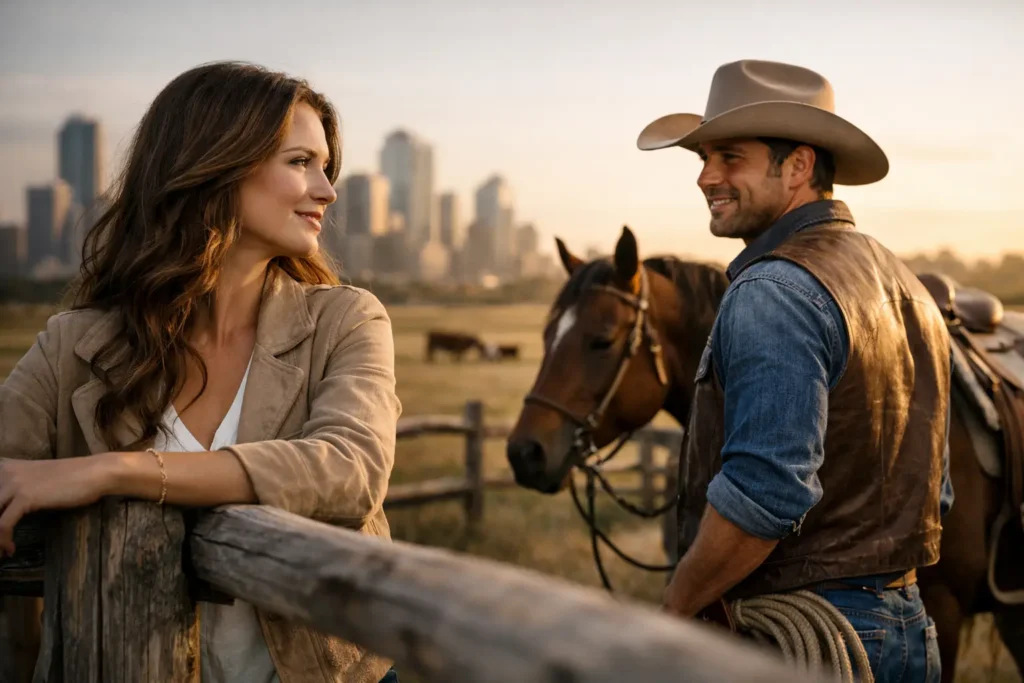
A pair of polished shoes in ranch dust can say more than a page of backstory. They tell us someone arrived unprepared, likely irritated, and probably determined not to admit either fact. Put that person near a rancher with a broken fence, a stubborn horse, and no patience for grand speeches, and a familiar kind of romantic tension begins to earn its keep.
The ranch romance city woman setup has endured because it places two believable ways of life in the same frame. It is not really about choosing skyscrapers or cattle guards. It is about what happens when a person’s carefully built assumptions meet a place that refuses to cooperate. The best stories in this tradition understand that the ranch is not a costume department, and the city woman is not there to be corrected. Both characters have something to learn, and both bring useful strengths to the table.
The ranch is a setting with consequences
A convincing ranch romance begins with work. Gates need repairing. Animals need feeding before anybody has time for a heart-to-heart. Weather changes plans without asking permission. That practical reality gives the setting its authority.
Romance becomes more interesting when a character cannot simply walk away from every uncomfortable moment. A city professional may be used to solving problems with a phone call, a calendar invite, or an impressive presentation. On a ranch, some problems require physical effort, patience, and the willingness to try again after the first attempt goes sideways. Mud is an honest critic.
That does not make country life morally superior. Ranch life can be isolating, financially uncertain, and relentlessly demanding. A well-written story lets readers feel the cost of keeping land, livestock, and family traditions alive. The rancher should not be a man who spends every afternoon leaning against a fence looking handsome in a clean shirt. If that shirt stays clean through calving season, readers are allowed a little suspicion.
The place matters because it presses on the characters. A storm, a damaged water line, a family obligation, or a difficult business decision can expose who they are far better than a convenient misunderstanding ever could.
Why the city woman belongs in the story
The city woman works as a romantic lead when she arrives as a whole person, not a bundle of high heels waiting for a makeover. She may be a business owner, architect, teacher, lawyer, event planner, photographer, or someone rebuilding a life after a disappointment. Her experience should matter.
Perhaps she sees a practical way to help the ranch reach new customers. Perhaps she understands contracts, branding, preservation, or the difficult art of talking to people who do not agree. More quietly, she may bring an outsider’s ability to notice what everyone else has stopped seeing. Familiarity can be useful, but it can also make people blind to change.
Her adjustment to ranch life should have a few rough edges. Nobody learns to ride well, manage livestock, or understand the rhythm of rural work in a weekend. A little embarrassment can be funny. A character who insists that a charming old barn has “great potential” before discovering the repair bill can be even funnier. But the humor needs generosity. Readers want to see her grow in competence, not be humiliated for coming from somewhere else.
In strong ranch romance city woman stories, she does not abandon ambition to prove she has found love. Instead, she decides what ambition means now. Sometimes that means staying on the ranch. Sometimes it means building a life that includes both worlds. Sometimes it means the rancher must be the one who learns that devotion to home does not require fear of the wider world.
The rancher needs more than a good hat
A quiet, capable rancher is a fine starting point. He is not, however, a complete character just because he owns boots and can fix equipment. The most memorable heroes have a reason for their reserve, but they are not defined by it.
He may be carrying responsibility for family land, a younger sibling, an aging parent, or employees who count on him. Those pressures can make him cautious about love, especially if he has seen promises fail. Still, emotional distance cannot be his only skill. Readers need to see kindness in action: the way he treats a hired hand, handles a frightened animal, listens when it would be easier to dismiss someone, or admits he was wrong.
The city woman can challenge him without becoming a lecture disguised as a love interest. Their disagreements work best when both sides have a point. He may see risks she misses. She may recognize that tradition has become an excuse for avoiding a necessary decision. A romance comes alive when neither character wins by making the other smaller.
Conflict should come from values, not contempt
There is a thin line between playful culture clash and lazy caricature. Jokes about unfamiliar coffee orders, designer luggage, or manure on expensive shoes can land because they reveal discomfort. They become tiresome when the story treats one way of life as foolish.
The better conflict is deeper. She values independence because she fought hard to build a career. He values stability because other people depend on him. She believes leaving is sometimes brave. He believes staying is sometimes brave. Neither position needs a villain.
That kind of conflict also gives the romance room to breathe. Attraction may start with a glance across a porch or an unexpected rescue from an awkward situation. Lasting love requires harder things: listening, compromise, and the courage to let another person see the part of you that has stayed locked behind the practical decisions.
Details make the romance believable
As a photographer, I have learned that authenticity often lives at the edge of the frame. It is the dust on a truck floor, the patched glove tucked into a back pocket, the pause before a storm, or the fact that a wide western horizon can make a person feel both free and very small.
Fiction works the same way. A ranch romance does not need a textbook’s worth of agricultural information, but it needs specific details that show the author knows the setting is more than a postcard. The smell of coffee in a ranch kitchen before sunrise, the ache after a day of unfamiliar work, the sound of gravel under tires at night, and the uncomfortable silence after a family argument all do their part.
The city deserves the same respect. A woman who comes from Dallas, Denver, Chicago, or Los Angeles should not arrive carrying a vague label called “urban life.” Her former home has rhythms, relationships, pressure, and real beauty of its own. When both places are rendered honestly, the choice between them becomes emotional rather than decorative.
A satisfying ending is not a surrender
Readers come to romance for emotional resolution, and ranch romance is particularly good at delivering it. A restored relationship can sit beside a restored home, a repaired barn, or a future that finally feels possible. The landscape lends itself to visual closure without needing to force it.
Still, the ending should respect what the characters have given up and gained. If she moves to the ranch, the story should acknowledge the career, friends, and identity she leaves behind. If he changes his plans, that choice should cost something too. Love feels more satisfying when it is not a magic wand waved over practical problems.
That is one reason stories such as Boots and Stilettos have such a natural appeal. The contrast in the title promises charm, but the real opportunity lies underneath it: two people learning that a different life is not automatically a lesser one.
A good ranch romance leaves room for the dust, the work, the laughter, and the awkward first attempts at understanding. More than that, it gives its characters a home they have chosen with open eyes. That is a solid foundation for any love story, even if someone still has to clean the mud off the shoes.