
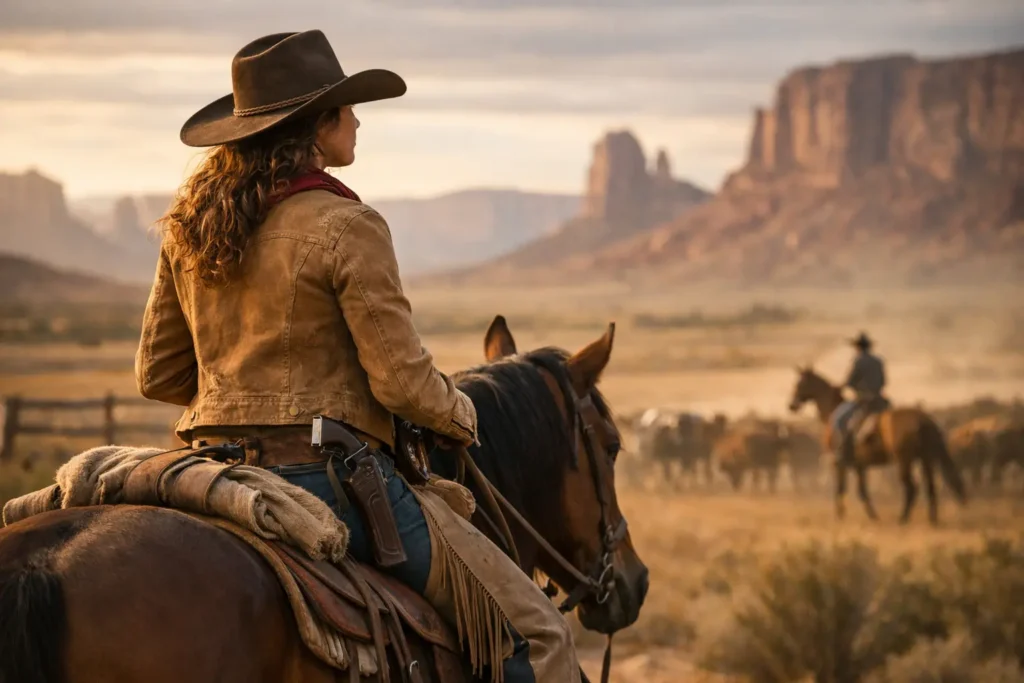
A woman standing at a depot with one worn suitcase, a ranch ledger full of debts, or a child depending on her has more at stake than a charming stranger riding into town. That is the beating heart of resilient heroine western romance. The setting may offer wide skies, horses, dust, and long miles between neighbors, but the real drama comes from a woman deciding what she will do when life refuses to make things easy.
The West is often remembered as a place of grand gestures: a train whistle at sunset, a rider on a ridge, a town built around one busy street. Those details matter. They give a historical romance texture and scale. Still, the stories that linger usually make room for smaller, tougher moments: repairing a fence after a storm, keeping a business afloat, facing gossip without surrendering to it, or accepting help without handing over the reins of one’s life.
What a Resilient Heroine Western Romance Gets Right
Resilience is not the same thing as perfection. A heroine who never doubts herself, never makes a poor choice, and never needs anyone is less a person than a recruiting poster. Real strength has some wear on it. It can look like fear followed by action, grief carried into the next morning, or a stubborn refusal to let one hard season define every season after it.
That distinction gives Western romance its emotional weight. Historical heroines had fewer legal, financial, and social options than many women have now. A story should acknowledge that reality without treating the heroine as helpless or turning every conflict into a modern speech in period clothing. She can be constrained by her time and still be resourceful within it. In fact, the limits are often what make her choices matter.
A woman running a boardinghouse may have to balance kindness against unpaid bills. A widow on a ranch may know the land better than anyone but still face men who assume she needs saving. A schoolteacher arriving in an unfamiliar town may have the education to make a new life, yet no family nearby when trouble arrives. None of these situations requires a villain twirling a mustache. The pressure is already there, baked into the circumstances.
Readers recognize that pressure because it is human, even when the story takes place a century ago. Most of us have known some version of carrying too much, starting over, or discovering that the plan was not nearly as sturdy as we believed.
Strength Needs Room for Tenderness
The finest romantic pairings do not use love as a prize awarded after the heroine has endured enough hardship. Romance works better when it becomes part of the life she is building, not a replacement for it.
That is where a capable hero earns his place in the story. He may offer a practical skill, local knowledge, protection from a threat, or simply a steady presence when everything else seems uncertain. But he should not solve the heroine’s central problem by taking control of it. If he rides in, fixes the roof, defeats every obstacle, and explains her own future to her, the story may have plenty of action but very little partnership.
A better hero pays attention. He respects what she has already survived. He understands that help can be offered without being imposed. That sounds simple, but it creates a satisfying tension: two independent people learning the difference between being alone and being supported.
Tenderness is not a weakness in these stories. It is often the bravest thing on the page. A heroine may be able to negotiate a land dispute or face down a difficult neighbor, yet admitting that she wants a home, a family, or someone who knows her well can be the more vulnerable choice. Clean romance has particular room to let those quieter moments carry real heat: an earned touch of the hand, a conversation on a porch after everyone else has gone to bed, a promise made only after both people understand its cost.
Why the Western Setting Raises the Stakes
Place is never just wallpaper in a good Western romance. A dusty road is a problem when the nearest doctor is far away. A blizzard is a problem when supplies are low. A dry summer can change the future of a family before anyone says a word about it.
That is why authentic detail matters. Readers can tell when a setting has been assembled from a pile of familiar props. They do not need a catalog of every spur, saddle, or saloon mirror. They need a few telling details used at the right moment: the mud on a hem after a hard rain, the smell of coffee in a crowded kitchen, the practical worry of getting goods into town before the weather turns.
Years spent working as a photographer taught me that locations have a way of correcting assumptions. Light changes. Distances are larger than they looked on a map. The beautiful old building has a broken step, a strange echo, and a back room nobody mentioned. Fiction benefits from the same observation. The West should feel inhabited, useful, inconvenient, and occasionally magnificent, sometimes all before lunch.
The landscape can also expose character. A small community notices who arrives, who leaves, and who is in trouble. Privacy is difficult, but so is disappearing. For a heroine creating a place for herself, that can mean both scrutiny and unexpected allies. The town busybody may be tiresome, but she might also be the first person to bring soup when disaster strikes. Human beings remain pleasantly complicated, even in a town with one mercantile and a hitching rail out front.
The Difference Between Independent and Isolated
One trap in writing a resilient heroine is confusing independence with isolation. Independence means she has agency. She can make decisions, accept consequences, and pursue a goal that belongs to her. Isolation means the story cuts her off from every meaningful relationship so that she can prove she needs no one.
Those are not the same thing. A strong heroine can lean on a sister, a friend, an older mentor, or the hero while keeping her own judgment. In many Western settings, community was not optional. People relied on neighbors for news, labor, safety, and survival. That interdependence can enrich a romance rather than weaken its central couple.
It also opens the door to second chances. Perhaps the heroine has left a painful past behind. Perhaps she has made a mistake that cost her dearly. The most moving stories do not erase the past with a wedding or a single declaration of love. They let trust return in pieces. A repaired relationship, a new skill, a business that finally turns a profit, or a decision to stay can carry as much emotional satisfaction as the romance itself.
A Heroine Worth Rooting For
Readers do not need a heroine to be agreeable every minute. They need to understand the truth beneath her choices. She may be guarded because she has been disappointed. She may be proud because pride was once the only thing left to her. She may misjudge the hero, make a mess of a conversation, or refuse a kindness she badly needs.
The key is consequence and growth. Her decisions should shape the story. When she changes, it should be because she has learned something costly and useful, not because the plot requires her to become easier to manage. The same standard applies to the hero. A romance becomes memorable when both people must give up an old certainty to make room for a future together.
That balance is one reason historical Western romance continues to find readers. Beneath the period clothing and open country are recognizable hopes: safety without surrender, love without losing oneself, and a home built through choices rather than luck. Stories such as Dust and Inheritance are drawn to that fertile ground, where family history, difficult landscapes, and the possibility of connection can all pull in different directions.
A resilient heroine does not need to conquer every hardship with a clenched jaw and a perfectly timed line. Let her be clever. Let her be tired. Let her laugh when the situation deserves it and ask for help when it matters. Give her a future she has a hand in creating. Readers will follow her across a lot of rough country for that.