
Some spy thrillers are built around car chases, explosions, and enough gunfire to make the ammo budget look like a small government program.
Double Exposure has danger, action, and plenty of tension, but at its heart, it is about something even more dangerous than bullets.
Betrayal.
Secrets.
Trusting the wrong person.
Seeing something you were never supposed to see.
And, of course, a photographer who finds himself in the worst possible frame.
If you enjoy spy books that focus on betrayal and secrets, Double Exposure was written for you. It is an espionage thriller, but it is not just about who has the biggest weapon. It is about who is telling the truth, who is lying, and who has been setting the trap long before the first shot was fired.
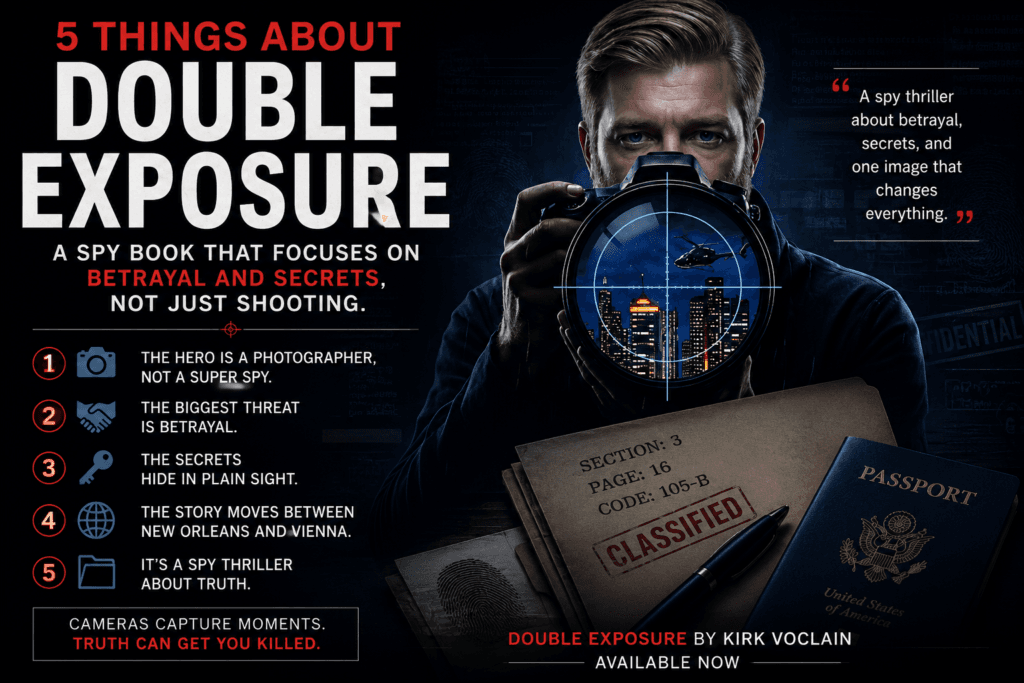
Here are five things that make Double Exposure different.
1. The Hero Is a Photographer, Not a Super Spy
Reed Sawyer is not the kind of spy thriller hero who walks into every room like he owns the building and already knows where all the exits are.
He is a professional photographer.
That matters.
A photographer notices things other people miss. He studies light, expression, posture, movement, timing, and the tiny details most people walk right past. Reed’s skill is not brute force. His greatest weapon is his ability to observe.
That is what makes him useful.
It is also what gets him into trouble.
In Double Exposure, Reed captures something through his camera that he was never supposed to see. What begins as a routine assignment in Vienna turns into a nightmare when his lens catches the truth behind an assassination attempt.
And once Reed sees it, there is no unseeing it.
That is one of the things I love most about this story. Reed’s photography is not just a character detail slapped on for flavor. It is the engine of the book. His camera opens doors, reveals secrets, and puts him directly in the crosshairs.
Not bad for a guy who probably thought the most dangerous thing about photography was a client saying, “Can you just Photoshop that?”
2. The Biggest Threat Is Betrayal
Yes, Double Exposure has danger. And YES, Reed is hunted. But also yes, there are people who want him silenced.
But the real threat is betrayal.
This is a spy thriller where Reed does not simply have to survive the enemy. He has to figure out who the enemy actually is.
That is a very different kind of tension.
In a straight action story, the bad guy usually announces himself pretty quickly. In Double Exposure, the danger is more slippery. The people who should protect Reed may not be trustworthy. The agency that sent him may not be on his side. The mission may have been compromised before Reed ever lifted his camera.
That kind of betrayal hits harder because it is personal.
A bullet can miss.
A betrayal can rewrite your entire life.
For Reed, the question is not just, “Who is trying to kill me?”
The better question is, “Who wanted me standing here in the first place?”
That is where the story digs in. The secrets in Double Exposure are not random puzzle pieces. They are connected to power, loyalty, manipulation, and the terrifying realization that Reed may have been chosen for this trap because of the very thing that makes him good at his job.
His eye.
3. The Secrets Hide in Plain Sight
One of the central ideas in Double Exposure is that the most dangerous secrets are often not hidden in dark basements or locked vaults.
Sometimes they are right in front of you.
In this story, a camera lens becomes more than a tool for photography. It becomes part of the mystery, part of the danger, and part of the reason Reed’s life comes apart.
That concept fascinated me because photographers carry complicated equipment all the time. Lenses, cases, camera bodies, batteries, cables, brackets, memory cards, and accessories can look confusing to people outside the profession. Most people see gear. A photographer sees purpose.
But what if something else was hidden inside that familiar world?
What if the very tools used to capture truth could be twisted into something deadly?
That is one of the reasons Double Exposure leans so heavily into secrets. The danger is not always loud. It does not always arrive with sirens and explosions. Sometimes it looks completely normal until the right person looks closer.
And Reed Sawyer is very good at looking closer.
Maybe too good.
4. The Story Moves Between New Orleans and Vienna
Double Exposure has international espionage, but it also has a strong Southern heartbeat.
The story moves from the rain-slicked streets of New Orleans to the old-world beauty and tension of Vienna. Those two settings give the book a unique flavor.
New Orleans brings atmosphere, history, shadows, music, old buildings, hidden corners, and a sense that every street has heard more secrets than it is willing to repeat.
Vienna brings elegance, danger, intelligence work, European architecture, and the kind of polished beauty that can hide something very ugly beneath the surface.
That contrast matters.
Reed is pulled between worlds. He is a South Louisiana photographer thrown into an international conspiracy where every location has its own rhythm, its own rules, and its own danger.
As a writer, I wanted the locations to feel visual because Reed himself is visual. He sees places differently. He notices texture, light, reflection, and the way people move through a room. The settings are not just backdrops. They are part of the tension.
After all, when your main character is a photographer, the scenery better show up dressed for the job.
5. It Is a Spy Thriller About Truth
At its core, Double Exposure is about truth.
Who controls it?
And who hides it?
Also who profits when no one believes it?
Reed’s problem is not only that he sees something dangerous. His real problem is that powerful people are willing to make sure no one believes him.
That is what gives the story its emotional punch.
A camera can capture the truth, but what happens when the world is told the photographer is lying?
That question runs through the whole book. Reed is not just fighting to stay alive. He is fighting to prove that what he saw was real. He is fighting against a system designed to make him look guilty, unstable, or expendable.
That is why betrayal and secrets matter so much in Double Exposure. They do not just create plot twists. They attack Reed’s identity, his credibility, and his understanding of the people around him.
And when a photographer loses control of the image, the frame, and the story, he has only one choice.
Find the truth before someone else edits him out of it.
Why Readers Who Love Betrayal-Driven Spy Books Should Read Double Exposure
If you like spy books that are all shooting and no thinking, there are plenty of those out there.
But if you enjoy espionage thrillers where the danger comes from hidden loyalties, secret agendas, double-crosses, coded clues, and the slow realization that someone has been playing a much deeper game, Double Exposure may be exactly your kind of book.
It has action.
And it has conspiracy.
Also it has international danger.
But most of all, it has a photographer caught inside a trap built from betrayal, secrets, and one deadly image he was never meant to capture.
Because in Double Exposure, the camera does not just take pictures.
It exposes the truth.
And some people will do anything to keep that truth in the dark.
Double Exposure is available now. Grab your copy and step into the frame with Reed Sawyer.
Get your Copy here: https://a.co/d/08nlrhiV