
There are certain images that do more than illustrate a story.
They open a door.
This one does exactly that.
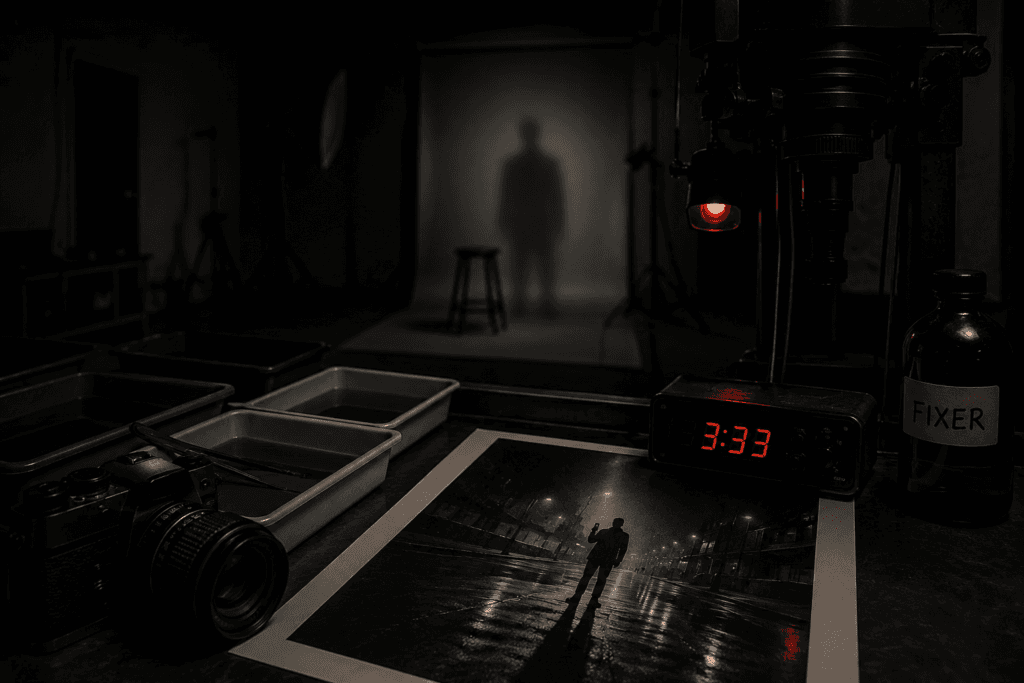
A darkroom. A camera. Chemical trays. A bottle marked Fixer. A red digital clock burning the numbers 3:33 into the shadows. And in the background, barely separated from the darkness, a figure stands where no figure should be standing.
That is the mood of Zero Exposure in one image.
It is not loud. It does not shout. It waits.
And that, to me, is what makes it terrifying.
The Darkroom as a Strange Place
A darkroom is already one of the most mysterious places in photography. For those who have never worked in one, it is hard to explain the feeling. You stand under a dim safelight, surrounded by trays of chemicals, watching a blank sheet of paper slowly reveal an image that was invisible only moments before.
That process is creepy by nature.
Developer brings the image forward. Stop bath halts the process. Fixer makes the image permanent. Rinse washes away what no longer belongs.
In other words, the darkroom is not just where photographs are made.
It is where invisible things become undeniable.
That is why this image hits so hard for Zero Exposure. The story begins with something that should be familiar to me, photography, my studio, my equipment, my world. But then the familiar turns strange. The safe place becomes the dangerous place. The image appears before the explanation does.
That is very much the heartbeat of the book.
The Creepy History of 3:33 A.M.
The number 3:33 has gathered a strange reputation over the years. In popular folklore, this time is often described as a late-night period when strange things happen. Merriam-Webster defines the moment as a late-night time when it is the strangest.
And then there is 333 itself.
In modern numerology and “angel number” culture, repeating numbers are often treated as signs or messages. Some popular interpretations connect 333 with creativity, expression, guidance, growth, and alignment. Allure describes angel numbers as repeating numerical patterns that people interpret as especially meaningful, and it lists 333 as connected to creativity.
Now, I am not writing a numerology manual here, thank goodness, because my calculator already judges me. But as a storyteller, 333 is loaded with atmosphere. It can feel like warning, invitation, alignment, and intrusion all at once.
That makes it perfect for Zero Exposure.
Why 3:33 Is So Important in Zero Exposure
In Chapter 2: Latent Image, Kirk wakes in the darkroom with chemicals already poured, trays already arranged, and no memory of how he got there. His watch reads 3:33 a.m., and the moment feels wrong because it feels “placed” and “chosen.”
That is the key.
In the story, 3:33 is not simply a spooky number on a clock. It is evidence.
It suggests that what is happening is not random. Someone, or something, is composing the scene. The clock is part of the frame. The darkroom is part of the frame. Even Kirk is part of the frame.
That is what makes the moment so fascinating. A photographer is used to controlling the image. He chooses the light. He chooses the angle. He chooses what stays in the frame and what gets cropped out.
But at 3:33 a.m., Kirk realizes he may not be the photographer anymore.
He may be the subject.
The Image Inside the Image
Look closely at this artwork and you can feel the story mechanics working.
The print in the tray shows a lone figure in a wet street. That connects directly to the moment in Latent Image when a photograph appears in the developer tray, showing Canal Street in New Orleans and Reed Sawyer, a man who should only exist inside Kirk’s novel.
The darkroom clock reads 3:33, which places us in the exact moment when the ordinary world begins to fail.
The bottle marked Fixer matters too. In photography, fixer makes the image permanent. In Zero Exposure, that idea becomes much bigger. The question becomes, what happens when a story is “fixed” into reality? What happens when a fictional image stops being imaginary?
That is where the book gets dangerous.
Because in this world, saving a file may not just preserve words.
It may preserve events.
Why This Image Works
This image works because it does not explain too much.
That is important.
The best creepy images leave room for the viewer to participate. Your brain starts filling in the dark areas, and honestly, your brain is a terrible employee at 3:33 in the morning. It starts inventing things. It starts seeing shapes. It starts asking questions.
Who is standing in the background?
Who took the photograph in the tray?
Why is the clock showing 3:33?
Why does the darkroom look less like a workspace and more like a crime scene?
That is exactly the feeling I wanted for Zero Exposure.
The book is about a photographer who writes a spy novel, then slowly realizes the boundary between fiction and reality may not be as solid as he thought. The camera sees things before he understands them. The darkroom reveals what should have stayed hidden. The image arrives before the truth.
And somewhere in the red glow, the Architect is watching.
Final Thought
For me, this image captures the soul of Zero Exposure.
It is photography as suspense.
It is the darkroom as a doorway.
It is 3:33 a.m. as a warning.
A photograph is supposed to prove what was there.
But in Zero Exposure, the more dangerous question is this:
What if the photograph shows what is coming?
Pre-Order your copy of Zero Exposure here: https://a.co/d/0fb6mhyi