
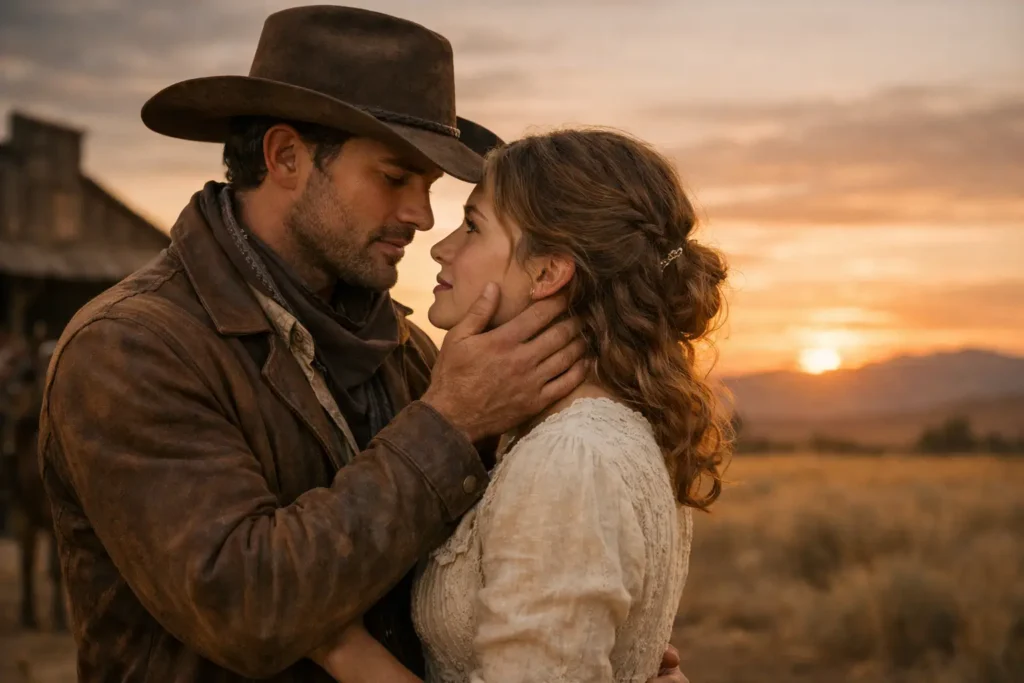
A hitching post outside a weathered hotel. Dust on a boot toe. A letter folded twice and carried too long in a coat pocket. Historical western romance works because its emotional details are often as plain and durable as those objects. The setting gives love a difficult job to do. It must survive distance, pride, bad timing, family obligations, and a landscape that rarely makes anything easy.
That combination is why stories set in the American West continue to hold readers. They offer movement, risk, and wide-open country, but the heart of the story usually lives in a smaller space: a kitchen table, a porch after sundown, a quiet ride into town, or the moment two guarded people decide to tell the truth.
Historical Western Romance Is Built on Real Stakes
A good Western setting does more than supply horses, hats, and dramatic sunsets. It puts pressure on every decision. Travel takes time. News arrives late, if it arrives at all. A missed train, an injured horse, or a sudden storm can change the course of a life. That is useful material for fiction because the obstacles are not invented merely to keep two people apart for another chapter. They belong to the world.
Romance thrives on consequence. In a modern story, a character can send a text, book a flight, or look up an answer before dinner. In the nineteenth-century West, a person might need several days, a borrowed wagon, and a fair amount of nerve just to deliver a message. The slower pace creates room for anticipation. It also makes a promise weightier. If someone says, “I’ll be back by spring,” those words have a long way to travel.
The physical setting matters, but hardship alone is not the attraction. Readers return for capable characters facing hard circumstances without becoming cardboard heroes. The rancher should not be admirable simply because he owns land and says little. The woman arriving by train should not be brave only because she has a trunk and a secret. Their choices, mistakes, humor, and tenderness are what make them worth following.
The West Works Best When It Is Specific
There is no single Old West. A cattle town in Texas does not feel like a mining camp in Colorado. A dry stretch of Arizona carries a different mood from a Montana valley after the first snow. Even two communities fifty miles apart may have different economies, customs, dangers, and hopes.
Specificity keeps a historical western romance from becoming a costume party with horses. A reader should sense what people eat after a lean winter, how far the nearest doctor lives from town, why a business is failing, and what work must be finished before dark. Those details do not need to arrive as a history lecture. A cracked water barrel, a burned biscuit, or a character counting the last jars in a pantry can do more than a page of explanation.
Photography taught me that a place is rarely defined by its postcard view. The memorable part may be the worn paint on a door, the shadow beneath an awning, or the way a road disappears around a rise. Fiction works much the same way. Broad landscapes establish scale, but small observed details persuade us that people truly live there.
Research is essential, although it must stay in its proper place. Readers deserve accuracy about the period, particularly when a fact shapes the plot. At the same time, a novel is not improved by making every character pause to explain the construction of a saddle or the timetable of a freight line. Research should support the scene, not stand in front of it waving for attention.
The Details That Carry Emotional Weight
The most useful historical details are often the ones that reveal character. A woman who mends a coat before asking for help tells us something about her. A man who saves the last apple for a child, then pretends he was never hungry, tells us something too. The object is ordinary. The choice is not.
This is one reason clean romance fits the genre so naturally. Emotional intimacy does not require explicit scenes to feel powerful. A hand offered when someone is climbing down from a wagon, a fire kept burning through a bad night, or a shared confidence can carry real heat. Restraint can make a moment sharper, not softer, because readers understand what it costs the characters to lower their defenses.
Why Second Chances Belong in Western Love Stories
The West has long been associated with starting over. That idea can become a cliché if it is handled carelessly, but it remains meaningful because people do seek new ground after loss, failure, or disappointment. A new town does not erase the past. It simply gives a character somewhere to meet it differently.
That is the fertile ground of a second-chance romance. Perhaps a widow has learned to manage on her own and does not intend to surrender that hard-earned independence. Or perhaps a former lawman wants a quieter life but discovers that peace is not the same thing as hiding. Or even perhaps two people knew each other years ago, when pride spoke louder than affection. The plot becomes interesting when love asks neither person to become smaller.
Family is often part of the bargain. A ranch may be inherited with debt attached. Younger siblings may need protection. A child may be watching every adult decision with unnerving accuracy. These responsibilities keep the romance connected to a larger life. Falling in love is not the finish line. It is the beginning of a partnership that must function when the roof leaks, the cattle wander, and somebody has to make supper.
There is room for humor here, too. Western characters have plenty to contend with, and a story can grow weary if every conversation arrives wearing black gloves and carrying a tragic past. A stubborn mule, an overconfident dog, or a town busybody with perfect timing can give a chapter air. Humor does not cancel the stakes. It lets the characters feel human enough to survive them.
What Readers Can Expect From the Best Historical Western Romance
The strongest books in the genre balance two promises. One is the satisfaction of romance: characters who earn trust, face a meaningful conflict, and arrive at an emotionally satisfying ending. The other is the pull of historical fiction: a place with its own rules, texture, and unanswered possibilities.
Some readers want a sweeping wagon-trail story. Others prefer a tighter romance centered on one town, one ranch, or one family. Neither approach is automatically better. A broad story can create a grand sense of adventure, while a smaller one can make every glance and conversation matter. The key is proportion. The historical setting should challenge the characters without swallowing them whole.
Suspense can also fit comfortably in the saddlebag. A disputed inheritance, a missing deed, an old betrayal, or trouble threatening a community can give the romance forward motion. The danger works best when it reveals who the characters are under pressure. A chase is exciting. A chase that forces someone to choose between safety and loyalty is a story.
That blend of mystery, resilience, and hard-won affection is part of what shaped my own interest in stories such as Dust and Inheritance. The West offers plenty of room for trouble, but it also offers room for people to become more honest, more courageous, and occasionally wiser than they were when they rode into town.
Historical western romance lasts because it understands a simple truth: love is never separate from the life surrounding it. It is tested by work, weather, memory, family, and the miles between one porch light and the next. When a story gets those things right, the final promise feels earned. And that is a fine reason to keep a good book nearby when the evening gets quiet.