
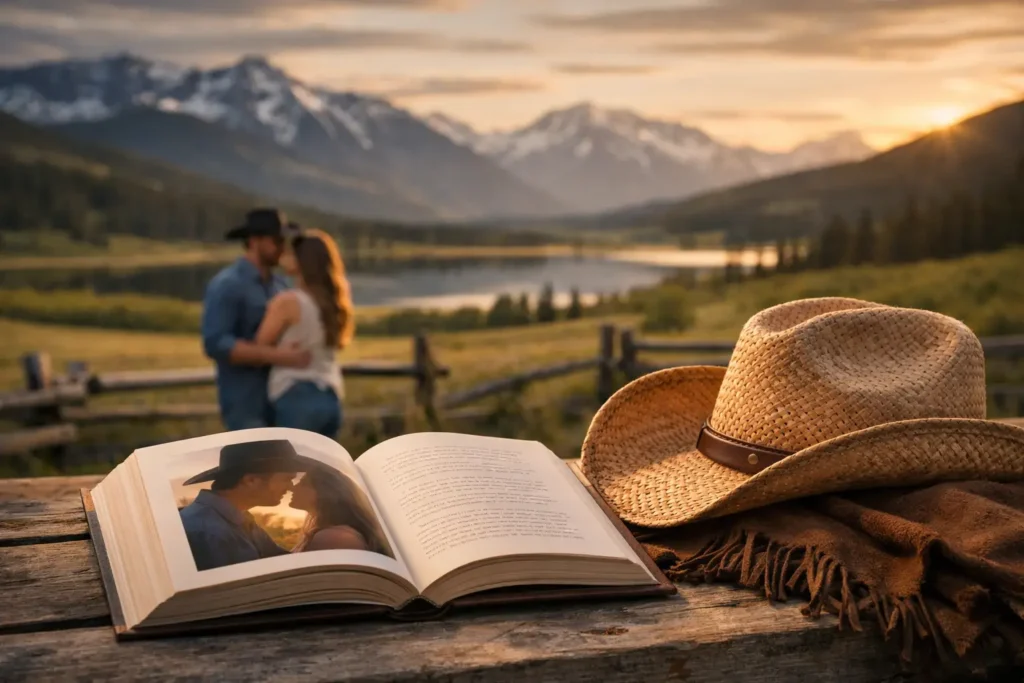
A Montana road can run straight toward a horizon for miles, then turn sharply at a river, a weathered fence, or a ridge that blocks the light earlier than expected. That contrast helps explain the staying power of Montana romance novels. The landscape feels enormous, but the emotional world is often close enough to hear through a thin wall at the local diner.
Readers come for the mountains, ranches, rivers, and big skies, certainly. They stay because a good story set there understands that distance does not make people less connected. It makes every connection count. A neighbor who shows up after a storm, a family name with a long memory, a town where one small decision travels fast – these are not merely scenic details. They put pressure on the characters and give a love story somewhere solid to stand.
The Setting Has a Job to Do
A western setting can be decorative. Put a couple on horseback, mention a sunset, add boots with a little dust on them, and the cover almost designs itself. But the Montana that lingers in a reader’s mind has a role in the plot.
Weather can alter plans without asking permission. A long drive is not a quick errand. A broken fence, a late calving season, or a road made difficult by snow can force people into the same room, reveal their priorities, or make a promise inconvenient to keep. None of that requires melodrama. It simply gives ordinary choices consequences.
That is part of the appeal. In a setting where the land asks something of everyone, competence becomes attractive. So does kindness. A character who notices a neighbor’s trouble and helps without keeping score can carry more romantic weight than a grand speech delivered at exactly the right moment. The speech may still be welcome. Readers of romance have never objected to a well-timed declaration. It just means more when it follows action.
The physical scale also creates a useful emotional contrast. Mountains and open range make a person’s private worries seem small for a moment, then bring them into sharper focus. A character can have room to think while driving along an empty highway, but eventually he has to go back to town, face a difficult parent, reopen an old conversation, or admit that independence has become a convenient hiding place.
Why Montana Romance Novels Favor Second Chances
Second-chance romance fits Montana particularly well because the place naturally carries a sense of history. Families may have worked the same land for generations. Old friendships survive periods of silence. A person returning home is not arriving as a blank slate. Someone remembers the awkward teenage years, the job that went wrong, or the summer a heart got broken.
That history adds texture, but it needs a careful hand. Familiarity can become confinement if every character exists only to repeat the past. The most satisfying stories allow people to be known and still change. A woman who left town to build a career may return with greater confidence, not as someone who needs to be corrected. A rancher who has spent years carrying family responsibility may need to learn that accepting help is not failure.
The romance grows in the space between who the characters were and who they are becoming. That is a more interesting conflict than a misunderstanding that could be settled by one reasonably clear conversation. Real emotional obstacles tend to involve grief, pride, family duty, trust, or the fear of losing a hard-won identity. They cannot be solved in chapter three with a text message and a cup of coffee, although coffee remains an excellent start to many things.
For clean romance readers, this focus is especially rewarding. Emotional intimacy gets room on the page. The meaningful moments might be a repaired porch step, a conversation after a long day, an offered coat in cold weather, or a choice to stay when leaving would be easier. The heat comes from the stakes, not from explicit detail.
Small Towns Create Honest Pressure
A small town in fiction can be warm, funny, frustrating, and occasionally far too informed about everyone else’s business. All of that is useful.
In a large city, characters can vanish into a crowd after a mistake. In a small Montana community, they are more likely to see the other person at the grocery store, the school fundraiser, or the café where the server knows their usual order. That is not necessarily a lack of privacy. It is an opportunity for accountability. People have to live beside the consequences of their choices.
The town should never function as a cartoon chorus of busybodies, however. A believable community contains different kinds of people: the friend who gives blunt advice, the older neighbor who quietly helps, the relative who means well but oversteps, and the newcomer who sees the town more clearly than those who have always lived there. Even minor characters can make a setting feel inhabited rather than staged.
There is a trade-off here. Readers who want only a couple alone against a beautiful backdrop may prefer a more remote story. Readers who enjoy family ties, friendships, and a town’s shared rituals often welcome the larger cast. Neither approach is better. The key is that the community must add pressure, comfort, or surprise. If it could be removed without changing the story, it is probably just scenery.
The Best Western Romance Characters Are Not Costumes
Cowboy hats, pickup trucks, horses, and ranch work are part of the visual language of western romance. They can be enjoyable details, and there is nothing wrong with a good pair of boots. Still, clothes and equipment do not create character.
The people who feel real have specific skills, limits, and contradictions. Someone may be capable in a crisis but uncomfortable with praise. A character can know every back road in the county and still have no idea how to speak honestly about a past loss. Another may arrive from elsewhere with polished city habits and discover that she is tougher than she thought, without treating rural life as a costume adventure.
Authenticity comes from attention. A photographer learns this quickly. The broad view establishes the place, but the telling image is often a hand resting on a gate, worn leather on a saddle, or a face changing expression before the person says a word. Fiction works much the same way. The big sky matters. So does the pause before a character answers a question that has been avoided for years.
Historical western romance has an added responsibility. The past should feel lived in, not polished until it looks like a theme park. Daily work, travel, money, social expectations, and the limits placed on people all shape the choices available to them. Yet historical accuracy should serve the story rather than bury it under a wagonload of facts. Readers want to feel the dust on the road, but they also want to care who is walking it.
That balance is one reason historical western romance continues to appeal. In my own historical western romance, Dust and Inheritance, the western setting offers more than a backdrop. Land, legacy, and the burdens people inherit shape the personal decisions at the heart of the story.
A Satisfying Ending Earns Its View
Romance promises an emotionally satisfying ending. It does not promise that the road there will be simple. In fact, the best Montana love stories usually understand that love is not an escape from real life. It is a decision about how to meet real life together.
A convincing ending does not require every family problem to disappear or every financial concern to evaporate under a spectacular sunset. It requires change that feels earned. The characters have faced the thing that kept them apart, made a meaningful choice, and shown they can build something better than the old pattern.
That is why the final scene in a Montana romance can feel larger than its size. It may be a porch light left on, a truck turning into a familiar drive, a table set for two, or a quiet walk beneath a sky that has been there through every bad decision and every brave one. The landscape has not fixed anyone. It has simply given the story room to tell the truth.
For readers who like romance with strong roots, capable people, and a little dust on the boots, Montana remains a fine place to spend a few chapters. The best novels will leave you with more than scenery. They will leave you believing that a second chance can be built, board by board, choice by choice.