
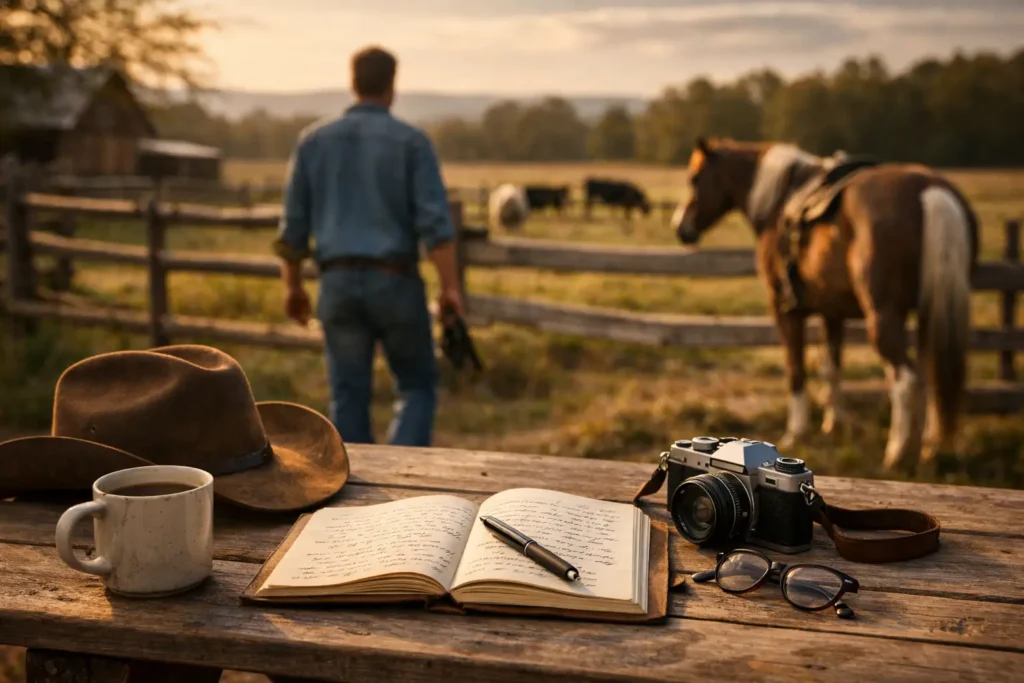
Before daylight, the coffee is already on, a gate has sagged in the night, and somebody is trying to remember which calf slipped through the north fence. That small pressure is the heart of writing believable ranch life. The setting is not a costume closet full of boots, hats, and weathered pickup trucks. It is a workplace, a home, a family history, and sometimes a source of trouble before breakfast.
Readers can spot a borrowed Western set quickly. The horses arrive on cue, every man speaks in gravelly pronouncements, and sunset conveniently lasts three chapters. Real ranch life can certainly be beautiful, but it is also repetitive, physical, expensive, and governed by things nobody can negotiate with: weather, animals, equipment, markets, and time.
For fiction, that is excellent news. Constraints create story. A ranch becomes believable when its daily demands press on the people who live there.
Start Writing Believable Ranch Life With Work
A ranch should have a reason for existing beyond giving your hero somewhere handsome to lean against a fence. Is it cattle, horses, hay, a guest operation, or a family place that has survived by adapting? The answer shapes the rhythm of every scene.
Cattle work is not simply a backdrop for a tense conversation. It affects where people stand, what they can hear, how clean they are likely to be, and how much patience they have left by evening. A character repairing fence may be preoccupied with a storm rolling in. Another may be late to dinner because a water tank quit at the far end of the property. Neither event needs to become a disaster. Their value is in the friction they add.
Give each day a practical spine. Someone checks water. Someone feeds animals. A vehicle needs fuel. A delivery is expected. A sick animal changes the plan. If your scene takes place in the barn, know why the character is there at that particular hour. A person can still fall in love, uncover a secret, or make a bad decision while doing chores. In fact, those moments often land better because the work keeps them from making speeches.
The work also prevents ranch characters from becoming symbols instead of people. A rancher may be capable, tired, funny, guarded, generous, stubborn, or all five before lunch. Competence is attractive on the page, but perfection is dull. Let a character misjudge a horse, forget a tool, lose patience, or make the practical choice that hurts someone they love.
Let Place Do More Than Look Pretty
The American West is not one setting. A high desert ranch, a Texas cattle operation, a Montana valley, and an Oregon horse property can all feel like different worlds. Elevation, rainfall, roads, distance to town, and local terrain matter as much as the color of the sky.
Specificity is more useful than a pile of regional vocabulary. Instead of announcing that a ranch is remote, show the consequences. The nearest supply store may require a long drive. Cell service may vanish in a draw. A muddy road can delay a delivery. In dry country, dust gets into hinges, floor mats, and tempers. In colder country, a broken heater is not an inconvenience to be dealt with tomorrow.
As a photographer, I learned that a location reveals itself in layers. The wide view gets attention, but the smaller evidence gives it credibility: fence posts leaning with age, a feed sack by the door, dried mud on a trailer ramp, a jacket hung where someone can grab it before heading out. Fiction works much the same way. One accurate, observed detail is worth more than a paragraph trying very hard to sound Western.
That does not mean every scene needs a catalog of objects. Choose details that interact with the emotional moment. A woman arriving at a ranch after years away may notice the porch rail her father repaired badly but never replaced. A man facing a hard decision might pause over a gate that has been patched so many times it is more repair than original wire. The setting becomes part of the character’s memory, not scenery pasted behind it.
Weather Is a Character, Not a Mood Filter
Western fiction loves a dramatic storm, and for good reason. Weather can change a plan without requiring a villain to walk through the door. But weather should affect more than the lighting.
Rain makes roads difficult, creates mud, alters chores, and can turn a simple trip into a problem. Heat changes tempers and schedules. Wind carries sound in odd ways and makes a conversation on a porch less private than it seems. Cold demands preparation, then punishes the person who assumed preparation was optional.
Use weather in proportion. A hard wind does not need to foreshadow murder. Sometimes it just blows grit into a character’s teeth while they try to finish a task. That ordinary annoyance may tell readers more about ranch life than a theatrical thunderclap.
Get the Language Right, but Don’t Perform It
Regional speech is one of the easiest places to overreach. A few natural terms can establish experience. Too many can make every page sound like it was written by a tourist with a phrasebook and a new belt buckle.
Listen for sentence rhythm rather than collecting colorful expressions. People who know one another well often speak economically, especially when work is waiting. They may use shorthand because everybody understands the situation. They may not explain every piece of equipment, every family connection, or every local custom for the benefit of the reader.
At the same time, clarity matters. If an unfamiliar term is essential, let its meaning emerge from action. A character does not need to define a chute while using it. Show what it does, what can go wrong, and why the moment matters. Readers are good at following context when the scene gives them something at stake.
Avoid treating every ranch character as a variation of the same hard-eyed cowboy. Ranches need people with different skills and viewpoints: the careful bookkeeper, the neighbor who knows every shortcut, the teenager who wants a life elsewhere, the older hand who has seen too many dry years, the outsider who notices what locals take for granted. Conflict grows naturally when those people want different things from the same land.
Research the Parts That Can Break Trust
You do not need to own a ranch before writing one. You do need enough humility to find the gaps in your knowledge. Readers forgive a fictional property layout. They are less forgiving when basic animal care, seasonal work, geography, or travel times make no sense.
Start broad, then narrow your research to the scenes you intend to write. Learn the yearly cycle of the kind of operation you have chosen. Study maps and satellite views so the distance between the house, barn, road, and town remains consistent. Read firsthand accounts. Watch for the boring details, because those are often the useful ones.
If possible, talk with people who have lived the work. Ask open questions about routines, surprises, repairs, family life, and the things outsiders routinely get wrong. Then listen. The best material may be a comment about packing extra gloves, worrying over water, or recognizing trouble from the way animals behave.
Research should support the story, not take it hostage. A reader does not need every step of a chore unless the procedure creates tension, reveals character, or changes the plot. Think of technical accuracy as the framing beneath a photograph. It holds the image steady, but it should not distract from the subject.
Make the Ranch Matter to the Plot
A believable ranch setting earns its page time by changing what characters can do. Distance can isolate them. A family operation can complicate inheritance, loyalty, romance, and resentment. A drought, a damaged fence, or a difficult sale can force a decision that had been postponed for years.
This is especially useful in romance and suspense. In a romance, shared work can reveal patience, humor, and trust more convincingly than a grand speech. In suspense, the property’s routines can make an absence noticeable. The person who always checks a certain gate does not show up. The truck is where it should not be. A familiar trail has fresh tracks after rain.
The key is restraint. Let the setting offer possibilities, then let the characters make choices. The ranch should apply pressure, not solve every problem for them.
In Dust and Inheritance, the appeal of a Western setting lies partly in that pressure: land carries memory, family obligations rarely arrive neatly labeled, and the practical demands of a place do not pause for private heartbreak. That combination gives emotional stakes something solid to stand on.
Leave Room for the Ordinary
Not every ranch scene needs a runaway horse, a violent storm, or a showdown at the property line. Quiet scenes earn the bigger ones. A meal after a long day, a drive into town for supplies, a child learning a familiar chore, or two people mending something without discussing what is broken between them can carry real weight.
Those moments also let readers feel the place rather than merely admire it. The ranch becomes believable when it has an offstage life. Someone still has to put tools away. Someone forgot to latch the chicken feed. Coffee cools on the counter while a phone rings from another room.
Write the sunsets if the scene needs one. Just make sure somebody has work to finish before dark.