
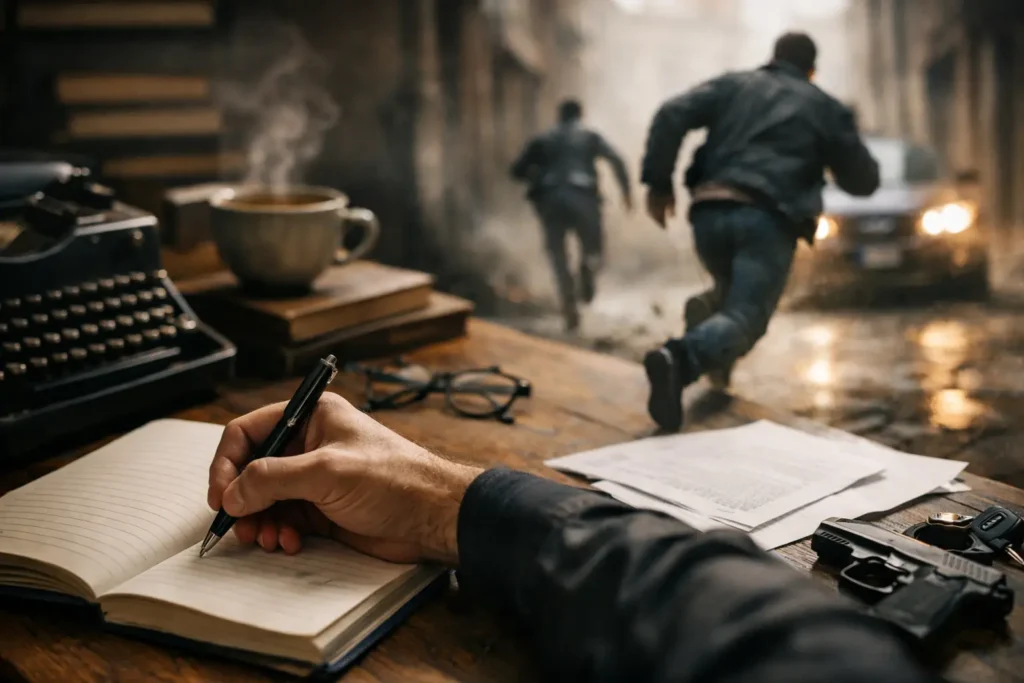
A chase scene can cover three city blocks, a muddy pasture, or the length of a crowded train platform. What matters is not the distance. It is the instant when a character realizes that standing still is no longer an option.
That is the heart of how to write chase scenes: pressure, choice, and consequence. Cars squeal, feet pound, and doors slam, but motion alone does not create suspense. Readers turn pages because someone they care about has something to lose, and because the next decision might make a bad situation worse.
I learned a version of this lesson long before I started writing fiction. As a photographer, I occasionally had one chance to catch a moment before it vanished: light changing on a street, a face in a crowd, a storm arriving faster than expected. The camera taught me to notice what is in front of me, what is behind me, and what will be gone in two seconds. Chase scenes benefit from the same attention.
Start the Chase Before Anyone Runs
A chase works best when the reader understands the threat before the action begins. Give us a reason that capture, escape, or delay matters. A character racing after a stranger with a stolen briefcase is a situation. A character racing after the stranger because the briefcase contains proof that could clear her brother’s name is a story.
The stakes do not have to involve a ticking bomb or a national crisis. In a suspense novel, a witness may be trying to reach a public place before being silenced. In a historical romance, a rancher might pursue a runaway horse carrying a frightened child. In a clean contemporary romance, the chase could be quieter: a man hurrying through an airport to stop a woman from leaving before he finally tells the truth. The energy comes from emotional cost as much as physical danger.
Before writing the scene, answer three practical questions. Who wants what? What happens if they fail? Why can’t this be solved by a phone call, a polite conversation, or waiting until morning? If the answer to the last question is vague, the scene may feel manufactured no matter how many tires you make screech.
Give Every Pursuer a Different Goal
A chase becomes flat when one person runs and another person follows for several pages. The physical direction is clear, but the dramatic direction is not.
The pursued character may be trying to escape, protect someone nearby, reach a specific location, or buy time. The pursuer may want to catch them, but perhaps not publicly. Maybe the pursuer needs an item intact, needs information, or wants to prevent an embarrassing scene. Those competing limits create opportunities for reversals.
A protagonist who simply sprints faster is not very interesting. A protagonist who has to choose between taking a shortcut and leaving an injured companion behind has a real problem. Likewise, the person chasing them should not behave like a machine with expensive shoes. Let both characters think, misjudge, adapt, and reveal themselves under stress.
This is especially useful in thrillers. The best pursuit scenes do more than move the plot from Point A to Point B. They expose character. The careful analyst discovers he can act decisively. The confident operative loses control when the plan collapses. The ordinary person who has spent a novel avoiding trouble makes one brave, inconvenient choice.
Use the Setting as an Active Obstacle
A generic alley is easy to write and easy to forget. A particular location gives a chase identity.
Instead of telling readers that a character races through downtown, choose details that affect movement. A delivery truck blocks a narrow street. Rain turns painted crosswalk lines slick. A festival crowd spills into an intersection. A hotel lobby has polished floors, too many witnesses, and a revolving door that becomes an awkward bottleneck. Now the setting is doing work.
Real locations are helpful, but accuracy should serve the story rather than handcuff it. A chase through a place you know can gain texture from small observations: the side entrance people overlook, the uneven pavement, the smell of river water near the loading docks, the way sound changes under an overpass. You do not need a travel brochure in the middle of a foot pursuit. Select two or three sharp details, then keep moving.
For scenes involving vehicles, resist the temptation to turn every road into a stunt course. Traffic, visibility, road conditions, and panic all matter, but the reader does not need a technical report. Focus on what the character can perceive and decide in the moment. A rearview mirror full of headlights can carry more tension than a paragraph of engine specifications.
Control the Reader’s Point of View
Clarity is kindness in an action scene. Readers should know where the characters are, what they are trying to do, and what changes when a plan fails. Confusion is not suspense. It is just confusion wearing a leather jacket.
Stay close to the viewpoint character’s experience. If she is running through a warehouse, let us feel the cold concrete under her shoes, hear the distant metal rattle, and see the exit sign that may or may not lead outside. Do not suddenly report what the pursuer is thinking unless your chosen point of view allows it.
Sentence length can help set the pace, but it is not a magic switch. Short sentences create urgency when used at the right moment. They lose their power if every line arrives in the same clipped rhythm. Mix brief beats with occasional longer sentences that orient the reader or deliver a decision.
For example: “He cleared the stairwell and hit the landing hard. Below him, the lobby doors flashed with afternoon light. If he reached them first, he could disappear into the crowd. If he missed, there was nowhere else to go.” The action is fast, but the reader knows why those doors matter.
Build the Scene in Turns, Not a Straight Line
The most effective chase scenes change shape. A good plan fails. A small advantage appears. A shortcut becomes a trap. The pursued character thinks help has arrived, then realizes the situation is worse.
You do not need a twist every other paragraph. Too many surprises can make a scene feel like a pinball machine. But a chase should evolve. Divide it mentally into beats: the initial break, the first obstacle, a shift in advantage, a costly choice, and an ending that changes the larger story.
That ending matters. A chase should not fade out because everyone is tired. Someone gets away, someone is caught, an object changes hands, a secret is exposed, or a character sees something that alters the next chapter. Even an unsuccessful pursuit can create a meaningful result. Perhaps the protagonist loses the suspect but notices a detail that points toward a new location. Failure is still movement when it changes the game.
Let Consequences Catch Up
People do not walk away from a hard chase and immediately deliver polished speeches. Give characters a moment afterward to breathe, assess damage, and deal with what the scene cost them.
The cost may be physical, but emotional consequences are often more lasting. A detective who abandons a lead to save a bystander may be right, yet frustrated. A woman who escapes may realize she has involved someone she loves. A man who catches his target may discover that the target was trying to protect him.
These quieter seconds also make the next burst of action stronger. Constant speed becomes monotone. Suspense needs contrast, the same way a photograph needs shadow as well as light.
Revise for Cause and Effect
On a revision pass, trace each action through the scene. One decision should cause the next complication. If a character turns left simply because the author needs them near a construction site, readers may not name the problem, but they will feel it.
Look for convenient rescues, obstacles that appear from nowhere, and characters who forget abilities or injuries when the plot needs a boost. Coincidence can start trouble. It rarely makes a satisfying finish.
Then read the scene aloud. If you stumble over a sentence, your reader may stumble too. If you cannot picture where everyone is standing, running, or turning, add one clean detail rather than three paragraphs of explanation.
The chase scene is not really about speed. It is about a character under pressure, moving through a world that refuses to cooperate. Get that right, and even a run across a quiet parking lot can make a reader lean closer to the page. For more behind-the-scenes thoughts on suspense, character, and the stories that grow from real places, the newsletter is a good place to keep in touch.