
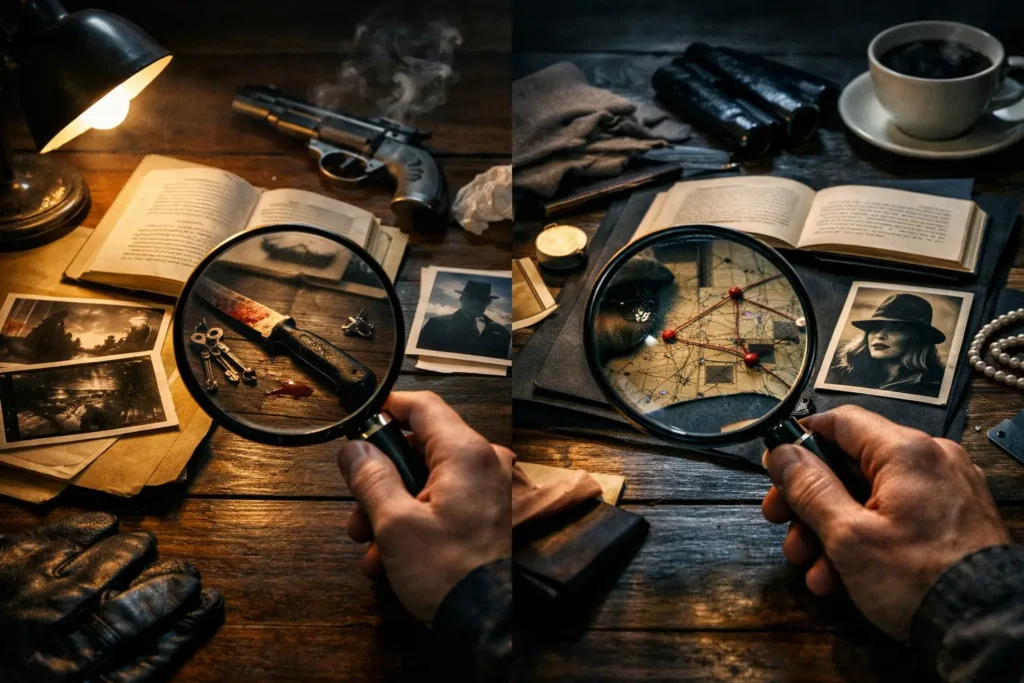
A body in a locked room and a stranger running through an airport can both keep a reader awake past a sensible bedtime. Yet they promise different pleasures. A useful thriller mystery comparison starts with that difference: mystery fiction invites us to solve something, while thriller fiction puts us close enough to the danger to feel the heat from it.
The categories overlap so often that bookstores, publishers, and readers regularly use the terms together. That is not wrong. It just leaves out the interesting part. A mystery and a thriller may both contain secrets, crimes, false leads, and a final turn of the screw. What changes is the question at the center of the story and the speed at which the answer must arrive.
Thriller Mystery Comparison: The Question Driving the Story
A traditional mystery usually begins with a disruption that has already happened. Someone has disappeared. A valuable object is gone. A death makes no sense. The reader follows an investigator, professional or otherwise, as the facts are gathered and the pattern begins to emerge.
The main question is often: What happened, and who did it?
A thriller is more likely to begin with an active threat. A witness is being followed. A routine assignment becomes dangerous. A person discovers information that powerful people would prefer to keep buried. The clock begins early, and the character may not have the luxury of working through every clue over a quiet cup of coffee.
Its central question is usually: Can the protagonist stop this before something worse happens?
That distinction sounds neat on paper, but good stories are rarely so tidy. A mystery can have a chase, and a thriller can conceal the identity or motive of its antagonist. The best cross-genre novels use both engines. They give readers a problem to solve and a reason to turn the page before midnight becomes 2:00 a.m.
Pace Is More Than Fast Chapters
Readers often describe thrillers as fast-paced and mysteries as deliberate. That is generally true, but pace is not simply a matter of short chapters or frequent explosions. A quiet scene can be tense if the character is about to make a costly mistake. A chase can feel surprisingly slow if it does not change the story.
In a mystery, the pace often comes from discovery. Each clue narrows the field, overturns an assumption, or reveals that a trusted character has been holding back. The reader is invited to notice details. A muddy boot print, a missed phone call, or a photograph hanging crookedly on a wall may matter more than it first appears.
In a thriller, pace comes from consequence. A choice made in one chapter creates a problem in the next. The protagonist may have incomplete information, limited time, and no obvious person to trust. The reader does not need every answer immediately because the immediate danger is already doing its job.
My years behind a camera made me appreciate how much tension can live in a detail. Photographers learn to look at the edges of the frame, not only at the obvious subject. A thriller often works the same way. The person in the background, the reflection in a window, or the image that was never supposed to be captured may be more important than the person standing front and center. A true story, mostly, allegedly. Don’t check the metadata.
The Role of the Protagonist
Mystery protagonists tend to move toward the truth. They ask questions, compare accounts, and pay attention when something does not fit. They may be detectives, journalists, historians, attorneys, shop owners, or ordinary people pulled into an unsettling event. What matters is their willingness to keep looking.
Thriller protagonists often move away from danger, then discover that danger has learned their address. They may have useful skills, but a convincing thriller does not require a superhero. In fact, ordinary competence can be more suspenseful than perfection. Someone who knows how to read a room, navigate an unfamiliar city, or recognize a questionable photograph may survive because of experience, not because the plot handed them a cape.
That difference shapes the emotional experience. Mysteries reward curiosity and deduction. Thrillers emphasize vulnerability, momentum, and difficult decisions. A reader who enjoys piecing together motives may prefer a clue-rich mystery. A reader who wants an escalating situation and a character under pressure may reach for a thriller.
Of course, many of us want both. We want to know why the danger started, who is behind it, and whether the person caught in the middle can get home in one piece.
Clues, Suspense, and What the Reader Knows
A mystery often plays fair with information. The writer can misdirect the reader, but the solution should feel possible in hindsight. When the detective names the culprit, the reader should be able to look back and see the trail, even if it was cleverly disguised.
That is why mystery readers can be wonderfully demanding. They notice timelines. They remember who had access to the study. They are not fooled merely because a character says, “I was asleep.” Frankly, they have heard that one before.
Thrillers may reveal the danger before the protagonist understands it. The reader sees a threat approaching while the character is focused on the wrong problem. This creates suspense in its purest form: knowledge with nowhere to go. The reader wants to warn the character, but turning pages is the only available method.
A mystery withholds answers. a thriller often supplies a frightening answer and then asks whether it can be prevented. The blended story alternates between both. It allows readers to worry about what is happening while trying to understand why.
Setting Does Different Work in Each Genre
Setting is not wallpaper. In a mystery, a setting can create a closed circle of suspects: a small town, an isolated lodge, a family business, or a tight professional community where everybody knows something and nobody tells the whole truth.
In a thriller, setting can become an obstacle course. An unfamiliar airport, a crowded city street, a remote highway, or a hotel with too many entrances can add pressure without needing excessive spectacle. Real locations help because readers understand the practical problems. Where can the character go? Who can they trust? How quickly can a safe place become unsafe?
Believable details matter most when they serve the story. A city should not become a travel brochure, and technical knowledge should not turn into a lecture. A few accurate observations can make a scene feel lived in. The rest should keep moving.
Which One Should You Read Next?
Choose a mystery when you want the satisfaction of gathering pieces, weighing motives, and arriving at a solution that changes the meaning of what came before. Choose a thriller when you want urgency, rising stakes, and a protagonist forced to act before the situation closes in.
Choose a thriller-mystery blend when the ideal evening includes both a dangerous situation and a secret worth uncovering. That combination is especially satisfying because the plot can work on two levels. The character must survive the immediate problem, but survival alone is not enough. The truth still has to be found.
Readers do not need to pledge loyalty to one shelf. Some nights call for a patient investigation. Others call for a story that grabs the collar in chapter one and does not let go. The pleasure is in recognizing what kind of tension you are hungry for, then finding the book that delivers it honestly.
If your preference runs toward authentic settings, secrets caught in plain sight, and suspense with a human pulse, there is always another story waiting just beyond the next page.