
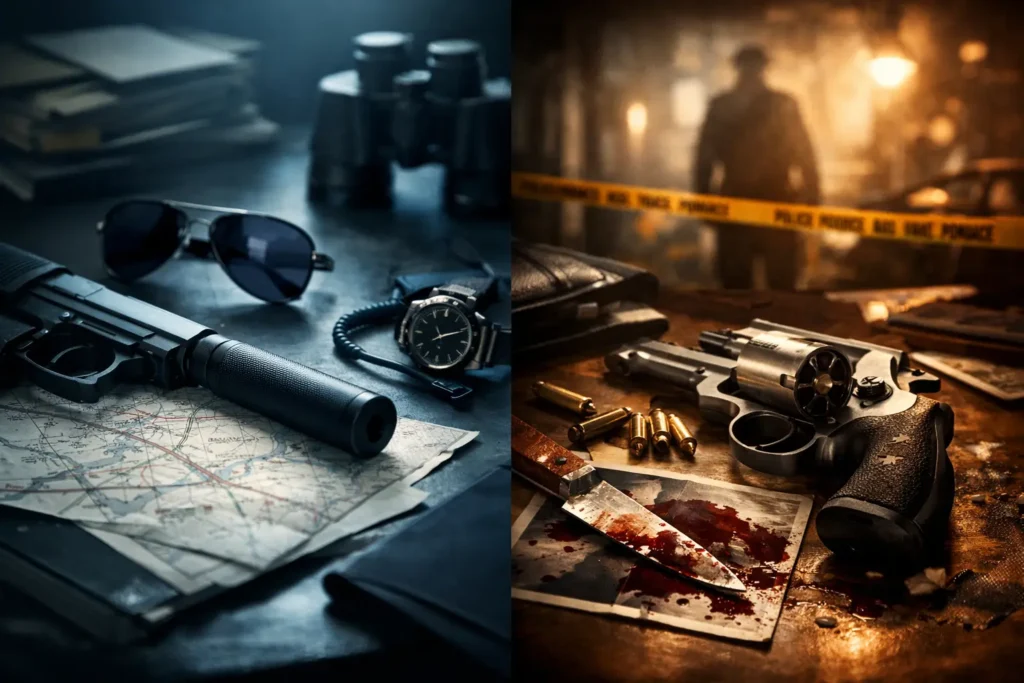
A locked hotel room, a missing file, and a stranger who knows far too much can belong to either genre. That overlap is why spy fiction versus crime fiction is often treated as a minor shelving decision. It is not. The two forms of suspense ask different questions, move at different speeds, and put their characters under very different kinds of pressure.
Crime fiction usually begins close to the wound: a body, a theft, a disappearance, a lie that has finally become too expensive to keep. Spy fiction may begin there too, but the trouble tends to widen quickly. One person’s secret can become a threat to an organization, a country, or a network of people who would prefer to remain invisible.
Both genres can deliver a fine late-night reading problem, the kind that makes a sensible person say, “Just one more chapter,” and then discover the coffee machine has become relevant. But their engines are built differently.
Spy Fiction Versus Crime Fiction: The Central Difference
Crime fiction is often about restoring order. Something has gone wrong in a recognizable community, and someone must determine what happened, who benefited, and what truth has been buried. The investigator may be a detective, a journalist, a lawyer, a private citizen, or simply the person who cannot leave the mystery alone.
The crime itself matters, but so does its human fallout. A good mystery makes the reader feel the missing person’s absence at the dinner table, in a family business, or among neighbors who suddenly remember different versions of the same evening. The stakes can be enormous, yet they are frequently personal before they are public.
Spy fiction is more likely to begin with compromised trust. An intelligence officer receives bad information. A courier does not arrive. An old friend may be working for the other side. Documents, photographs, travel records, and carefully managed identities carry consequences beyond the people holding them.
That does not mean spy stories are automatically bigger or better. A small, tense espionage novel set in one city can feel more dangerous than a crime novel involving a national scandal. The distinction is not the number of passports, gadgets, or shadowy hallways. It is the source of the pressure. Crime fiction asks who crossed a line. Spy fiction asks who drew the line, who moved it, and who can still be trusted after it disappears.
The Shape of the Mystery
A traditional crime story often gives readers a puzzle with a center. Evidence accumulates. Alibis crack. A detail that seemed ordinary in chapter three becomes very interesting in chapter twenty-seven. The pleasure comes from following a trail and seeing the pattern before, or at least alongside, the investigator.
Spy fiction can use that same structure, but it frequently trades a clean puzzle for uncertainty. The protagonist may not know which information is true, which ally is compromised, or whether the mission itself has been designed to fail. Readers are not merely looking for the culprit. They are trying to understand the board while the pieces are moving.
That creates different rhythms. Crime fiction often tightens as facts become clearer. Spy fiction may tighten because the facts become less reliable. A character who thinks he has solved the problem may have only identified the first layer of it.
For writers, this difference is more than a plotting trick. In crime fiction, clues should feel fair even when they are difficult to interpret. In spy fiction, ambiguity can be part of the atmosphere, but it still needs rules. Readers will follow misdirection gladly. They will not enjoy feeling that the author simply changed the answer behind the curtain.
Heroes With Different Jobs
The crime-fiction hero is commonly defined by persistence. He keeps asking questions after everyone else wants the questions to stop. That character may have authority, but authority is not required. Some of the most compelling crime protagonists are outsiders because they notice what insiders have learned to ignore.
The spy-fiction protagonist lives with a different burden. Secrecy is not an obstacle to the job. It is often the job. That can make ordinary relationships difficult. A detective may have trouble getting a witness to talk. A spy may have trouble telling a friend where he has been, why he missed dinner, or why a familiar face at the airport makes his expression change.
This is one reason espionage stories often carry a particular emotional loneliness. The hero cannot always explain the danger, ask for help, or trust the person standing beside him. Even success may require a compromise that leaves no one cheering.
Still, the genres borrow freely from each other. A crime investigator can be isolated and morally bruised. A spy can be driven by a very personal loss. The most memorable characters are not defined by their job title anyway. They are defined by what they will risk, what they refuse to become, and the cost of being wrong.
Setting Does More Than Provide Scenery
Crime fiction often gains strength from a specific place. A courthouse town, a rain-soaked city neighborhood, a ranch community, or a beach resort in the off-season can create its own social map. People know each other’s business, or think they do. The setting helps explain what can be hidden and what cannot.
Spy fiction tends to use location as pressure. Airports, border crossings, hotels, embassies, train stations, and unfamiliar streets are not merely scenic backdrops. They put characters in motion and deny them the comfort of home ground. A city can look beautiful in a photograph and still feel unsettling when a character does not know which door leads to safety.
Years behind a camera taught me that real places have useful imperfections. Light changes. Streets are louder than expected. A building that looked grand from a distance has a service entrance, chipped paint, and a tired security guard drinking bad coffee. Those details matter in any suspense novel because they make the tension feel lived in rather than assembled from a brochure.
In a story such as Double Exposure, photography can also become part of the suspense language. An image records what was in front of the lens, but it does not automatically explain what the photographer saw, missed, or misunderstood. That gap between appearance and truth belongs comfortably in both crime and spy fiction.
Why Readers Often Love Both
Readers who enjoy crime fiction usually appreciate the satisfaction of discovery. Readers who enjoy spy fiction often savor tension, shifting loyalties, and the sense that the visible story is only part of the story. Put those tastes together, and the overlap makes perfect sense.
Both genres reward attention. And both rely on stakes that feel human, even when the plot reaches far beyond an ordinary life. Also both can offer danger without requiring nonstop action. A quiet conversation can carry as much suspense as a chase if one person knows something the other does not.
The choice between them may come down to mood. Pick crime fiction when a carefully constructed mystery, a local secret, or the pursuit of justice sounds appealing. Pick spy fiction when you want false identities, divided loyalties, international shadows, and the uneasy feeling that every answer has created a new question.
Of course, plenty of novels refuse to choose. A murder investigation can uncover an intelligence operation. A spy can find that the mission has become a personal crime story. Genre labels are useful signposts, not handcuffs. The best books know what promise they are making, then find a fresh way to keep it.
The next time a story opens with a missing person, an incriminating photograph, or a stranger carrying the wrong name, pay attention to where the tension leads. If the trail narrows toward a truth someone wants hidden, you may be in crime fiction. If it keeps expanding until trust itself becomes the mystery, you are probably in spy territory. Either way, keep the coffee warm.