
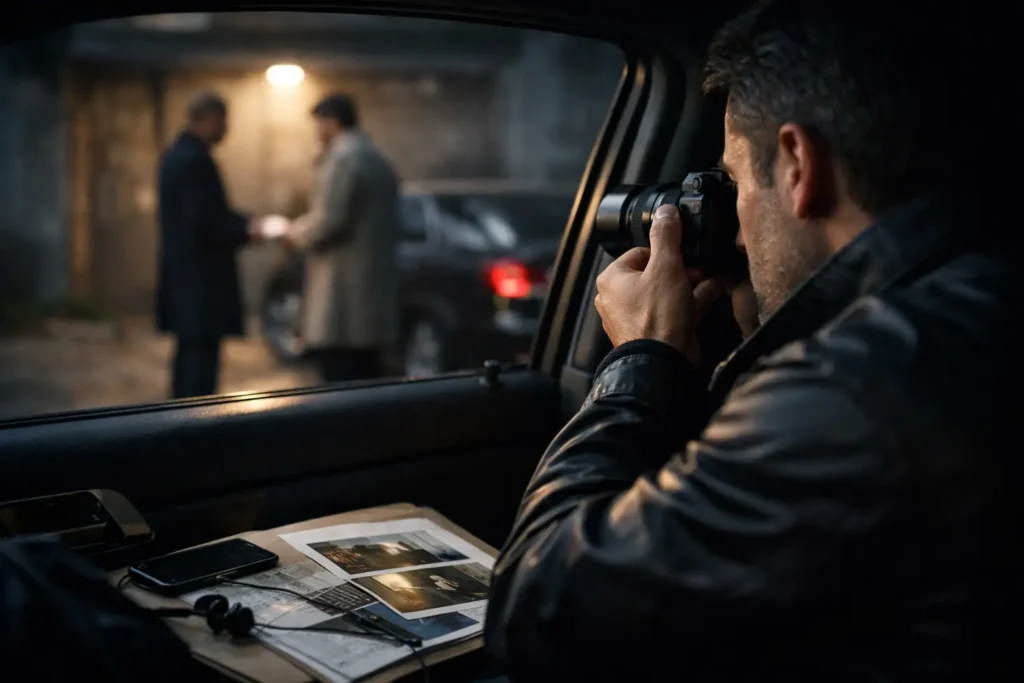
A camera bag can attract attention in the wrong place. So can a person who looks as if he is trying too hard not to attract attention. After decades spent working as a photographer, traveling with equipment and watching how people move through airports, hotels, streets, and guarded doors, I’ve learned that suspense rarely arrives with a flashing sign. It begins with a detail that doesn’t quite fit. That is one reason realistic espionage fiction stays with readers.
The best spy stories may include false identities, confidential files, and people with troublingly calm voices. But their real power comes from something quieter: the sense that ordinary life is only one bad decision away from becoming dangerous. A character misses a train, notices a familiar face in an unfamiliar city, or realizes that a photograph contains more than it should. Suddenly, the story has traction.
Realistic Espionage Fiction Starts With Human Stakes
Fictional espionage can become a parade of impossible gadgets, bulletproof heroes, and villains who explain everything before they disappear through a secret wall. That can be entertaining in its own right. Sometimes a reader wants the fireworks, the fast cars, and the improbable escape with the perfectly timed explosion in the background.
Realism asks for a different kind of tension. It asks what a person stands to lose before the chase begins.
A convincing protagonist may have training, instincts, or specialized knowledge, but he should also have limits. Fatigue matters. Fear matters. A bruised hand can make a simple task difficult. A worried spouse, an old friend, a damaged reputation, or a promise made years ago can matter more than the fate-of-the-world speech.
That does not make a thriller smaller. It makes the danger legible. Readers understand why a character keeps moving when stopping would be safer. They recognize the cost of withholding the truth from someone they love. The tension becomes personal before it becomes international.
In a believable espionage story, nobody needs to be foolish just to keep the plot alive. People make mistakes because they are rushed, loyal, frightened, proud, or working with incomplete information. Those are the mistakes readers recognize from real life, even if their own workday has not involved a cryptic message or a suspicious suitcase.
The Details Do the Heavy Lifting
Authenticity is often less about knowing every acronym than noticing what a location feels like at a particular hour.
A hotel lobby has a rhythm. Guests arrive with luggage, staff members look up and then return to their work, and someone near the elevator may seem perfectly ordinary until that person appears again three blocks away. An airport is full of people who are tired, distracted, late, and trying to remember where they put their boarding pass. Those settings already contain tension. A writer does not need to decorate every corner with a spy in dark glasses.
Photography taught me to pay attention to light, movement, and what falls outside the frame. A photograph may show a subject clearly while hiding the context that gives the image meaning. Fiction works much the same way. The important clue is not always the obvious object in the center of the scene. It may be the reflection in a window, a closed shop on a busy street, or the fact that someone knows a little too much about a person they have just met.
Research helps, of course. Real places have physical logic. Streets lead somewhere. Weather affects travel. Security procedures can slow people down. A busy public space can be both anonymous and intensely exposed. Getting these basics right earns reader trust.
Still, research should support the story rather than march across the page wearing a name tag. A character can know a great deal without delivering a lecture to a companion who presumably has access to the same briefing. The writer’s job is to select the telling detail, then move on before the reader starts checking the exits.
Why Technology Should Create Problems, Not Solve Them
Technology has changed the texture of suspense. Phones track locations, cameras watch entrances, messages travel instantly, and nearly everyone carries a device that can record a moment before anyone has time to object. This gives writers useful pressure, but it can also make plots too convenient.
If every question is answered by a quick search, the story loses air. If every obstacle is resolved by a mysterious app, it loses credibility. Realistic espionage fiction treats technology as a complication as often as a solution.
A phone can be useful, but it can also die at the wrong moment, provide misleading information, or make a character visible when invisibility would be better. Digital evidence can reveal a pattern, yet it can lack the human context needed to interpret it. A grainy image may prove that someone was present, but not why.
The most compelling stories remember that people are still the weak link and the saving grace. Trust is hard to verify. A source may be honest but wrong. A friend may conceal information for protective reasons. A photograph may be authentic and still tell only half the truth.
That tension between evidence and interpretation gives an espionage novel room to breathe. It also keeps the plot from becoming a contest between fictional supercomputers.
Realistic Espionage Fiction Needs Consequences
The cleanest way to tell if a spy story has weight is to look at what happens after the exciting scene.
A narrow escape should leave more than a torn sleeve. It may cost a character a relationship, expose a private weakness, force an ally into danger, or make returning home impossible in the way it once was. Even a successful operation can create a mess that does not vanish when the final page approaches.
Consequences are not punishment for their own sake. They give action meaning. If a protagonist can take enormous risks without physical, emotional, or moral cost, the reader eventually stops worrying. The character has become a magician, and the writer has hidden a trapdoor beneath every difficult moment.
The trade-off is balance. Too much aftermath can stall a fast-paced book, while too little makes the danger feel weightless. The answer depends on the story. A globe-spanning thriller may need sharp, economical moments of reflection. A psychological suspense novel may linger longer on the damage caused by deception. In both cases, the characters should carry the past into the next scene.
That is how a reader feels the pressure. Not through a larger explosion, but through the knowledge that even the right choice can leave a mark.
The Ordinary Person Makes the Best Entry Point
Career intelligence officers can make excellent protagonists, particularly when their knowledge creates as many burdens as advantages. Yet there is a special tension in watching an ordinary person stumble into an extraordinary problem.
A photographer, translator, archivist, business traveler, or person searching for an old friend may notice something others overlook. Their expertise gives them a credible reason to act, but it does not make them invincible. They may understand pictures, languages, schedules, or people, while knowing very little about the dangerous game unfolding around them.
That gap creates suspense naturally. The reader learns alongside the character, one careful piece at a time. It also allows the story to ask a more interesting question than, “Can the expert complete the mission?” The question becomes, “How much of an ordinary life can this person save after learning the truth?”
There is room for humor here, too. Anyone who has traveled knows that the grandest plans can be defeated by a delayed flight, a dead battery, or a hotel key card that refuses to cooperate. Small frustrations make extraordinary circumstances feel grounded. They remind us that even the coolest character in the room may still be looking for the correct charging cable.
Believability Is a Promise to the Reader
A realistic spy novel does not need to reproduce classified work, and it should not pretend to. The goal is not a manual. It is a promise that the story understands how uncertainty feels.
Good espionage fiction respects the reader’s intelligence. It offers clues without waving a flag over them. It gives characters reasons for their choices. It makes settings feel inhabited rather than borrowed from a brochure. Most of all, it remembers that secrets are dangerous not because they are glamorous, but because they change the lives of people forced to carry them.
That is the kind of suspense worth building: a shadow at the edge of a familiar photograph, a detail that refuses to stay quiet, and a character who has just enough time to realize the picture is larger than it first appeared.