
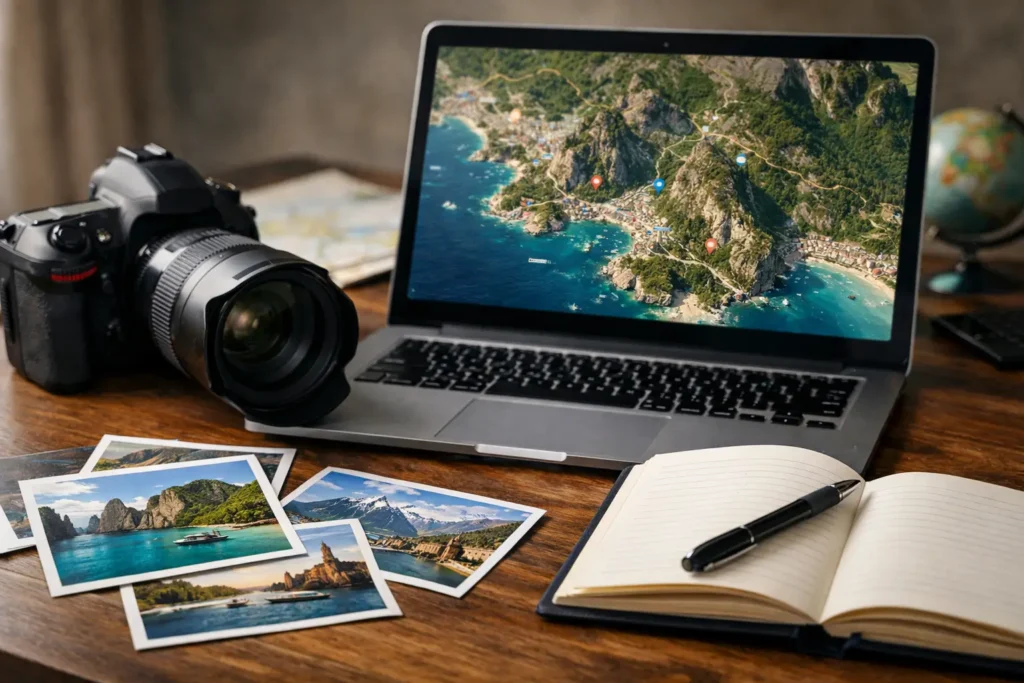
A location can look perfect on a screen and disappoint before the camera comes out of the bag. The mountains may face the wrong direction at sunrise. The waterfront may be fenced off. The charming alley may contain three dumpsters, a delivery truck, and a souvenir shop selling plastic swords. That is why how photographers research travel locations is less about finding pretty places and more about learning how a place actually behaves.
After more than forty years behind a camera, I’ve learned that the first photograph is usually taken long before arrival. It happens during the quiet work: studying maps, looking at angles, checking the season, and asking whether the scene supports the story you hope to tell. A camera records what is there. Research helps you recognize what matters.
How Photographers Research Travel Locations Before Booking
Good location research begins with a purpose. A landscape photographer may be searching for side light on sandstone. A travel photographer may need the first rush of commuters on a city street. An author gathering material for a thriller may need to know how long it takes to walk from a hotel lobby to a ferry terminal, and what a character would smell along the way.
Those are different assignments, so they require different questions. “Is this place photogenic?” is a start, but it is not much of a plan. A better question is: What do I need this location to do?
For photography, the answer might be to provide a clean sunrise composition, human activity, weather drama, or a sense of scale. For fiction, it may be a believable meeting place, an escape route that feels plausible without becoming a technical manual, or a setting that reveals something about a character. A polished office building says one thing. The same character waiting in a dim diner beside a highway says another.
Once the purpose is clear, maps are often the first useful tool. They reveal distance, elevation, roads, footpaths, bodies of water, nearby neighborhoods, and the general shape of a place. Satellite views can be especially humbling. That isolated overlook in a beautiful online photo may sit beside a large parking lot. Sometimes that is a problem. Sometimes the parking lot is simply where you leave the car before walking to the good view.
Street-level imagery, when available, adds another layer. It can show building height, sidewalk width, storefronts, utility poles, tree cover, and the small visual clutter that maps politely ignore. I look for the direction a street runs, the likely view at an intersection, and whether a landmark is truly visible from the angle I have in mind.
Light Is a Location’s Personality
A photographer does not merely visit a place. He visits it at a particular hour, in a particular season, under a particular sky. Change any one of those variables and the location may become a different character entirely.
Before a trip, I want to know where the sun rises and sets in relation to the subject. A church façade that glows warmly late in the day may be flat and forgettable at noon. A canyon that appears open and inviting in summer may stay in deep shadow during a winter morning. Coastal locations bring another consideration: tides. A stretch of beach can gain or lose much of its visual interest as the water moves.
Weather deserves the same attention. Forecasts are not promises, especially in mountains, deserts, and near water. Still, seasonal patterns provide useful expectations. Fog, rain, snow, wind, dry grass, autumn color, and spring crowds all affect the frame. They also affect the notes a novelist takes home.
The most dramatic light is not always the best light. A gray morning can be excellent for photographing old brick, forests, markets, and reflective streets. Overcast skies soften contrast and allow color to carry the image. Bright sun is useful when you need graphic shadows, strong texture, or a hard-edged Western feel. The trick is to match the conditions to the subject rather than declaring one kind of weather superior.
Online Images Are Clues, Not Evidence
Photo-sharing sites, tourism galleries, and social media posts can help identify viewpoints and seasons. They can also lie without intending to. An image may be years old, heavily edited, taken during an unusual weather event, or made with a lens that compresses distance until a modest hill looks like the final scene of an adventure movie.
I treat online photographs as clues. If several images show the same scene from roughly the same angle, that angle is probably accessible. If every photograph crops tightly around one picturesque doorway, the rest of the street may be less cooperative. Comments and captions can reveal practical details, but they should be verified through current official information or a direct call to the property, park, or local business involved.
The goal is not to reproduce someone else’s photograph. That is a quick way to come home with a version of an image already made thousands of times. The goal is to understand the ingredients: direction of light, time of year, weather, elevation, and lens choice. Then you can arrive prepared to see your own picture.
The Research That Happens on Foot
No amount of advance planning replaces showing up early and walking slowly. The first visit is reconnaissance. I leave the camera ready but do not feel compelled to make a masterpiece immediately. I watch where people pause, where shadows fall, which doors open, and how the sounds change from one block to the next.
This is where the useful details live. The bell above a café door. The warm smell of bread at seven in the morning. A train passing behind old warehouses. A faded sign painted directly on brick. None of these details may become the main subject of a photograph, but together they give a location its pulse.
For writers, this is the difference between placing a character in a generic coastal town and placing one on a sloping street where gulls argue over a paper bag while a ferry horn shakes the windows. Specificity does not require pages of description. Often, one accurate detail does more work than a paragraph of scenery.
I keep notes in plain language. Rather than writing “atmospheric commercial district,” I might write, “Narrow sidewalk, rainwater running along curb, bakery window fogged from inside, buses loud enough to interrupt conversation.” Those notes are useful months later because they preserve an impression, not just a fact.
Access, Courtesy, and the Backup Plan
A fine location is only useful if you can photograph it responsibly. Public access, opening hours, seasonal closures, construction, private property, event schedules, and local rules can change without much warning. Checking ahead saves frustration and prevents the awkward performance of acting surprised when a clearly posted sign says not to enter.
Courtesy is part of the craft. Ask permission when appropriate, respect posted boundaries, avoid blocking doorways or walkways, and remember that residents are not background props. A small town, historic site, or working business is somebody’s everyday life, not a film set built for our convenience.
Every research plan also needs a backup. Weather changes. Roads close. A favorite viewpoint becomes crowded. The backup does not have to be glamorous. It may be a covered arcade during rain, a nearby neighborhood with interesting architecture, or an indoor location where you can study details and wait for conditions to improve. Some of my better travel photographs began as Plan B, which is a polite name for admitting the sky had other ideas.
Bringing the Place Home
The best location research continues after the trip. Download and organize photographs while memories are still fresh. Label folders with the place and date, but also add useful terms such as “rainy alley,” “river at dusk,” or “hotel lobby details.” A photograph of a street sign may seem dull at the time. Six months later, it can rescue a scene from a wrong turn.
Review the frames that did not work. They often teach more than the successful ones. Was the light wrong? Did you arrive too late? Was the lens too wide to show the relationship you wanted? Did the place feel different than the online images suggested? Those answers improve the next trip.
For fiction, the work becomes a form of selective memory. A novel does not need a travel diary. It needs the right details in the right moment. A location can be compressed, rearranged, or combined with another as long as its emotional truth remains intact. Readers may never stand on that exact corner, but they can tell when the author has noticed how the pavement slopes underfoot.
That is the reward for doing the homework. You return with more than pretty pictures or a list of landmarks. You return with a place that has weight, weather, sound, and a few useful secrets. Those are the details that stay with a reader long after the suitcase has been put away.