
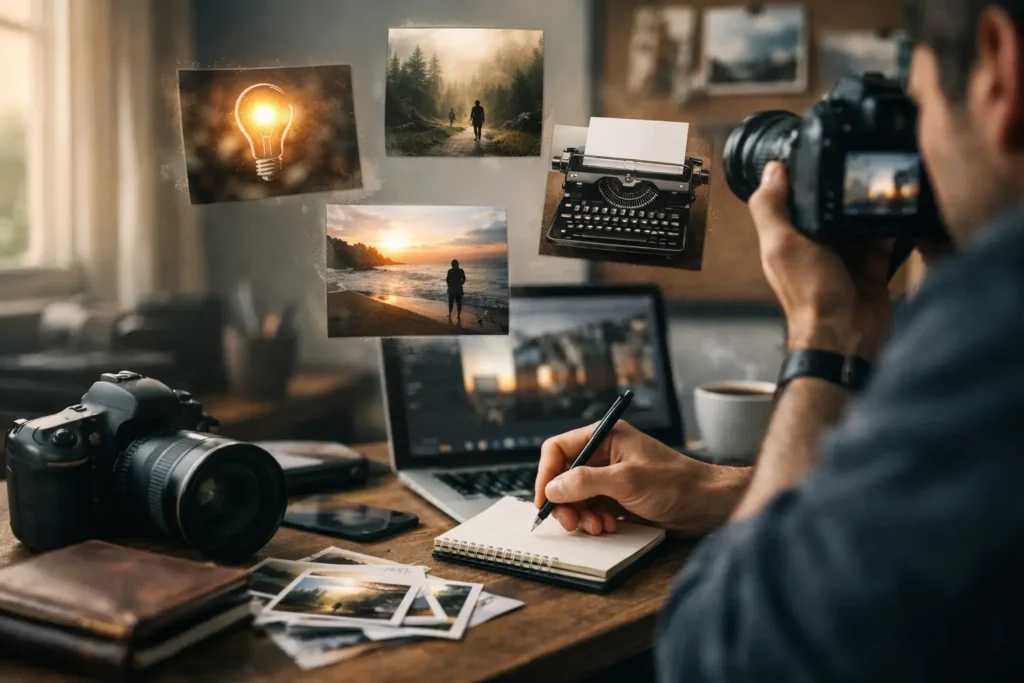
A photographer can stand on an ordinary street corner and come home with more than a folder of images. There might be a rain-darkened motel sign, a man waiting beside a pay phone that probably no longer works, or a woman in cowboy boots carrying flowers into a courthouse. Those fragments have weight. How photographers capture story ideas often begins there: paying attention long enough to notice that a scene has a question tucked inside it.
For more than forty years behind a camera, I learned that the most useful moments rarely announce themselves. They appear between assignments, on the walk back to the car, or while waiting for light to improve. A photograph records what was visible. A story starts asking what happened just before the shutter clicked, and what might happen after.
How Photographers Capture Story Ideas in Plain Sight
Photography trains the eye to separate the ordinary from the specific. A parking lot is ordinary. A parking lot behind a closed restaurant at 5:40 a.m., with one luxury sedan parked beneath a flickering security light, is specific. Specificity creates tension because it gives the mind something solid to examine.
The camera also teaches restraint. When photographing a scene, you cannot include every billboard, passing car, and cloud. You choose what belongs inside the frame and let the rest fall away. Fiction works much the same way. A reader does not need a catalog of every object in a room. They need the cracked family photograph on the desk, the dust on the window ledge, or the suitcase that has not been unpacked.
This is not a call to turn strangers into characters without care. The people encountered in real life are not props. A gesture, location, or overheard rhythm of conversation can suggest a fictional possibility, but the character should grow into someone new. Give them their own motives, history, choices, and surprises. Real life supplies the spark. Imagination builds the fire.
Look for the unanswered detail
A good photograph is often built around an unanswered detail. Why is that child looking away from the parade? Also why does the old ranch house have one upstairs window lit at noon? And why is a polished shoe print on a dusty warehouse floor?
The question matters more than an immediate answer. Writers can be too eager to solve the mystery before the story has had a chance to breathe. A working notebook filled with small, unresolved observations is more valuable than a notebook filled with plots that have already gone stale.
I have found that a useful story note is usually brief: “Desert gas station. Wedding ring under the register.” That is enough. Months later, the note may become a suspense scene, a romance complication, or nothing at all. Not every frame deserves a gallery wall, and not every observation deserves a novel. The habit of collecting them is what counts.
Light Changes the Meaning of a Scene
Photographers think about light because light decides the mood before anyone has read a caption. Late afternoon can make an abandoned road feel hopeful. The same road under a hard white noon sun can feel exposed and unforgiving. Fog softens a city block, while fluorescent light can make a hospital corridor feel cold even when the walls are freshly painted.
Writers have access to that same tool. Rather than telling readers a character feels uneasy, place them in a room where the blinds are drawn against bright daylight and the only illumination comes from a television with the sound muted. The setting carries part of the emotion.
There is a trade-off here. Too much atmospheric description slows a fast scene to a crawl. In a thriller, a sentence or two may be enough to establish the visual stakes before the character has to act. In a historical romance, the same setting may deserve a little more room because the place helps carry the reader into another time. Pace determines how long the lens stays open.
Color can carry meaning, too, though it need not become a secret code. The red dust on boots, a blue porch swing, a yellow motel receipt folded into a wallet: these details give a scene visual memory. Readers may not consciously recall every shade, but they remember how the place felt.
Locations Are More Than Backdrops
A photographer learns quickly that a location has a personality. Two blocks can look entirely different depending on who passes through them, what has been left behind, and what the weather has done to the buildings. The same is true on a ranch road, in an airport, or in a small-town diner just before closing.
The best story locations create pressure. A crowded terminal limits privacy. An isolated highway removes easy help. A family-owned store forces two people with unfinished business to keep crossing paths. None of that requires a villain lurking behind every door. Sometimes the obstacle is simply distance, obligation, weather, or a place that refuses to let a character remain anonymous.
Experience helps, but it is not the only route to authenticity. A camera encourages a person to study a place carefully: the direction of traffic, the sounds at different hours, the wear on a handrail, the type of shoes people wear there. Those details can be gathered through responsible observation, personal travel, old photographs, maps, and conversations. The goal is not to show off research. It is to keep the setting from feeling like cardboard painted to resemble a city.
A location can also hand you a plot turn. A hotel lobby has strangers, luggage, departures, and the uneasy fact that everyone assumes someone else is paying attention. A county fair has noise, crowds, family history, and plenty of places for a private conversation to go wrong. The story idea is not “set a scene at a county fair.” It is “what could only happen at this county fair, on this particular night?”
People Reveal Stories in Small Motions
Portrait photography depends on patience. A posed smile tells you very little. The moment after the smile fades can tell you much more. People adjust a cuff, protect a coffee cup with both hands, glance toward a door, or straighten up when a particular name is mentioned. Those small actions suggest inner weather.
For fiction, behavior is usually more convincing than explanation. Instead of writing that a man misses his late father, show him stopping at a hardware store because he cannot pass the brand of work gloves his father wore. Instead of announcing that a woman is guarded, let her answer every personal question with a practical question of her own.
That does not mean every character needs a mysterious stare and a tragic object in their pocket. Real people are often funny, distracted, stubborn, generous, and inconsistent. A tense scene becomes more believable when someone has to deal with a squeaky cart wheel, a bad cup of coffee, or a call from a relative at precisely the wrong time. Life does not pause to improve the lighting.
Carry a Notebook, Not a Net
The camera in a phone makes it easy to collect visual references, but the best story tool may still be a small notebook or a notes app used with intention. Write down sensory details the camera cannot capture: the warm smell of sun on old wood, the way a crowded room goes quiet for half a beat, the phrase a tired cashier repeats to every customer.
Avoid trying to document everything. That approach turns a walk through town into homework and makes creativity feel like an unpaid internship. Capture the details that snag your attention. A few lines are enough: place, mood, a person’s action, and the question it raises.
Later, review those notes without demanding a result. Combine an image from one day with a setting from another. The silver trailer parked behind a dance hall may belong beside the courthouse flowers from months earlier. Suddenly, two unrelated observations begin talking to each other. That is often where a premise takes its first breath.
Let the Image Become a Scene
A story idea becomes useful when it moves beyond description. Give the person in the image a problem, a want, and a reason not to walk away. Then add a consequence. The woman entering the courthouse with flowers may be there to support a friend. She may be there to stop a wedding. She may be there because the flowers conceal a message meant for someone who never arrives.
The first version does not have to be brilliant. It only has to be alive enough to produce the next question. What does she do when the plan changes? Who notices? What does it cost her to continue?
That is the quiet gift of a photographer’s eye. It teaches us to notice the frame, but stories ask us to step through it. Keep watching. Keep making notes. The next image that lingers in your mind may not be a photograph at all. It may be the first page of a story waiting for its light.