
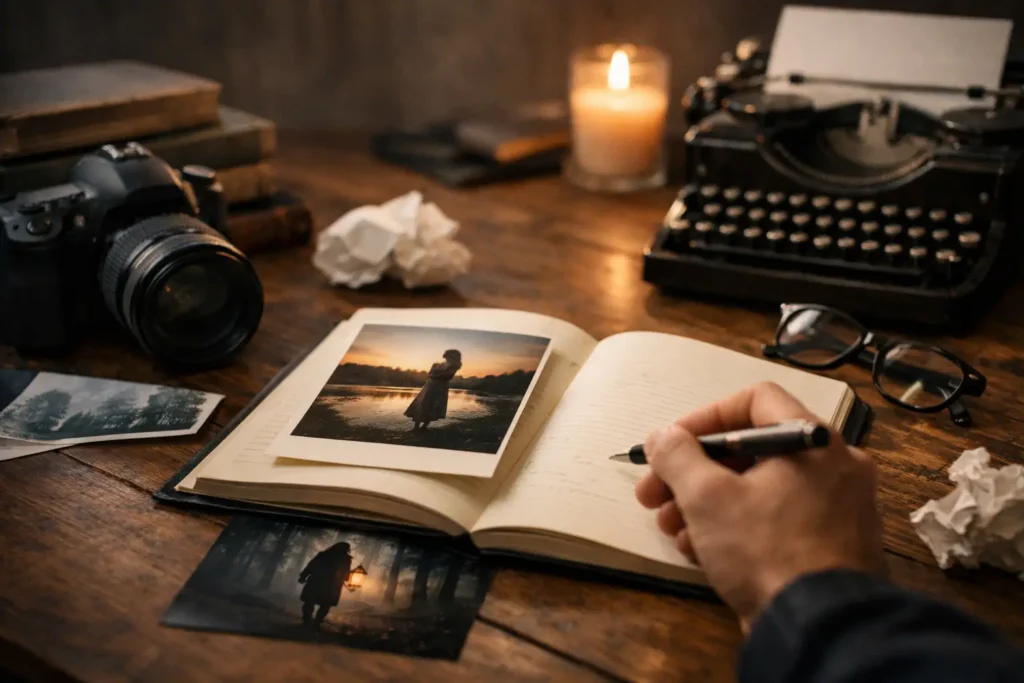
A photograph can put a loaded gun on the table without showing a weapon. It can preserve a face no one recognizes, a landmark that should not be there, or a moment a character swears never happened. The best photography inspired fiction examples understand that a picture is never merely evidence. It is evidence filtered through angle, timing, light, memory, and the person holding the camera.
After more than forty years behind a professional camera, I’ve learned that photographs carry two stories. There is the visible one: the bride laughing in a doorway, the traveler at a train station, the late-afternoon shadows on an empty street. Then there is the story outside the frame. Who arrived late? Who was watching? What happened thirty seconds before the shutter clicked? Fiction lives very comfortably in that second story.
Why photography belongs in fiction
Photography gives a writer a practical object with emotional weight. A camera can be a character’s profession, refuge, alibi, obsession, or mistake. A print can cross decades in a shoebox. A digital file can be copied, cropped, mislabeled, or discovered by the one person who knows what it means.
More importantly, photography makes readers look twice. A novel may tell us that a woman is frightened, but a close image of her gripping a coat collar in the background of an ordinary vacation shot lets readers discover it for themselves. That small act of discovery creates participation. Suspense gets stronger when the reader notices a detail before the character does, or notices it at exactly the same terrible moment.
The trade-off is that cameras are not magic truth machines. A photograph records light, not certainty. It can hide context as effectively as it reveals it. That limitation is where a mystery becomes interesting. If every image solves the case, the camera becomes a convenient prop. If an image complicates the case, it becomes story.
Photography inspired fiction examples with real staying power
A frame that sees too much
Michelangelo Antonioni’s Blow-Up, adapted from a story by Julio Cortázar, remains a useful example because its central image grows less certain the more closely it is examined. A photographer enlarges a casual park photograph and believes he has captured evidence of a crime. The premise is simple, but the tension comes from interpretation. Grain, scale, and expectation all get involved.
That is an excellent lesson for thriller writers. A photograph need not provide a clean answer. It can offer a shape in a window, a figure at the edge of a crowd, or a reflection that may mean everything or nothing. The character’s confidence in what he sees can be as dangerous as the image itself.
In practical terms, this kind of story works best when the photograph changes the character’s next decision. The image sends someone back to a location, causes an old friend to lie, or makes a seemingly safe person suddenly suspect. It should create motion, not simply decorate a chapter.
The observer becomes part of the danger
Alfred Hitchcock’s Rear Window is often remembered for its apartment courtyard and mounting unease, but its visual logic is especially useful. The central character watches, interprets, and gradually realizes that observation has consequences. Looking is not passive for long.
Photography and surveillance are not the same thing, of course. A photographer may be documenting a festival, shooting architecture, or trying to capture a rare bird. Still, both involve attention. A person who spends time noticing patterns may see the wrong car returning to a motel, an unfamiliar figure near a private event, or a face that does not belong in an old group photo.
The key is restraint. Let the photographer have a believable reason to make the image. Readers can sense when an author has placed a perfect clue directly under a lens just because the plot needs it. A real photographer misses shots, catches distractions, and sometimes learns later that the accidental frame mattered most.
Romance found in the space around the subject
Photography-inspired fiction does not need a body in the basement or a coded memory card. In The Bridges of Madison County, photography helps create intimacy between two people who see the world differently from those around them. The camera gives the characters something concrete to discuss, a reason to travel together, and a way to reveal what each notices.
That is why photography fits clean romance and historical romance so naturally. A portrait session puts two guarded people in the same room. A newspaper photographer arrives in a small town with an inconvenient deadline. A family album uncovers the identity of a woman who gave up more than anyone knew. The lens invites characters to pause, and a pause is often where emotion catches up with them.
For a romance, the most telling image may not be the polished portrait. It might be the crooked snapshot a character almost throws away: someone laughing without posing, a child reaching for a parent’s hand, a ranch house before a hard winter. Such photos can carry tenderness without requiring a speech to explain it.
A historical record with gaps
Old photographs are particularly useful in historical fiction because they feel authoritative even when they are incomplete. A faded studio portrait appears to settle a family question, until a name written on the back does not match the clothing, date, or location. A town photograph reveals which building stood beside the hotel before the fire. A military portrait brings a stranger’s face into a descendant’s hands.
The temptation is to make every old photo pristine and conveniently labeled. Real collections are messier. Dates are guessed at. Names are misspelled. Relatives remember the same event differently. The absence of information can be more compelling than a complete caption.
In a Western romance, for instance, a photograph might establish a character’s claim to a place, but it can also expose the cost of that claim. A homestead picture shows a man standing proudly beside a new house. Years later, someone recognizes the woman half-hidden near the porch. The photograph does not tell the whole story. It gives the past a face.
What makes a camera believable on the page
Writers do not need a technical manual to use photography well, and too much equipment talk can slow a scene faster than a dead battery. A few accurate details, placed where they matter, go a long way.
Light is usually more important than camera model. A photographer notices a harsh noon sun, window light falling across a face, rain turning pavement into a mirror, or the brief warmth before sunset disappears. Those observations establish point of view. They also give a scene physical credibility because the character is reacting to what is actually in front of them.
Timing matters too. A photo is a fraction of a second, which makes it a natural engine for tension. The shutter fires before someone turns away. A flash reveals a detail in a dark room. The subject blinks at the wrong moment. The photographer lowers the camera and realizes the scene has changed.
Technical language should earn its place. If a character needs to adjust exposure under difficult conditions, mention it because the choice affects the image or the risk, not because the author wants to prove ownership of a camera bag. Most readers will follow a clear consequence more readily than a parade of settings.
Turning an image into a plot turn
A useful test is to ask what the photograph costs. Perhaps taking it loses a character’s trust. Perhaps keeping it makes travel dangerous. Perhaps sharing it destroys a carefully protected family story. The stakes do not have to be global to matter. A photograph can threaten a marriage, a reputation, a second chance, or a person’s understanding of their own past.
In my own suspense novel Double Exposure, photography is more than scenery because it affects how characters see risk, truth, and one another. That is the opportunity the medium offers a writer. A photographer can enter places other people ignore, but they also carry away moments that may be inconvenient for someone else.
The strongest photography inspired fiction examples leave a little room around the edges. They let readers study the frame, notice the missing piece, and feel the pull of what happened just before the shutter clicked. If you enjoy stories built on secrets, settings, and the details people overlook, there are plenty more waiting beyond the frame.