
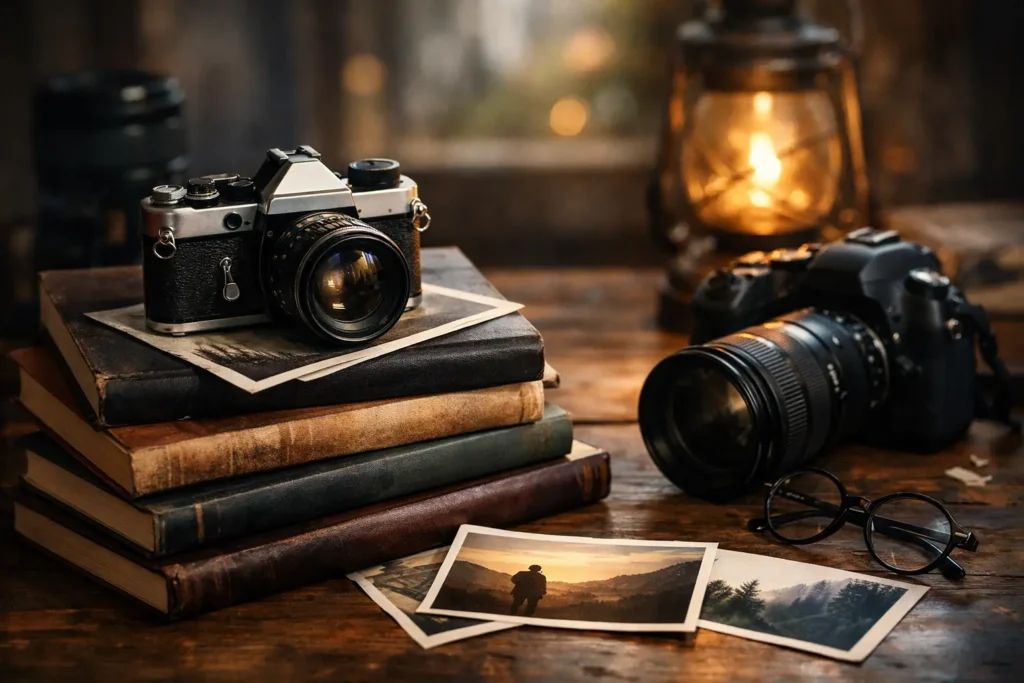
A contact sheet can tell a story before anyone has selected the final frame. There is the almost-right expression, the figure entering at the edge, the detail that seems meaningless until the second look. That habit of close observation is why fiction books for photographers can be such rewarding reading. The best ones understand that a scene is never merely seen. It is framed, interpreted, remembered, and sometimes badly misunderstood.
After more than four decades behind cameras, I’ve learned that a photograph records far less than people think and far more than they expect. A novel can work the same way. The reader sees a room, a gesture, a face in bad light, then realizes 100 pages later that the important thing was sitting quietly in the corner all along.
These nine books are not all about photographers. A few put images at the center of the plot; others sharpen the skills photographers already bring to a story: patience, attention to place, an eye for a revealing detail, and a healthy suspicion of first impressions.
Fiction Books for Photographers Who Notice Details
Blow-Up and Other Stories by Julio Cortázar
The title story in this collection remains one of the most unsettling pieces of fiction about photography. A photographer takes what appears to be an ordinary picture in a Paris park, then studies the image more closely. Each new look seems to alter what the photograph means.
Cortázar understood a truth every working photographer eventually meets: a frame feels definite until it doesn’t. Cropping, enlargement, timing, and personal expectation all shape the story we think we captured. The prose can feel deliberately slippery, which is exactly the point. This is a short, strange read for anyone who has ever enlarged a file and found a surprise hiding in the pixels.
The Photograph by Penelope Lively
A single old photograph, discovered after a woman’s death, sends several people back into a family history they thought they knew. The image reveals an intimate moment, but it does not come with a caption. Everyone who encounters it supplies one.
That is the quiet power of Lively’s novel. A photograph may preserve an instant, yet the people looking at it bring years of loyalty, regret, and self-protection to the task. Photographers who have watched clients react differently to the same portrait will recognize the emotional territory. The book is measured rather than fast-paced, but it rewards a reader willing to study the frame.
Atonement by Ian McEwan
Atonement begins with a child witnessing a scene she cannot properly interpret. Her certainty does the damage. What follows is a story shaped by observation, imagination, memory, and the costly difference between seeing something and understanding it.
For photographers, the lesson is not that the camera lies. It is that context matters. A photograph may show precisely what was in front of the lens while still failing to explain the moment. McEwan builds that idea into the structure of the novel, making this a strong choice for readers drawn to psychological suspense and stories about the consequences of a mistaken conclusion.
Suspense That Works Like a Long Lens
A long lens changes the relationship between observer and subject. It lets you watch from a distance, but it also narrows the field of view. Suspense novels often operate the same way, directing attention toward one telling movement while keeping the larger situation just outside the frame.
The Talented Mr. Ripley by Patricia Highsmith
Patricia Highsmith’s Tom Ripley is a master of looking, copying, and noticing what other people want to see. The novel’s tension grows from small social details: clothing, speech, possessions, manners, and the peculiar discomfort of a person standing where he may not belong.
Highsmith does not rush to explain her characters. She lets a detail hang there, the way a photographer might wait for a subject to reveal something without realizing it. The book carries adult themes and a cool, unsettling mood, so it will not suit every reader. For those who enjoy psychological suspense, though, it is a precise study in identity and observation.
Rebecca by Daphne du Maurier
Manderley is one of fiction’s great locations because du Maurier makes the house feel photographed from every angle. The drive, the rooms, the sea, and the traces left by Rebecca all create an atmosphere in which the setting is never just background.
The unnamed narrator arrives at Manderley already feeling out of place, and the reader notices the estate through her anxious eyes. That limited perspective makes every object meaningful. A dress, a room, a handwriting sample, a remark from a servant: each carries weight because the narrator is always trying to read the scene correctly. It is an excellent choice for photographers who enjoy mood, architecture, and visual storytelling with a slow-building sense of dread.
The Spy Who Came in from the Cold by John le Carré
This is espionage fiction stripped of flashy gadgets and polished movie glamour. John le Carré builds tension through worn offices, tired faces, guarded conversations, and the uncomfortable knowledge that a person’s apparent role may not be the real one.
The novel has the discipline of a strong black-and-white photograph. There is little wasted light. Each detail earns its place, and the atmosphere comes from restraint. Readers who enjoy thrillers will find a sharply constructed story about deception and moral pressure. Photographers may appreciate how much le Carré can suggest through posture, silence, and setting rather than explanation.
Stories With a Strong Sense of Place
A location is more than a backdrop. Anyone who has photographed a ranch at sunrise, a wet city street, or an aging hotel lobby knows that place affects posture, color, mood, and behavior. These novels make their settings active participants in the story.
True Grit by Charles Portis
Mattie Ross tells the story of her determined journey through Indian Territory to seek justice for her father. Her voice is direct, funny, stubborn, and remarkably clear. The country she travels through is not a postcard version of the West. It is difficult terrain filled with practical problems and memorable people.
Portis gives readers crisp visual material without pausing to admire his own writing in the mirror. That is a useful reminder for photographers and writers alike. A good image does not need to shout about how beautiful it is. It simply puts the right person in the right place under the right pressure. Fans of historical Western romance and frontier stories will find plenty to enjoy in the landscape and the character work, even though this is not a romance.
News of the World by Paulette Jiles
Set in post-Civil War Texas, this novel follows an aging news reader traveling with a young girl who must be returned to relatives she barely knows. Jiles writes the Texas landscape with a spare, tactile clarity. Dust, distance, weather, wagons, and small settlements all influence the choices the characters make.
The story understands that travel is rarely just movement from one point to another. It changes people by putting them in unfamiliar light. Photographers who love road trips, old towns, and the way a horizon can make a person feel small will find a lot to admire here. The novel also offers the warmth of a relationship gradually built through necessity and trust.
The Shipping News by Annie Proulx
Quoyle, a man whose life has gone badly off course, begins again in coastal Newfoundland. He finds work at a local newspaper and slowly becomes part of a place shaped by salt air, hard weather, odd family history, and people who have learned to endure.
Proulx’s setting is vivid enough to feel like a series of windblown photographs. More importantly, she shows how a location can challenge a character into becoming someone different. This is not a conventional thriller, but readers who appreciate resilient people, strong communities, and atmosphere will recognize its appeal. It is also a fine antidote to stories where scenery exists only to fill the space behind the hero.
Choosing Novels That Feed Your Creative Eye
The right fiction book depends on what you want from your reading time. If you are drawn to the uncertainty of images, begin with Blow-Up, The Photograph, or Atonement. If your taste runs toward tension and hidden motives, Highsmith and le Carré offer very different kinds of suspense. For readers who recharge by studying a setting, Rebecca, True Grit, News of the World, and The Shipping News provide locations worth lingering in.
There is no need to treat a novel like homework. Read with the same curiosity you bring to a new location. Notice what appears first, what remains outside the frame, and which small details return with new meaning. A good book can improve your eye without offering a single lesson about f-stops, gear, or editing software.
That connection between photography and story is one reason cameras fit so naturally into suspense fiction, including my own Double Exposure. A picture can be evidence, a memory, a mistake, or the beginning of trouble. Sometimes it is all four. The next novel you pick up may leave you looking at your own photographs a little more carefully, and that is never a bad use of an evening.