
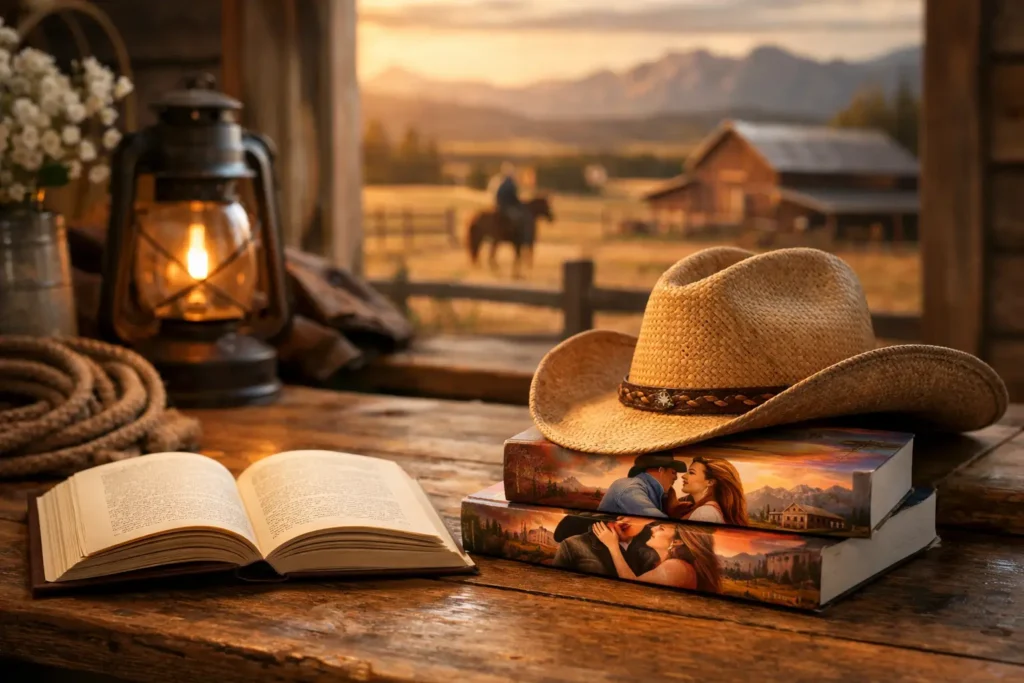
A ranch gate rarely opens onto a simple love story. On the other side may be unpaid bills, a stubborn uncle, a weathered house full of memories, and acreage that suddenly belongs to someone who never planned to own a pair of work boots.
That is the dependable engine behind inherited ranch romance books. The inheritance is not a decorative excuse to move a character west. It is a pressure point. It gives a protagonist a problem that cannot be ignored, a place that demands attention, and a past that has a few opinions about what should happen next.
For readers who enjoy clean romance with strong settings, family ties, and a little dust on the page, the appeal runs deeper than a handsome rancher and a sunset. The best stories make the land matter. They let the romance grow through practical decisions, difficult history, and the uncomfortable realization that starting over is usually more work than advertised.
Why inherited ranch romance books have lasting appeal
Inheritance stories begin with a built-in contradiction. A character receives something valuable, but the gift arrives tangled with responsibility. A ranch might be beautiful, but beauty does not repair fences, settle a disagreement with a neighboring property, or explain why an estranged relative left it behind.
That tension gives the story a natural pulse. The person who inherits the place may be grieving, skeptical, financially stretched, or completely out of place. Often, all four are true before breakfast. The ranch becomes both a setting and a test. Is the character willing to stay? More importantly, what would staying mean?
Romance fits neatly into that uncertainty because love is rarely convenient in these stories. The other main character may be rooted in the community and wary of outsiders. They may have known the previous owner well. They may believe the new heir will sell the land, flatten the old house, and disappear by summer.
Neither person has to be entirely right. That is where the story gets interesting.
A convincing ranch romance lets both sides carry understandable fears. The heir may need a clean break from a city life that went sideways. The local rancher, veterinarian, contractor, or neighbor may have spent years protecting a way of life that is easily romanticized from a distance. Their conflict works when it comes from something concrete, not a misunderstanding that could be fixed in thirty seconds over coffee.
The ranch is more than a postcard
Readers know the difference between a real working setting and a scenic backdrop with excellent lighting. A ranch has rhythms: early chores, changing weather, equipment that chooses the worst possible moment to quit, livestock that does not care about anyone’s emotional breakthrough, and distances that look shorter on a map.
Those details need not turn a romance novel into an agricultural manual. A few well-chosen specifics do more than pages of research notes. The smell of wet leather after a storm, dust settling on a porch rail, a broken water line at dawn, or the sound of a truck taking the long road home can place a reader squarely in the scene.
My years behind a camera taught me that locations have personalities. Light changes the mood of the same barn, road, or field from one hour to the next. A wide landscape can feel freeing one day and isolating the next. Fiction benefits from the same attention. The ranch should shape what characters see, how they move, and what they cannot avoid.
That physical reality also keeps the romance honest. A conversation held while repairing a fence has a different energy than one held in a restaurant. People have something to do with their hands. They can avoid eye contact. They can reveal competence, impatience, humor, or generosity without announcing it in a speech.
Legacy gives the love story weight
The strongest inheritance plots are not really about property. They are about what people believe they owe the past.
Perhaps the inherited ranch was the childhood home a character could not wait to leave. Perhaps it belonged to a grandparent who saw more potential in them than they saw in themselves. Maybe an old letter, a disputed will, or a locked room brings an unanswered family question into the open. The mystery does not need to overwhelm the romance, but it can deepen the stakes.
Legacy is also where these books often find their emotional center. The protagonist may arrive believing the ranch is a burden to sell. Over time, they learn that keeping it is not the only way to honor the person who left it behind. A legacy can be carried forward, changed, or even released. That is a more satisfying choice than treating tradition as automatically sacred.
There is a useful trade-off here. Too much focus on family history can slow the romance to a crawl. Too little, and the inheritance feels like a convenient plot coupon. The balance comes from making each discovery affect a present-day decision. If a secret changes nothing, it may be better left in the desk drawer.
A second chance needs practical stakes
Second chances are common in ranch romance for a good reason. A ranch offers room to rebuild a life, but it does not offer an easy escape from the life that came before. The past tends to arrive in a pickup truck, carrying paperwork.
A character might be recovering from a career disappointment, a broken engagement, a family conflict, or a long-held belief that they are not capable of staying anywhere. The ranch provides a chance to act differently. It does not magically fix the wound.
That distinction matters in clean romance especially. Emotional intimacy carries the story. The characters earn trust through small, observable choices: showing up when a job goes bad, listening without trying to solve everything, admitting a mistake, or respecting a boundary even when it hurts. Those moments can be quieter than grand declarations, but they stay with readers longer.
The love interest should have an arc of their own, too. They are not a local tour guide with good shoulders and a spare tractor. They need wants, limits, and something at risk if the relationship changes. Maybe the ranch’s future challenges their own plans. Maybe old loyalty makes it difficult to trust the heir. A romance becomes memorable when both people have to give up a little certainty.
What makes a satisfying ending
A happy ending in an inherited ranch romance does not require every problem to vanish. In fact, it is often more believable when some work remains. The roof may still need repair. The cattle may still be stubborn. A family relationship may be improving rather than fully healed.
What readers want is a meaningful choice. The protagonist decides what the ranch represents and what kind of life they want to build there. The couple chooses each other with their eyes open, not because the final chapter ran out of pages.
That is why these stories can feel so satisfying. They offer the pleasure of open country and close-knit communities, but they understand that belonging is not handed over with the deed. It is made through labor, forgiveness, and the daily decision to remain present.
For readers drawn to Western romance with family secrets, resilient characters, and a clean emotional payoff, that combination has real staying power. Those are some of the ingredients that shaped my own historical Western romance, Dust and Inheritance. A good ranch story leaves a little dust on your boots, a few questions in your mind, and a reason to believe that home can sometimes be chosen.