
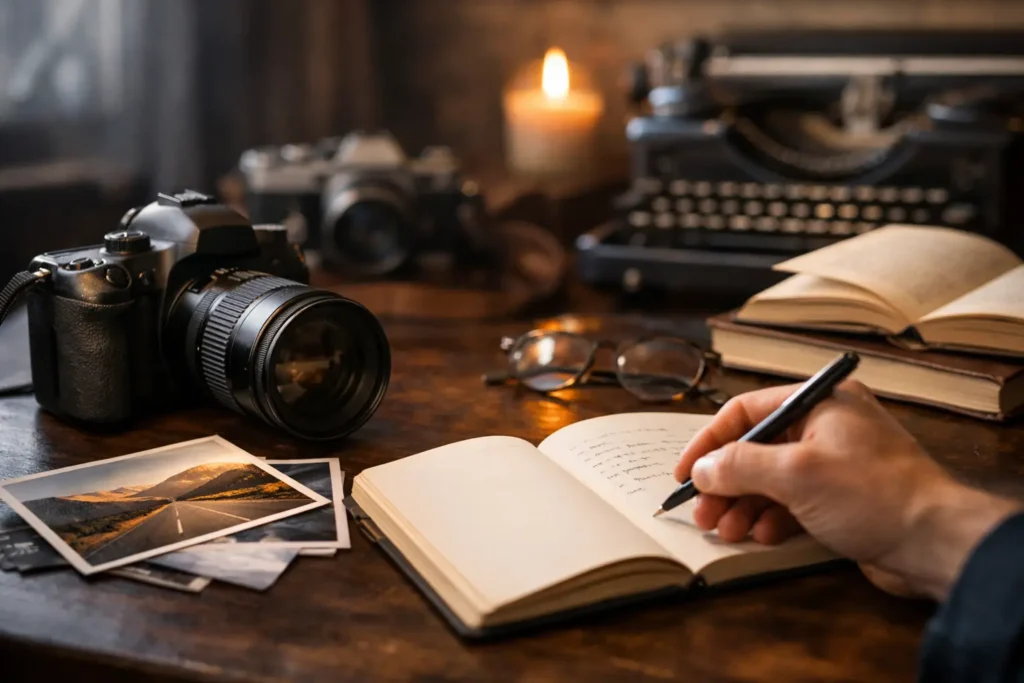
A photographer turned novelist learns early that the most useful details are rarely the loudest ones. They are the scuffed toe of a boot under a café table, the hotel clerk who keeps glancing at the lobby doors, the yellowed edge of a photograph tucked into a desk drawer. A camera trains the eye to notice what belongs in a frame and, just as useful, what does not.
After more than forty years behind a camera, I found that habit followed me to the page. Photography and fiction use different tools, but both depend on attention. One asks a viewer to pause over a single instant. The other asks a reader to keep turning pages because something in that instant feels unfinished.
That connection is not simply about putting photographers into novels. It is about seeing people, places, and tension with enough specificity that a made-up story feels as if it has fingerprints on it.
How a Photographer Turned Novelist Builds a Scene
A photograph begins with selection. The world is inconveniently full of lampposts, parked cars, strangers walking through the background, and power lines that appear to grow from a person’s head. The photographer has to decide where to stand, what to include, and where the viewer’s eye should land first.
Fiction requires the same discipline. A scene does not become believable because every object in a room receives equal billing. A reader needs the details that reveal mood, character, or trouble. In a suspense scene, a spotless kitchen might matter less than the second coffee mug sitting in the sink. In a historical romance, the faded wallpaper may say more about a family’s circumstances than a paragraph of explanation.
The trick is choosing details that pull their weight. If a detail changes nothing, it may be pretty, but it is probably scenery. If it makes a reader wonder who was there, what happened earlier, or what could go wrong next, it has earned its place.
That is one reason real locations are so valuable. Travel and professional assignments have put me in airports before daylight, hotels with more locked doors than necessary, crowded city streets, quiet back roads, and rooms where everyone watches everyone else. Those experiences do not get copied directly into a novel. Real life is usually messier, slower, and less cooperative than fiction. Still, the memory of a place supplies textures that research alone can miss: the odd echo in a corridor, the smell after a hard rain, the way a small town goes quiet after dinner.
Light Is More Than a Photography Term
Photographers talk about light constantly, often to the dismay of anyone trying to leave for dinner. Light changes a face, sets a mood, hides a flaw, and can turn an ordinary parking lot into a place that feels vaguely suspicious. It also teaches patience. The same scene at noon and at dusk is not the same scene at all.
On the page, light can do similar work without becoming decorative wallpaper. A bright, hard afternoon can make a confrontation feel exposed. A dim hallway can make a familiar home seem uncertain. The goal is not to describe every shadow. It is to let the setting affect the emotional temperature of the moment.
This is especially useful in suspense. A threat does not always need to announce itself with sirens and broken glass. Sometimes it arrives in a room that is too orderly, a porch light that has been left on, or a reflection in a dark window. The reader senses that something is off before the character has enough information to name it.
Romance uses observation differently but no less carefully. A character may not say what he feels, particularly if he is stubborn, distracted, or wearing a hat that has survived several bad decisions. Yet he might notice that someone has repaired a torn sleeve, saved the last piece of pie, or stayed behind to help with an unpleasant task. Small actions carry emotional weight because people reveal themselves in what they notice and what they choose to do.
The Difference Between Detail and Clutter
There is a temptation, particularly for writers with visual backgrounds, to describe everything. I have met this temptation. It is very persuasive and occasionally carries a tripod.
But fiction is not a catalog. Readers need room to build part of the picture themselves. Too much description can slow a chase, bury a conversation, or make a character seem as though he has paused during a crisis to appraise the curtains.
The better approach is to give a scene a few sharp anchors. Consider a man arriving at an unfamiliar office. Rather than inventory every furnishing, a writer might show the receptionist’s polished smile, a security camera angled toward the elevators, and a framed family photograph with one face turned down. Three details can suggest professionalism, surveillance, and a private wound. The reader has something to work with.
What details belong depends on the story. A spy thriller needs enough operational reality to feel grounded, but it should not turn into an instruction manual. A psychological suspense novel may stay close to a character’s uneasy thoughts, allowing ordinary surroundings to take on new meaning. A Western romance benefits from practical texture: weather, work, distance, family routines, and the hard-won comfort of a warm room. In each case, the detail must serve the story rather than show off the author’s research notes.
Photography Teaches Respect for the Subject
A camera can make people self-conscious. Some become animated; others fold inward. Over years of photographing people, you learn that the most interesting expression often comes just before someone is ready for it. You also learn that a person is more than the first impression they offer a lens.
That lesson matters even more in fiction. A villain who exists only to sneer at the hero will not hold a reader’s attention for long. Neither will a hero who is always clever, capable, and perfectly groomed after running through an airport. Real people have blind spots. They make decisions for reasons that seem sensible from where they stand. They can be brave in one situation and completely wrong in another.
Memorable characters need contradictions. The confident investigator may avoid talking about home. The practical rancher may keep a box of old letters. The woman who appears to have everything under control may be the only person in the room who recognizes the danger. These are not tricks. They are ways of treating characters as people with histories rather than chess pieces moved from plot point to plot point.
The Moment Before the Shutter Clicks
Photography has taught me to watch for the moment just before something changes. A child shifts from impatience to laughter. A speaker stops reading notes and speaks from the heart. A storm moves across a landscape, and the entire color of the day changes in a minute.
Fiction lives in that territory. Suspense is often not the explosion but the second before someone opens the wrong envelope, answers an unfamiliar call, or realizes the person across the table knows too much. The scene works because the writer has prepared it with quiet, meaningful evidence.
That is the shared craft of camera and novel: attention, timing, and restraint. In books such as Double Exposure, Zero Exposure, Dust and Inheritance, and Boots and Stilettos, the aim is not merely to place readers in an interesting location. It is to make them feel the pressure of being there, with someone to care about and a reason to keep moving forward.
A good photograph can leave you wondering what happened just before the frame and what came after it. A good novel gives that question room to grow for a few hundred pages. Pay close attention to the small, telling things around you. They are often where the next story is waiting.