
Every author dreams of getting “the email.”
You know the one.
The message that says a major book club, celebrity, publisher, producer, or media company has discovered your work and wants to feature it. For an indie author, that kind of email can make your heart jump just a little.
Then your brain catches up.
Recently, I received an email about my thriller Zero Exposure from this address:
hello.hellosunshinemedia@gmail.com
The sender claimed to represent Reese’s Book Club and Hello Sunshine. Eventually, the sender went even further and claimed to be Reese Witherspoon.
To be crystal clear, this post is about an email account that claimed to be connected to those names. I am not saying the real Reese Witherspoon or the real Hello Sunshine contacted me. In fact, that is the whole point of this article.
Authors need to verify who is actually behind an email before sending money, clicking links, agreeing to promotional services, or celebrating too early.
And trust me, this one came gift-wrapped in red flags.
The First Email Was Flattering, Which Is Exactly the Point
The first message sounded impressive. It referenced Zero Exposure, my prequel thriller, and even mentioned specific parts of the story.
Here is part of the actual wording I received:
“I was immediately drawn to Zero Exposure because it raises a thrilling question: What happens when the fictional world an author creates begins to fight its way into reality?”
That is a good line. I’ll give them that.
The email continued:
“I’m Reese Witherspoon, founder of Reese’s Book Club and Hello Sunshine. I’m reaching out because I believe Zero Exposure could spark a meaningful conversation among readers interested in suspense, espionage, technology, artificial intelligence, creativity, storytelling, and the increasingly complicated relationship between humans and the worlds they create.”
Now, as an author, you want to believe that. Of course you do.
Someone famous loves your book? Someone with massive influence sees potential in your story? Someone wants to feature your work?
That is author catnip.
But a professional-sounding email is not proof. These days, anyone with a keyboard and a decent prompt can produce flattery that sounds like it came from a media department.
My First Test: Did You Actually Read the Book?
I have developed a simple rule.
Before I do business with someone who claims they can promote one of my books, I want to know if they actually understand the book.
So I asked directly if they had read Zero Exposure.
The reply came back:
“Yes, I spent time reviewing Zero Exposure and the material surrounding it before reaching out.”
Notice the wording.
They did not say, “Yes, I read the book.”
They said they spent time “reviewing” the book and “the material surrounding it.”
That may sound reasonable at first glance, but it is also slippery. It leaves room for them to have read the Amazon description, a few reviews, maybe some website copy, and then build a convincing reply around that.
They also wrote:
“The detail that especially stayed with me was the 1955 manual typewriter.”
That caught my attention because the typewriter is an important part of Zero Exposure. It is also something easily pulled from my marketing copy, reviews, or online descriptions.
A scammer does not need to read your book. They only need to know enough to sound like they did.
Then Came the Money
After the flattery came the fee.
Here is the actual wording:
“Participation in the reader programming I mentioned involves a one-time participation fee of $255, which covers the program and the reader-engagement work associated with the feature.”
There it is.
The hook was attention. The bait was credibility. The ask was $255.
Now, $255 is not a huge amount in the world of book promotion. That is part of why this kind of scam can work. It is small enough that an author might think, “Well, if this is real, it could be worth it.”
That is exactly the danger.
Scams aimed at authors often do not begin with a ridiculous amount of money. They begin with a number that feels possible.
The Review Angle Got Even Stranger
At one point, the sender claimed they would support Zero Exposure with reviews.
This is part of what I received:
“I’m happy to support Zero Exposure with an honest review on Goodreads, BookBub, and Amazon based on my genuine reading experience.”
That sentence alone should make an author slow down.
Any time a marketing conversation starts blending paid promotion, reviews, and famous names, you need to stop and look very carefully. Reviews should be honest, voluntary, and independent. They should never feel like part of a payment negotiation.
Later, the sender claimed reviews had been posted and sent me Goodreads links:
“As promised, here are three of the Goodreads reviews that have been posted for Zero Exposure.”
Then another message followed:
“Here is another Goodreads review that has been posted for Zero Exposure.”
At this stage, the pattern was getting clearer. The sender appeared to be trying to create a sense of progress, credibility, and obligation.
In plain English: “Look, we did something for you. Now pay.”
That is not how legitimate professional promotion should feel.
The Marketing Explanation Was Full of Fog
When I asked for details about what the $255 actually purchased, the answer became a long cloud of marketing language.
Here is one of the replies:
“The program includes reader outreach, curation, discussion programming, community engagement, and ongoing management of the book throughout the 12 months. This is where the $255 participation fee comes in. It is a one-time fee for the full 12 months.”
That sounds official until you ask basic business questions.
Where will the promotion appear?
How many readers will see it?
What is the audience size?
What is the click rate?
What is tracked?
What reporting is provided?
What platform is used?
Who is managing it?
Where is the business address?
Why is this coming from a Gmail account?
Foggy answers are a warning sign.
Legitimate marketers can explain what they do. They may not guarantee results, but they can explain deliverables, audience, timing, tracking, reporting, and payment structure.
If they cannot explain the machine, there may not be a machine.
The Sales Guarantee Changed
At one point, the sender said they could not guarantee sales. That is actually the correct thing for a real marketer to say.
But later, the wording shifted.
I received this:
“I am prepared to guarantee a minimum of 25-60 attributable book sales during the 12-month program period.”
That is a major change.
First, no guaranteed sales.
Then, a guaranteed range of 25 to 60 sales.
But only after I pushed back.
That kind of shifting language is another red flag. Scammers often adjust the offer based on whatever objection you raise. They are not presenting a real product. They are trying to keep the conversation alive long enough to get paid.
Then Came the Identity Claim
Eventually, I asked more directly who I was talking to.
The sender claimed:
“I’m Reese Witherspoon, founder of Reese’s Book Club and Hello Sunshine.”
Later, the claim became even more direct:
“Yes, Kirk. That’s me.”
Again, this came from:
hello.hellosunshinemedia@gmail.com
That is not the kind of address I would expect for official business from a major media company.
Could a real person use Gmail? Sure.
Would a major celebrity, major book club, or major media brand ask an indie author for $255 through a Gmail account while sending vague promotional promises?
That is where the wheels start wobbling off the wagon.
The Fake Image Was the Comedy Finale
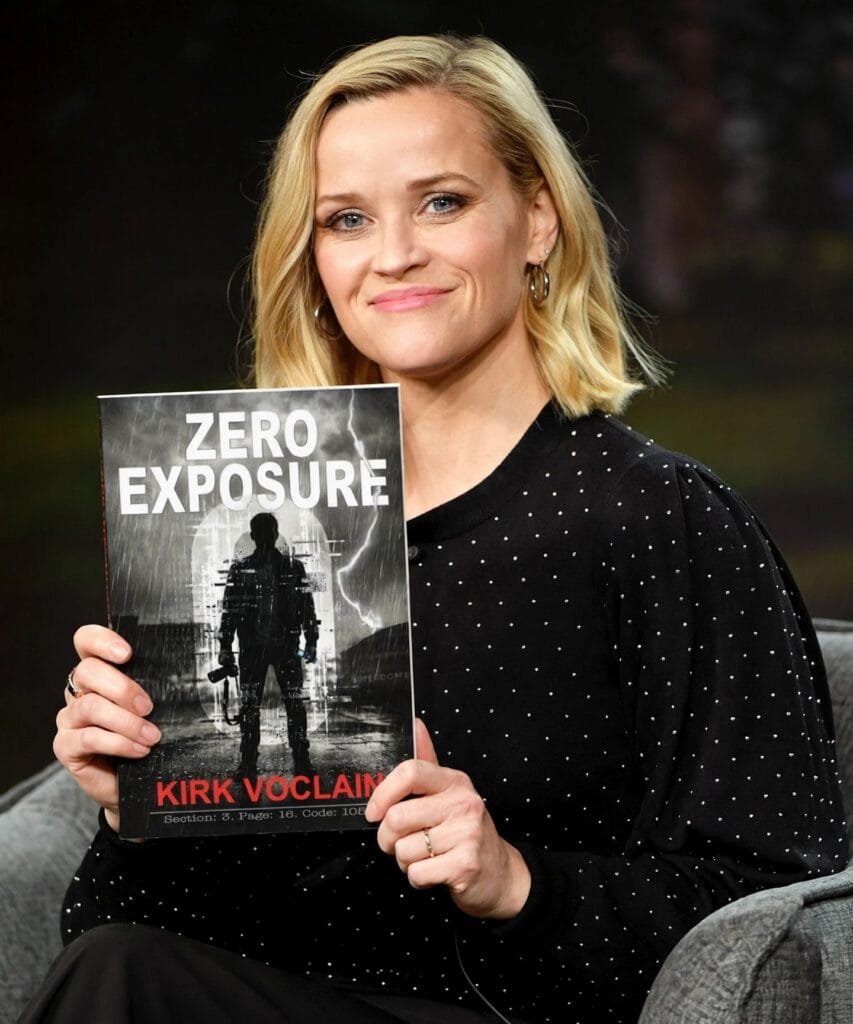
Then came the image.
The sender sent an image that appeared to show a well-known person holding my book Zero Exposure.
At first glance, an excited author might think, “Wow, there it is. Proof.”
But look closer.
The book is huge. Comically huge. My book looks like it was printed for a courtroom exhibit or a small coffee table with a thriller complex.
The size of Zero Exposure next to the person holding it is the dead giveaway. The proportions are wrong. The image looks like AI trying very hard to understand books, hands, celebrity publicity photos, and physics, all at the same time.
Nice try, robot. But the book is not supposed to be the size of a dorm-room mini fridge.
That image was not proof. It was the loudest warning sign in the whole exchange.
The Biggest Red Flags Authors Should Watch For
This experience is funny now, but only because I did not send money.
Here are the red flags that stood out:
- A major name using a Gmail address
A message claiming to be from a famous person, major book club, or media company should be verified through an official domain or official contact channel. - Flattery that sounds oddly specific
Scammers can scrape descriptions, reviews, blurbs, blog posts, and social media. A few accurate details do not prove someone read your book. - A participation fee appears after the praise
The pattern is simple: compliment the author, create excitement, then introduce a fee. - Vague promotional language
Phrases like “reader engagement,” “visibility,” “community,” and “programming” are not enough. Ask for specific deliverables. - Reviews become part of the conversation
Be very careful when paid promotion and reviews start appearing in the same discussion. - The story changes under pressure
If the offer changes every time you ask a serious business question, that is not a plan. That is improvisation. - Tracking pixels and odd email tools appear
Some emails included tracking elements, which is not automatically proof of a scam, but combined with the rest, it made the whole thing smell funny. - AI images are used as proof
A fake-looking image is not verification. It is often the opposite.
What Authors Should Do Before Paying Anyone
Before paying any person or company that claims they can promote your book, ask these questions:
- What is your official website?
- What email domain do you use for business?
- Can I verify you through a public contact page?
- What exactly am I buying?
- Where will my book be promoted?
- How many readers or subscribers will receive it?
- What reporting will I receive?
- Do you have examples of previous campaigns?
- Are reviews involved in any way?
- Can you provide an invoice, business name, and written agreement?
And here is the big one:
If a famous person supposedly contacts you, verify it outside the email thread.
Do not reply only to the same address. Go to the official website. Use the official contact form. Check verified social accounts. Look for a business domain. Slow down.
Scammers depend on excitement.
Your best defense is patience.
Why I Am Sharing This
I am sharing this because authors are targets.
We work hard on our books. We want readers. We want reviews. We want visibility. We want that one break that moves a book from “available” to “discovered.”
Scammers know that.
They know authors are hopeful. They know we spend money on editing, covers, advertising, newsletters, contests, review platforms, book fairs, and promotional services. They know the dream is powerful.
So they package the scam inside the dream.
This one used a famous name, a fake book club opportunity, vague marketing language, Goodreads links, a $255 fee, and finally, an AI image that fell apart the moment you looked at the size of the book.
If you are an author and you receive an email like this, do not panic and do not celebrate too fast.
Screenshot it. Save it. Verify it. Ask hard questions. Do not send money unless you know exactly who you are paying and exactly what you are buying.
And if someone sends you a fake AI image of a celebrity holding your book, look at the hands, the lighting, the proportions, and for heaven’s sake, look at the size of the book.
Sometimes the scam gives itself away.
Mine did.
Final Thought
I write thrillers, so I appreciate a good plot twist.
But this one was not good enough.
The villain used Gmail, vague marketing terms, questionable reviews, a $255 participation fee, and an AI image where my book looked like it had been printed by a billboard company.
Authors, be careful out there.
Not every opportunity is an opportunity.
Sometimes it is just a scam wearing a famous name tag.