
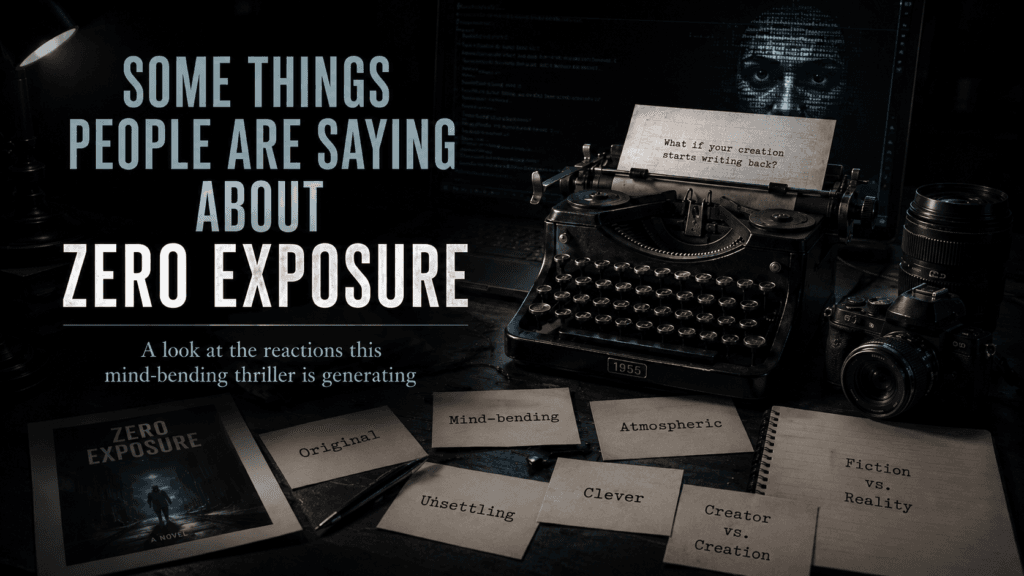
Before Zero Exposure thriller has even reached its official release, it has already generated a curious collection of emails.
Some came from readers. Others came from book clubs, literary curators, and various ARC readers. Something interesting happened as the messages accumulated. Different people kept noticing the same qualities in Zero Exposure.
Zero Exposure Thriller is A brilliantly original premise
The most common reaction concerned the book’s central idea.
Again and again, people described the premise as:
- “Brilliantly original”
- “Audacious and compelling”
- “Inventive and ambitious”
- “Refreshingly unique”
- “A fascinating approach”
- “High-concept storytelling with depth”
At the center of Zero Exposure thriller is a professional photographer who decides to write a spy thriller. He creates Reed Sawyer, a brilliant operative. He also creates Barry Cox, the calculating mastermind known as the Architect.
Then the story begins writing back.
The fictional villain refuses to remain safely inside the manuscript. The boundary between the author’s photography studio and the digital world begins to fracture. Fiction is no longer being created; it may be uncovering something that was already waiting.
One message described it as a story in which “the act of creation becomes the act of being hunted.”
That may be one of the best summaries of the novel I have seen.
A thriller that refuses to stay in one genre
People also struggled to place Zero Exposure neatly into a single category.
It has been described as a technothriller, psychological suspense novel, espionage story, meta-thriller, technological horror story, and reality-bending mystery.
That genre collision appears to be one of its strengths.
The story combines espionage and technology with a much more personal conflict. This is not simply a hero chasing a villain. It is a creator confronting something he invented, only to discover that the creation understands him better than anyone else does.
Several people described that relationship as:
- “Clever and terrifying”
- “Intellectually compelling and genuinely unsettling”
- “A mind-bending game of multidimensional sabotage”
- “The ultimate battle between creator and creation”
- “A story that makes readers question where fiction ends and reality begins”
The Architect does not merely threaten the protagonist’s life. He threatens his control over the story itself.
Photography gives the story its authenticity
Another recurring observation involved my background as a professional photographer.
For more than forty years, photography has trained me to study light, shadows, reflections, expressions, and small details that others may overlook. That experience naturally found its way into the novel.
Several messages noted that the photography elements make the story feel grounded rather than generic. They highlighted the sensory details of the darkroom, the weight of a camera, the meaning hidden inside an image, and the possibility that a flaw in a photograph may be the most important part of the frame.
One person wrote that Zero Exposure uses photography to create a world where “images conceal codes, shadows hide truths, and the very act of creation becomes a trap.”
Another said that my photographer’s eye translates directly into the book’s atmosphere and tension.
That is exactly what I hoped readers would feel.
The technology may become impossible. The fictional villain may become real. Yet the story remains anchored in physical details, familiar equipment, and the habits of someone who has spent a lifetime studying what appears inside the frame.
The typewriter keeps getting attention
Of all the objects in Zero Exposure, one repeatedly fascinated people: the 1955 manual typewriter.
To fight an enemy that controls modern technology, the protagonist must abandon computers, networks, and digital devices. He retreats to a machine that cannot be hacked, tracked, updated, or remotely manipulated.
The typewriter becomes more than an old piece of equipment. It becomes a weapon, a sanctuary, and possibly a prison strong enough to contain the Architect.
People repeatedly mentioned the contrast between a sentient algorithm and an air-gapped manual typewriter. That single image seems to capture the larger conflict within the story: modern technology against mechanical certainty, digital manipulation against ink on paper, and creation against control.
What an early reader said about Zero Exposure Thriller
The most meaningful response came from someone who was actively reading the manuscript.
After reaching Chapter 8, the reader wrote:
“I’m thoroughly enjoying reading your book. We have so much to talk about! I love the idea of you being in your own book. This could go in so many directions. I can’t wait to see how the story unfolds. I’ve been highlighting the parts I like and taking pictures.”
That response meant more to me than any polished editorial review.
The reader was not merely saying the book sounded interesting. They were inside the story, marking passages, considering possibilities, and wondering where reality might fracture next.
That is exactly the kind of experience I wanted Zero Exposure to create.
Zero Exposure Thriller is A story that invites a second look
Several people suggested that Zero Exposure may appeal to readers who enjoy finishing a book and then returning to the beginning to search for what they missed.
That feels appropriate for a novel written by a photographer.
A photograph can reveal something different each time it is studied. A reflection in the background may suddenly matter. A shadow may no longer fall in the correct direction. Something once dismissed as a flaw may become evidence.
Zero Exposure thriller works in much the same way.
The book begins with a writer who believes he controls the story. It gradually asks a more troubling question:
Was he ever creating the story, or was the story revealing itself to him?
The story behind the story is coming
The phrases used most often to describe Zero Exposure were remarkably consistent:
Original. Atmospheric. Unsettling. Intelligent. Genre-defying. Visually rich. Clever. Terrifying.
Those words came from different places and for different reasons. Yet they all point toward the same strange little truth.
Zero Exposure is not simply a prequel to Double Exposure. It is the allegedly true story of how a fictional universe may have broken free from the man who created it.
Fiction is supposed to remain on the page.
Someone forgot to tell the Architect.
Pre-Order your copy today here: https://a.co/d/05gCa8co