
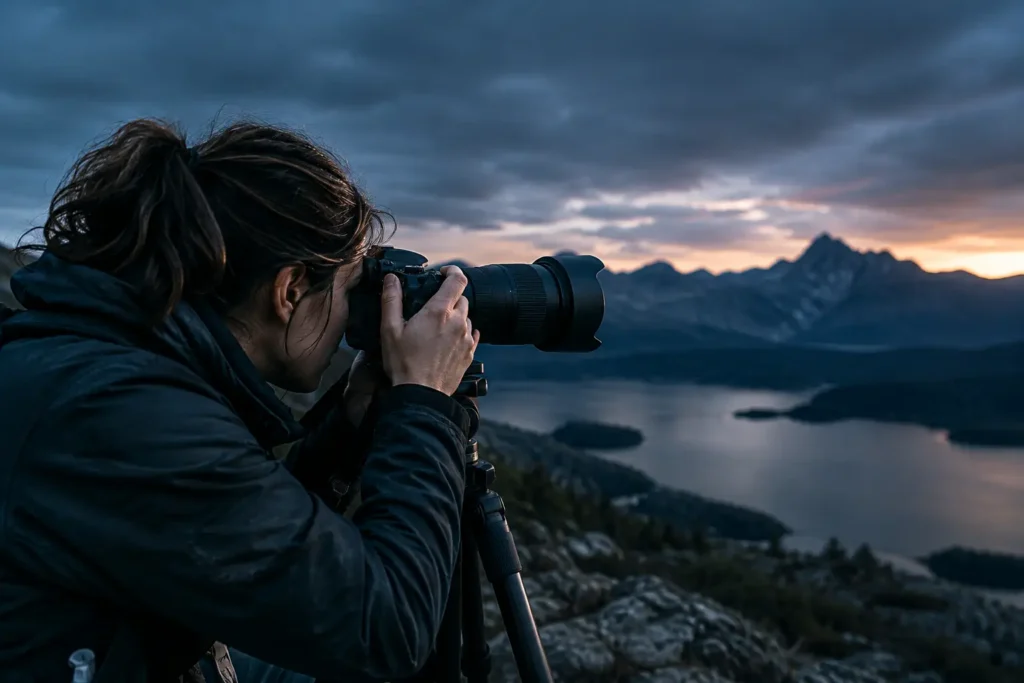
A hotel corridor can be perfectly clean, brightly painted, and entirely ordinary. Put the right person at the far end of it, give the exit sign a faint electrical buzz, and let a door stand open where every other door is closed, and the place changes. That is how photographers build thriller settings: not by finding a spooky castle on a hill, but by noticing the small visual facts that make a familiar place feel slightly off.
For more than four decades behind a camera, I’ve learned that locations have moods long before an author assigns them a body count, a secret file, or a missing witness. A photograph trains you to look at what is actually there: the quality of light, the direction of traffic, the places people wait, and the things they overlook. Those observations are useful in fiction because a convincing thriller setting is not decoration. It puts pressure on the characters.
A Thriller Setting Starts With What the Camera Sees
A camera forces a decision. You cannot include every inch of a street, airport, diner, or motel room in one frame. You choose what matters, and what stays outside the edges. Fiction works much the same way.
When I arrive at a location, I pay attention to the first detail that catches my eye. It may be a security mirror over a convenience-store aisle, a row of rain-darkened rental cars, or a polished lobby floor reflecting people who never look up. None of those details is automatically suspenseful. They become suspenseful when they suggest a problem.
The mirror means someone can be watched. The rental cars mean people can leave quickly, perhaps under names that are not their own. The reflection in the lobby gives a character a glimpse of movement behind him, but not enough information to know whether it matters.
That last part is essential. Thrillers live in the gap between what a character sees and what the character can prove. A setting should offer information, then hold some of it back.
Frame the Place, Then Limit the View
Wide shots establish geography. A narrow mountain road, an isolated house beyond a fence, and a storm moving across the valley tell readers where the danger might lead. But close shots create unease: muddy prints on a back step, a cracked phone screen on the passenger seat, a camera lens cap sitting alone on a desk.
A novelist needs both. Readers should understand enough of the physical space to follow action clearly, especially when characters are moving under stress. Yet they do not need a real-estate listing. If every room is described wall to wall, the scene loses its pulse.
A good rule is to choose details that do double duty. The old elevator is not merely old. It is slow, noisy, and the only route to the sixth floor. The oceanfront motel is not merely cheap. Its outside walkways leave every guest exposed. A crowded airport is not merely busy. It makes a face disappear in seconds.
Photography teaches economy. One well-chosen object can carry more tension than a paragraph of adjectives.
Light Does More Than Make a Scene Visible
Photographers spend a lot of time chasing light, avoiding light, or politely waiting for light to behave itself. In a thriller, light is also a practical tool for controlling what a character knows.
Midday light tends to expose. It can make a place feel public, hot, and difficult to hide in. An overcast afternoon flattens color and erases shadows, which can give an industrial park or a coastal road a drained, watchful feeling. At night, the smallest light source becomes important: a gas station canopy, a dashboard glow, a porch lamp left burning in an empty house.
The point is not to make every scene dark. Darkness is useful because it removes information, but too much darkness becomes generic. A bright setting can be just as tense when it offers nowhere to disappear. A courthouse lobby at 10 a.m., a school parking lot after a game, or a hotel breakfast room filled with strangers can trap a character in plain sight.
Color matters, too, though restraint wins. A red blinking light is a familiar thriller signal. It may be better to notice the sickly green cast of fluorescent bulbs on tired faces, or the hard blue light from a television in an otherwise dark room. Those colors feel observed rather than announced.
The Best Locations Have a Job to Do
A beautiful location is not necessarily a useful one. The most memorable thriller settings have friction built into them.
An old town square may be visually appealing, but what does it do to the story? Perhaps its festival crowds make private conversation impossible. Perhaps the narrow streets force a character to choose between being seen and getting lost. Perhaps every storefront has a window, and the protagonist begins to feel that the whole town is looking outward.
The setting can create time pressure, isolation, confusion, exposure, or temptation. It may give a character a place to hide, then make that hiding place unsafe. It may offer escape, but require the character to leave someone behind. Locations become memorable when they affect choices.
This is where real experience helps. Before using a place in a story, I like to consider the unglamorous mechanics. Where do people park? Which entrance is used after business hours? Is there a side hallway nobody notices? How long does it take to walk from the lobby to the elevators? The answers make a fictional scene feel grounded without turning it into a blueprint.
The trick is knowing when to stop. Authenticity should support suspense, not interrupt it. Readers want to feel the weight of a locked door and the distance to the next building. They do not need an inventory of hinges.
How Photographers Build Thriller Settings Through Timing
The same street is not the same location at 7 a.m. and 11:40 p.m. Timing changes the available light, the number of witnesses, the sounds in the background, and even how a character behaves.
Early morning has delivery trucks, commuters, coffee cups, and workers unlocking doors. Late afternoon carries urgency, traffic, and the last reliable chance to get somewhere before closing. After midnight, routine vanishes. A location that felt safe in daylight can become a collection of closed businesses, distant engines, and too much empty pavement.
Weather also changes the emotional temperature of a scene. Rain can conceal a face behind an umbrella, but it can also make driving slower and leave a trail of wet footprints. Wind may cover a conversation, then slam a gate at exactly the wrong moment. Snow offers visual beauty and practical consequences, especially when it turns a familiar road into a problem.
The most useful choice is usually the one that complicates the character’s plan. A thriller setting should not simply look cinematic. It should make the next decision harder.
Ordinary Places Carry the Strongest Suspense
Grand mansions and remote compounds have their place, but ordinary settings often hit closer to home. A pharmacy parking lot, a suburban cul-de-sac, a regional airport, or a small museum storage room can feel more believable because readers have stood in places like them.
The familiar gives the writer something valuable: contrast. A woman picking up dry cleaning should not expect to spot the same car twice. A man taking photographs at a public event should not find an image on his memory card that he did not intend to make. A family restaurant should not suddenly feel like the one place in town where a private meeting cannot remain private.
In Double Exposure, photography naturally became more than background color. A photograph freezes a fraction of a second, but people bring their own assumptions to what they see. That tension between image and interpretation is fertile ground for suspense. The camera records a fact, perhaps. The meaning of that fact is another matter.
Leave Room for the Reader to Look Around
The final lesson from photography may be the simplest: do not point at everything. If a scene announces every danger, readers stop participating. Give them a detail that seems harmless, return to it later, and let its significance change.
A dead plant in a window. A suitcase that never moves. A receptionist who knows a guest’s name too quickly. These details do not need a spotlight. They need a place in the frame.
That is how a setting earns its tension. It feels real enough to enter, specific enough to remember, and unsettled enough that readers keep looking over the character’s shoulder. The next time you pass through an ordinary hallway, notice what is open, what is silent, and what does not belong. A story may already be waiting there.