
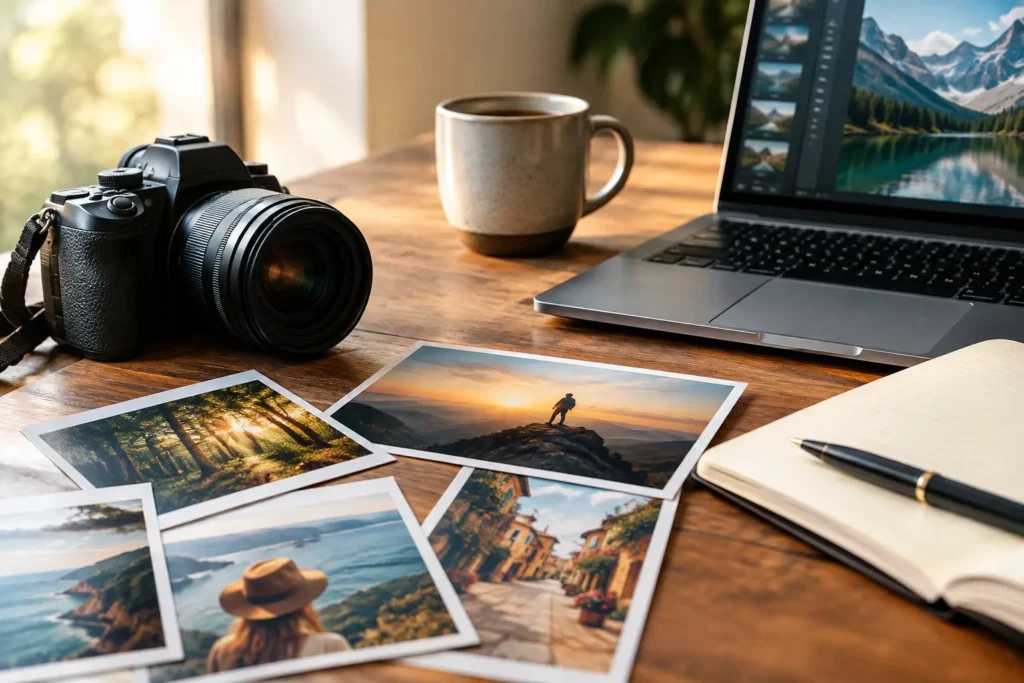
A photograph can look quiet on the page: a motel sign in late-afternoon light, a pair of boots by a screen door, an empty chair facing a hotel window. But give it a little time, and it starts making trouble. That’s how to use photos creatively: not as decoration or proof that you visited somewhere, but as a source of details, questions, and stories that might not have appeared any other way.
After more than four decades behind a camera, I’ve learned that the frame rarely contains the whole event. It contains evidence. The interesting part is often just outside the edges: who left the chair empty, why the sign has two burned-out letters, what happened before those boots were kicked off for the night.
For writers, readers, travelers, and anyone who wants to pay closer attention, photos offer a practical way to gather material without forcing inspiration. The goal isn’t to turn every snapshot into a novel. That would be exhausting, and your family might stop inviting you to dinner. The goal is to learn what a photograph can reveal.
Start with what the photo does not explain
The most useful photographs leave room for uncertainty. A perfect postcard view can be beautiful, but it may not give you much to work with beyond a nice sky. A picture of a rain-streaked windshield, a suitcase in a hallway, or a handwritten notice taped to a store window has more friction. Friction creates curiosity.
Try looking at one image for a full minute before deciding what it means. Notice the details your eye skipped the first time: the reflected figure in glass, the color of the light, the condition of a person’s hands, the odd object on the floor. Then write three plain sentences describing only what is visible.
After that, write three questions the image raises. Keep them specific. Instead of asking, “What is the story here?” ask, “Why is there only one place setting?” or “Why is the car parked facing the wrong direction?” Specific questions lead to scenes. Broad questions tend to lead to a blinking cursor and a fresh cup of coffee.
Use photos creatively by collecting small truths
A photograph is especially valuable when it preserves what memory would smooth over. Memory says, “It was an old diner.” A photo remembers the cracked red vinyl stools, the pie display that had been empty for hours, the bent flagpole beyond the parking lot, and the coffee cup with a spoon still standing in it.
Those small truths make a setting believable. They also prevent a story from becoming a stack of generic descriptions. A fictional town doesn’t need a paragraph explaining that it is run-down. Show a faded mural on the pharmacy wall and a bird’s nest tucked inside the missing letter of a downtown sign. The reader will do the rest.
This doesn’t mean copying a real place or person into fiction. Sometimes a photo provides a single detail, then the story heads somewhere entirely different. A photograph of a locked gate might become the entrance to a ranch in a Western romance, a forgotten service road in a thriller, or the place where two people finally decide to have an honest conversation.
The camera gives you raw material. Imagination decides what it becomes.
Let weather and light carry mood
Light is one of the quickest ways to change the feeling of a scene. Harsh noon light reveals. Soft window light suggests privacy. A parking lot lit by one flickering fixture feels different from that same parking lot on a bright Saturday morning.
When you study your own photographs, pay attention to the direction and quality of the light before you focus on the subject. Shadows can hide a detail, but they can also direct attention. Fog can make a familiar street feel isolated. Rain doesn’t automatically make a scene sad, either. It can make it funny, inconvenient, romantic, or suspicious, depending on who is stuck standing in it.
A photo can remind a writer that atmosphere is physical. The wind catches a jacket. Sunlight makes someone squint. Humidity curls the edge of an old paper receipt. These are modest details, but they give a reader something solid to stand on.
Photograph places before you need them
Writers are often told to research settings. That can sound like a grand operation involving maps, archives, and an alarming number of browser tabs. Those tools have their place. But carrying a camera or phone while you go about ordinary life is a quieter form of research.
Take pictures of the side streets, not just the landmarks. Notice the loading dock behind the restaurant, the lobby carpet in an older building, the way a rural mailbox leans after a hard winter. Photograph textures, signs, doorways, benches, and windows. Not every image will be attractive. That’s fine. Useful and attractive are cousins, not twins.
Keep simple notes with the photos when you can. A few words about sound, temperature, smell, or the reason you stopped may be more helpful six months later than the image itself. A photo of an airport gate becomes more alive when you remember the exhausted child asleep across two chairs and the announcement that kept repeating over a broken speaker.
There is a trade-off here. Constantly documenting life can keep you from experiencing it. Put the camera down after you have the details. The best memories usually include both the photograph and the moment you chose not to photograph.
Build a character from the edges of the frame
Portraits tell us something about a person, but photographs without people can reveal character just as effectively. A crowded workbench, a neatly repaired fence, a glove compartment full of receipts, or a row of cookbooks with stained pages all suggest habits and priorities.
Choose an image of a room, vehicle, or object and invent the person connected to it. Begin with practical facts: what do they own, what have they repaired, what have they kept too long? Then move toward pressure. What are they avoiding? What would embarrass them if a stranger looked closely at this place?
The key is restraint. A rusted pickup does not automatically belong to a mysterious loner with a tragic past. Sometimes it belongs to a patient grandfather who refuses to buy a new truck because this one still starts every morning. The less predictable choice is often closer to real life.
For suspense, objects can be especially useful because they create a question without announcing the answer. An envelope tucked beneath a lamp. A camera with one unfamiliar image on its memory card. A key on a ring with no label. The object matters because someone notices it, misunderstands it, or needs it at the wrong moment.
Make a photo prompt do actual work
Photo prompts are easy to collect and easy to ignore. To make one useful, give yourself a small assignment with a clear finish line. Write a 500-word scene that begins five minutes before the photo was taken. Or write a conversation between two people who disagree about what the image proves.
Another useful exercise is to describe the image through the eyes of two different characters. One sees a charming old house. The other sees a property with a broken porch rail and nowhere safe to park. Neither description has to be false. Point of view changes the evidence.
Don’t worry if the first attempt feels obvious. The first idea is often the most familiar version of the story. Stay with the image long enough to find the detail that doesn’t fit. That detail may be a small crack in the scene, but it’s usually where the light gets in.
Keep the photograph honest, even when the story is fiction
Photography teaches a useful lesson about storytelling: selection is not the same as invention. Every frame leaves something out. Every narrator does, too. The responsibility is to be clear about what you know, what you have changed, and what you have imagined.
A personal photo can inspire fiction without becoming a disguised memoir. Change the circumstances, combine details, move the setting, and let the characters make choices that belong to them. What remains is the emotional truth: the loneliness of a closed roadside café, the relief of a porch light after a long drive, the uneasy feeling of finding something that clearly belonged to someone else.
Keep a few photographs that catch your attention, even if you can’t explain why. Months later, one may offer the right detail for a scene, a setting, or a character who has been waiting patiently just outside the frame.