
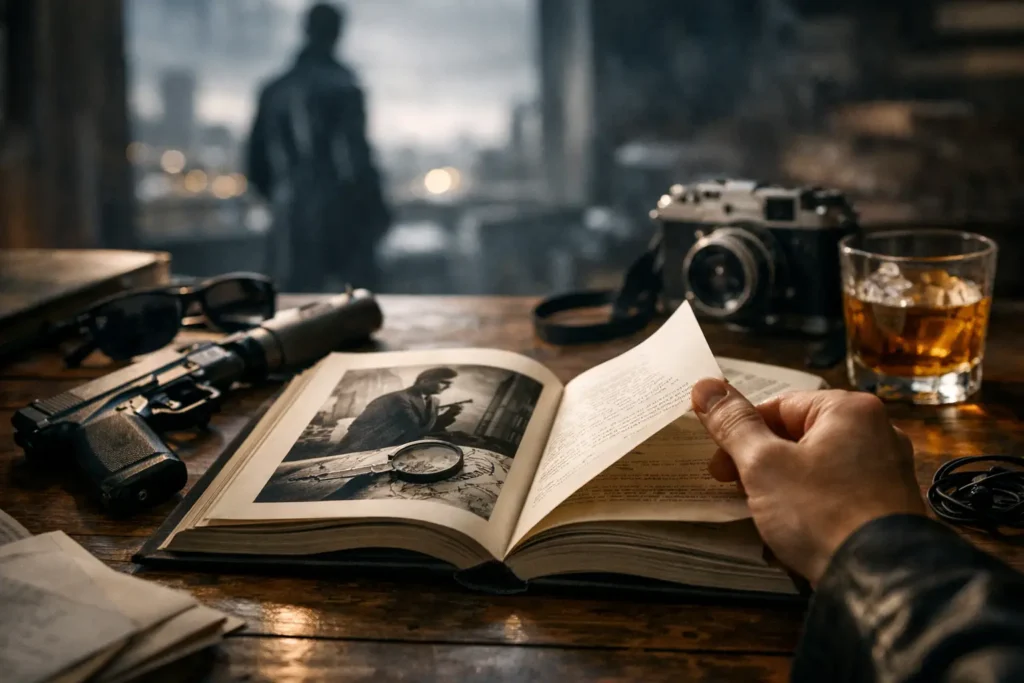
A man checks the reflection in a dark storefront before crossing the street. A woman receives a photograph that proves someone has been watching her. A forgotten file turns up in the wrong hands, and suddenly an ordinary airport, hotel lobby, or familiar neighborhood feels slightly off.
Spy thrillers work because they make danger feel close enough to touch. The best of them do not rely on explosions every ten pages or secret gadgets with blinking lights. They create suspense from information: who has it, who wants it, who is lying about it, and what happens when the truth finally surfaces.
For readers, that combination offers a particular kind of pleasure. A good mystery asks us to solve a puzzle. A good thriller makes us worry that the puzzle will explode before anyone solves it. Spy fiction often gets to do both.
Spy Thrillers Begin With a Crack in Ordinary Life
The most memorable spy stories rarely start in a command center. They start with a person who believes they understand the shape of their life, then discovers a crack in it.
That person might be a trained operative, but he does not have to be. In fact, an ordinary protagonist can make the danger more immediate. Readers understand the panic of realizing a routine drive home is no longer routine, or that a trusted colleague knows far more than they should. The character does not need to be reckless. Quite the opposite. Cautious people facing a problem too large to ignore often make the most believable heroes.
Espionage adds pressure because the rules are hidden. In a courtroom drama, the audience generally knows who is arguing each side. In a spy thriller, the person offering help may be setting a trap. A passport, an old photograph, a casual comment overheard in a restaurant can all mean more than they appear to mean.
That uncertainty is not a trick to be used carelessly. If every character turns out to be secretly working for someone else, readers eventually start checking the furniture for false identities. Suspicion works best when it grows from motive, opportunity, and a few details that seemed harmless at first.
The Real Engine of Spy Thrillers Is Trust
The chase may be the visible part of a thriller, but trust is usually the engine underneath it. A character must decide whom to call, what to reveal, and when to keep quiet. Those decisions carry more weight than a locked door or a fast car because they expose what the character values.
A veteran agent may know how to stay calm under pressure, yet struggle to trust anyone after years of deception. A civilian caught in the middle may be willing to take risks for a spouse, a child, or an old friend. Even an antagonist becomes more interesting when the reader can see the reasoning, however flawed, behind the betrayal.
The strongest stories allow loyalty to be complicated. A person can care deeply about someone and still keep a damaging secret. Someone can make a terrible choice for a reason that feels painfully human. That does not excuse the choice, but it gives the story texture.
This is where a thriller earns its emotional payoff. The reader is not only waiting to learn who survives or who escapes. The reader wants to know whether the people at the center of the story will recognize one another clearly when the secrets are gone.
Believable Details Make the Danger Sharper
Authenticity is a quiet but powerful tool in suspense fiction. Readers do not need a lecture on surveillance procedures, international law, or the inner workings of an intelligence agency. They do notice when a setting feels observed rather than borrowed from a movie poster.
A hotel corridor has a particular hush at two in the morning. A rental car dashboard glows an unfamiliar color. Rain changes how a city sounds, and an airport security line can make a person feel anonymous until the wrong face appears nearby. Those small, sensory details give a scene a floor to stand on.
My years behind a camera taught me to pay attention to what people pass without seeing: the shift in light across a parking garage, the way a stranger pauses near an exit, the background details that can change the meaning of a photograph. Photography is built on selection. You frame one thing and leave another outside the image. Suspense often works the same way.
A realistic setting also keeps a story from floating away into gadget fantasy. Technology can raise the stakes, certainly, but it is most effective when it serves the characters rather than replacing them. A message, a file, or an image matters because of the person who sent it and the consequences it creates. The device itself is rarely the interesting part.
Details Should Create Story, Not Show Off Research
Research can be a wonderful rabbit hole. It can also become the literary equivalent of being trapped at dinner beside someone explaining every feature of a new lawn mower.
The useful detail is the one that changes a decision, sharpens a setting, or reveals character. A passport with an unexpected stamp matters if it raises a question. A camera angle matters if it changes what a witness thinks they saw. The rest should stay in the writer’s notebook, where it can remain both accurate and mercifully quiet.
Pace Is More Than Moving Fast
Fast-paced fiction does not mean every scene must race at the same speed. A thriller needs contrast. The reader should have a chance to absorb a revelation before the next problem arrives, just as a photographer sometimes needs to wait for the subject to enter the frame.
A well-placed quiet scene can be more tense than a pursuit. Put two characters in a diner, give one of them a secret, and let the conversation circle what neither wants to say. The coffee gets cold. A phone vibrates on the table. Someone looks through the window a moment too long. Nothing overt happens, yet the reader feels the pressure building.
Then, when the story accelerates, it has somewhere to go. Action without consequence is noise. Action that forces a character to abandon a plan, question an ally, or risk someone they love has momentum.
Pacing also depends on clarity. Readers should feel uncertain about whom to trust, not uncertain about what is physically happening in a scene. A clean sequence of events lets the danger land. Confusion is not suspense, though the two are often mistaken for distant cousins.
Why Moral Gray Areas Matter
Spy fiction naturally deals in secrecy, divided loyalties, and choices made under pressure. That gives it room to explore moral gray areas without becoming gloomy or cynical.
The question is not simply whether a character will do the right thing. Often, the question is what the right thing costs. Protecting one person may endanger another. Telling the truth may cause harm in the short term. Remaining silent may be safer, but safety can have its own price.
Readers do not need every story to provide easy answers. They do need a moral center. The protagonist may make mistakes, lose patience, or follow a bad lead, but the story should understand that choices matter. Consequences are what make the stakes feel real.
That balance is especially valuable in clean, accessible suspense. A book can be intense without being needlessly graphic. It can show fear, loss, and danger while leaving room for courage, loyalty, humor, and the possibility that people can still choose well when it counts.
The Lasting Appeal of Spy Thrillers
Spy thrillers endure because they turn a familiar fear into a page-turning promise: the sense that the world contains hidden rooms, sealed files, and people whose real purposes are not obvious from across the table.
Yet the stories that stay with us usually come back to something simple. A person is trying to protect someone. Another person is trying to uncover the truth. A decision made in private finally has to be faced in the open.
That is why the best spy thrillers feel larger than their plots. They give us foreign cities, coded messages, and dangerous secrets, but they keep their focus on human beings under pressure. If that kind of story keeps you reading past bedtime, there are plenty of secrets still waiting on the page.