
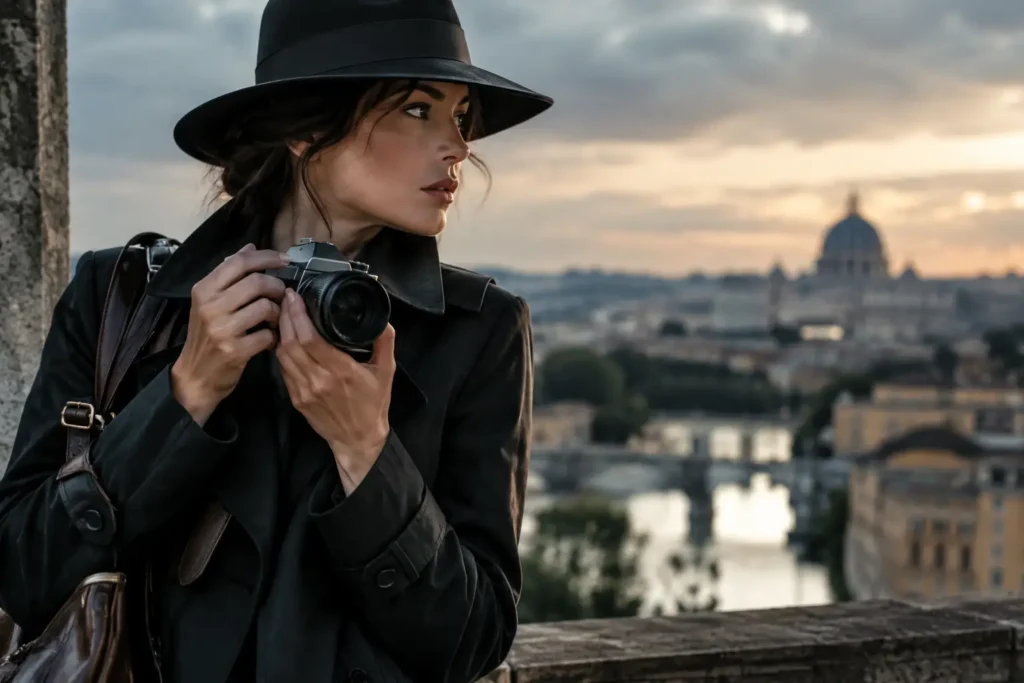
A camera is an unusually convincing reason for a person to be almost anywhere. A photographer can stand near an embassy gate, a hotel lobby, a harbor, a political event, or a lonely stretch of road without immediately raising alarms. The camera may be there for a magazine assignment, a wedding, a travel feature, or an excuse assembled in a hurry. That simple fact gives the best espionage novels featuring photographers a special kind of tension.
A photographer sees things other people miss because seeing is the job. But in a spy story, noticing the wrong thing can turn a harmless assignment into a very long walk home.
Why photographers belong in espionage fiction
Espionage depends on information, and photography has always been information with a pulse. A picture can establish who met whom, what was unloaded from a truck, which window was lit at midnight, or whether a public story and a private reality match. It can also lie beautifully. A crop changes context. A missing frame changes a sequence. One photograph may prove something, or it may be the bait that convinces an innocent person they have proof.
That makes photographers useful characters for more than their equipment. They are observers by temperament. Good ones notice light, body language, weather, access, timing, and the small, unplanned detail at the edge of the frame. A thriller can turn those ordinary professional habits into plot machinery without making the protagonist a superhero.
There is another advantage. The photographer is often an outsider. A trained intelligence officer knows the rules, the contacts, and the risks. A working photographer may know the streets, people, and visual rhythms of a place while having no idea that a routine image has made them interesting to dangerous people. That gap between practical skill and unwanted involvement is where suspense gets its traction.
The best espionage novels featuring photographers use the camera honestly
The truly satisfying examples do not treat a camera as a shiny prop pulled from a drawer in chapter three. Photography affects how the story moves. It determines what the central character can observe, how they enter a restricted social space, what evidence survives, and why someone else wants the negatives, memory card, print, or image file.
That may sound obvious, but there is a difference between a thriller containing a photograph and a thriller shaped by photographic thinking. In the stronger version, the plot asks questions a photographer would naturally ask. Was the image made before or after the event? Is the location really what the caption claims? What is reflected in the glass? Why is one person sharply focused while everyone else is blurred?
The best answers are rarely technical lectures. A reader does not need a manual on exposure compensation in the middle of a chase. Still, a few accurate details can make a scene feel lived-in. Anyone who has worked a fast-changing location knows that cameras have limitations, batteries fail at irritating moments, lenses draw attention, and the picture you need is often the one you cannot safely take.
A strong modern choice: Double Exposure
A photographer is especially at home in a conspiracy thriller because the profession combines access with vulnerability. In Double Exposure, photography is not decorative scenery. It is part of the story’s tension: a visual record can reveal more than its maker understood at the time, and a person accustomed to documenting events may suddenly be forced to decide how much truth a picture should carry.
That premise appeals to readers who like espionage with a grounded central character. The threat does not begin with a secret briefing in a basement office. It begins closer to the real world, where an assignment, a chance encounter, or a frame reviewed too late can alter the terms of an ordinary day.
Writing from a photographer’s viewpoint also changes the texture of suspense. Travel is not merely a list of scenic backdrops. Security is not a magic door opened by a clever line. A professional camera is useful, but it is also conspicuous. Try carrying a large lens through an airport, a crowded public venue, or a guarded entrance and you quickly learn that people notice it. Sometimes they want to know what you photographed. Sometimes they simply want you to leave.
That kind of detail matters because readers can feel when a setting has weight. The best thriller locations do not need a brochure. They need a particular smell after rain, an inconvenient doorway, a bad angle, a hotel clerk who remembers faces, and enough reality to make the fictional danger feel close.
Classic spy novels that reward a visual reader
The photographer-led spy thriller remains a relatively small shelf, but readers who enjoy its visual tension will find satisfying neighbors in the broader genre. These books may not always put a professional photographer at center stage, yet they understand that observation, identity, and proof are the real currencies of espionage.
Ken Follett’s Eye of the Needle is a fine example of information becoming dangerous simply because it exists. Its German spy, Henry Faber, is not a photographer by trade, but the novel understands the terrifying value of physical evidence and the race to control it. The story remains a good reminder that espionage often turns on one fact carried by one person at exactly the wrong moment.
Frederick Forsyth’s The Day of the Jackal is equally interested in the visual side of deception. Its tension comes from preparation, public appearances, false identities, and the narrow gap between what officials believe they see and what is actually happening. Readers drawn to cameras, surveillance, and the interpretation of appearances will recognize the same pressure at work.
John le Carré’s novels approach the subject from a more inward angle. In books such as The Spy Who Came in from the Cold and Tinker Tailor Soldier Spy, a face, a memory, a document, or a seemingly minor detail can matter as much as a photograph. The pace is more patient than a chase thriller, but the reward is the same uneasy realization: everybody is looking, and nobody has the whole frame.
These are not interchangeable books, and that is part of the pleasure. Follett and Forsyth build forward momentum with immediate stakes. Le Carré asks readers to watch people watching each other. A photography-centered espionage novel can borrow from either approach. It can move fast, or it can linger over the meaning of one image. Ideally, it does both.
What to look for in your next camera-and-spy thriller
When browsing for this niche, look past the word “photographer” in a description. The important question is whether visual evidence genuinely changes the story. A good premise may involve a photojournalist, travel photographer, forensic image specialist, portrait artist, or someone who takes pictures simply because that is how they make sense of the world.
The strongest stories usually have three qualities. First, the camera provides believable access rather than instant superpowers. Second, the image creates a problem that cannot be solved by handing it to the nearest official. Third, the character has something personal to lose beyond a file, a job, or a piece of equipment.
There is a trade-off here. Some readers want the technical realism of film, lenses, archival prints, and the patient work of examining an image. Others want the camera to get the protagonist into trouble quickly so the chase can begin. Both approaches can work. The better book is the one that understands what it promises.
Photography and espionage share a basic truth: the frame never shows everything. Something is outside the edge. Something happened before the shutter clicked. Someone is deciding what the viewer gets to see.
That is a fine place for a thriller to begin. And if you enjoy stories where a picture is more than a picture, keep an eye on the frame. Trouble is often standing just beyond it.