
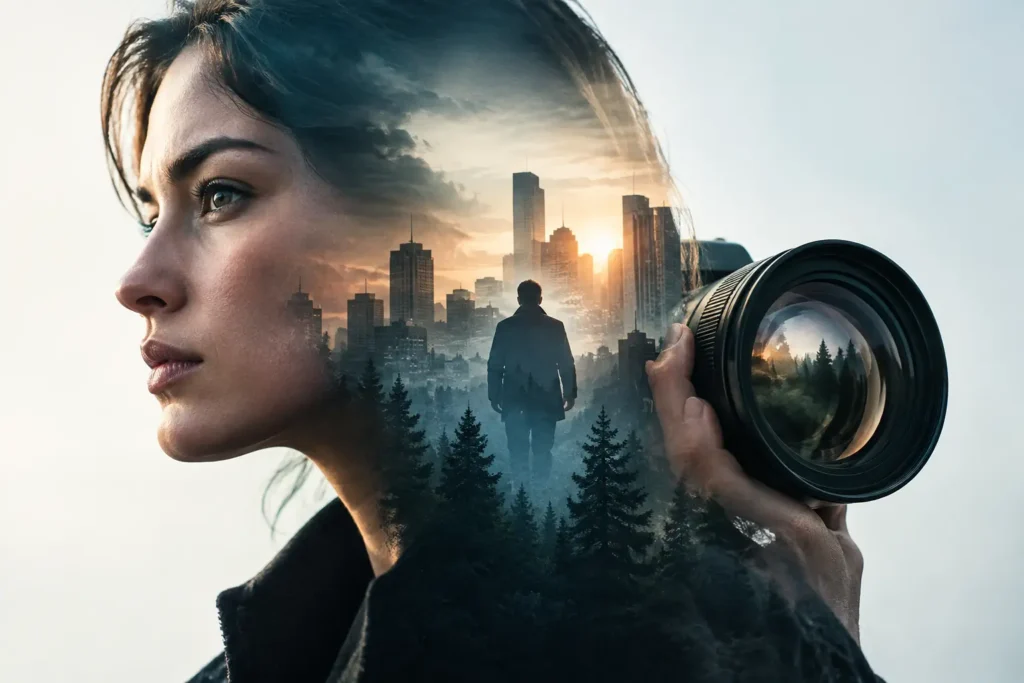
A camera can record a face, a place, or a moment. It can also leave out the one detail that changes everything. That tension sits near the heart of this Double Exposure review. The novel was written for readers who like suspense with a practical sense of place, where photographs matter not simply because they look good on a wall, but because what they reveal, conceal, or mislead can carry real consequences.
A fair word of disclosure: I wrote Double Exposure, so this is not an independent critique wearing a fake mustache. It is a candid look at what the book aims to do, where its particular flavor comes from, and the sort of reader most likely to enjoy the ride.
What Kind of Story Is Double Exposure?
At its core, Double Exposure is a suspense story shaped by mystery, uncertainty, and the uneasy feeling that an ordinary detail may not be ordinary at all. The book is meant to move. Clues have consequences, assumptions deserve a second look, and the pressure rises as the larger picture begins to come into focus.
That larger picture matters. I’ve always enjoyed stories in which the reader gets enough information to stay involved, but not so much that every turn can be seen from three counties away. Suspense works best when the ground feels solid at first. Then one fact shifts. Another fact refuses to fit. Before long, the familiar room has a door nobody noticed.
The novel also draws on something I know well from more than four decades behind a camera: photographs are persuasive. People tend to trust an image before they trust an explanation. Yet a photograph is a frame, not the whole world. It shows what was in front of the lens at one instant. It may leave out what happened before, what happened after, and what stood just outside the edge.
That’s fertile ground for fiction. No elaborate lecture required.
A Double Exposure Review Starts With the Details
A double exposure in photography layers one image over another. Sometimes the result is intentional and striking. Sometimes it is an accident that turns a perfectly good frame into a small disaster. Either way, the effect can make the viewer look twice.
That idea gave the story a useful creative compass. I wanted the novel to feel grounded in recognizable places and human behavior while allowing doubt to gather around what appears obvious. A detail can be meaningful without announcing itself with a brass band. A location should feel lived in, not like a cardboard backdrop assembled five minutes before the scene began.
Real-world experience helps with that. Years spent traveling, working assignments, dealing with equipment, navigating unfamiliar locations, and paying attention to people have taught me that reality is usually more specific than research notes alone. The right practical detail can do more work than a page of description. A camera bag carried for hours pulls at a shoulder. Light changes quickly. A person who is nervous may say the correct thing a little too carefully.
Those are the kinds of observations that influenced Double Exposure. They are not there to show off technical knowledge. They are there to make the story feel inhabited.
Photography Is Part of the Story, Not a Detour
Readers do not need to be photographers to follow the book. They do not need to know apertures, focal lengths, or why photographers can spend ten minutes arguing about a lens cap that is plainly in someone’s hand. The photography elements are intended to serve the tension and the atmosphere.
For readers who do enjoy cameras and images, there may be an extra layer of recognition. The act of looking closely is central to photography, after all. So is the discipline of noticing what other people overlook. Those habits belong naturally in a suspense novel.
Still, the book is not a technical manual with a thriller stapled to the back. The human stakes come first. Technical details only earn their place when they help a character make a choice, raise a question, or complicate what seemed simple.
The Pace Leaves Room for People
Fast-paced fiction can become a blur if every chapter is merely another alarm going off. A good suspense story needs motion, but it also needs people worth following through the trouble. The goal in Double Exposure was to balance momentum with character moments that let the reader understand what is at risk beyond the immediate problem.
That balance is always a trade-off. Some readers want a thriller to sprint from page one without pausing for breath. Others enjoy time to absorb a setting, a relationship, or the consequence of a difficult decision. This book leans toward forward movement, while making room for the personal currents underneath the plot.
The clean approach matters here as well. Tension does not require graphic content or constant profanity to land. A quiet conversation can carry danger. A missing fact can be more unsettling than an explosion. A character’s decision to trust the wrong person can create more suspense than a warehouse full of conveniently stacked crates.
What Readers Can Expect From Double Exposure
Readers who enjoy mysteries, thrillers, psychological suspense, and stories involving photography will likely find the book’s central ingredients familiar in the best sense. There is a puzzle to follow, mounting uncertainty, and an interest in how perception can be shaped by incomplete evidence.
The tone is accessible rather than bleak. That does not mean nothing is at stake. It means the story is designed to keep readers engaged without asking them to wade through material that feels grim simply for effect. I prefer a sharp turn in the plot to a loud one, and a believable response to a theatrical speech delivered at precisely the wrong moment.
The book may be a particularly good fit for readers who appreciate authentic texture in fiction. A setting should have its own weather, rhythms, and inconvenient details. Technology should behave like technology, which is to say it occasionally creates fresh problems. People should make choices for reasons that make sense to them, even when those choices make a reader want to set the book down briefly and say, “Well, that seems unwise.”
No novel fits every reader. Someone looking for a sweeping romance or a heavily procedural investigation may want a different emphasis. Someone who prefers patient, character-centered suspense with a strong visual sensibility may feel more at home here. That is not a limitation so much as a useful bit of map-reading before starting the trip.
Why the Title Matters
The title Double Exposure points beyond the camera technique. It suggests competing versions of events, overlapping motives, and the risk of seeing only the first layer of a situation. Suspense often lives in that space between appearance and truth.
Life gives us plenty of examples. Two people can witness the same moment and carry away different stories. A photograph can preserve a detail that nobody noticed at the time. A familiar place can feel entirely different after one piece of information changes. Fiction gets to press on those moments and ask what follows.
That is the promise I hoped the title would make: look again. Not because every shadow hides a conspiracy, but because certainty is often more fragile than it appears.
If that sounds like your kind of story, Double Exposure is waiting. Bring a little curiosity, keep an eye on the edges of the frame, and trust the details only after they have earned it.
Get your copy here: https://a.co/d/0h7NXKWI